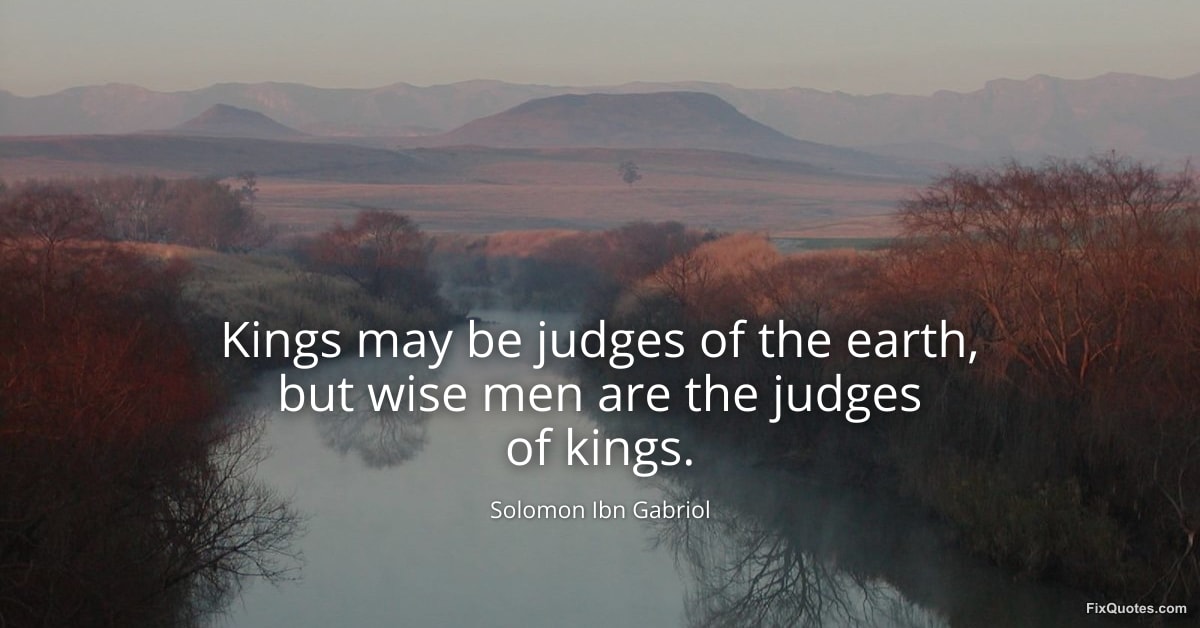
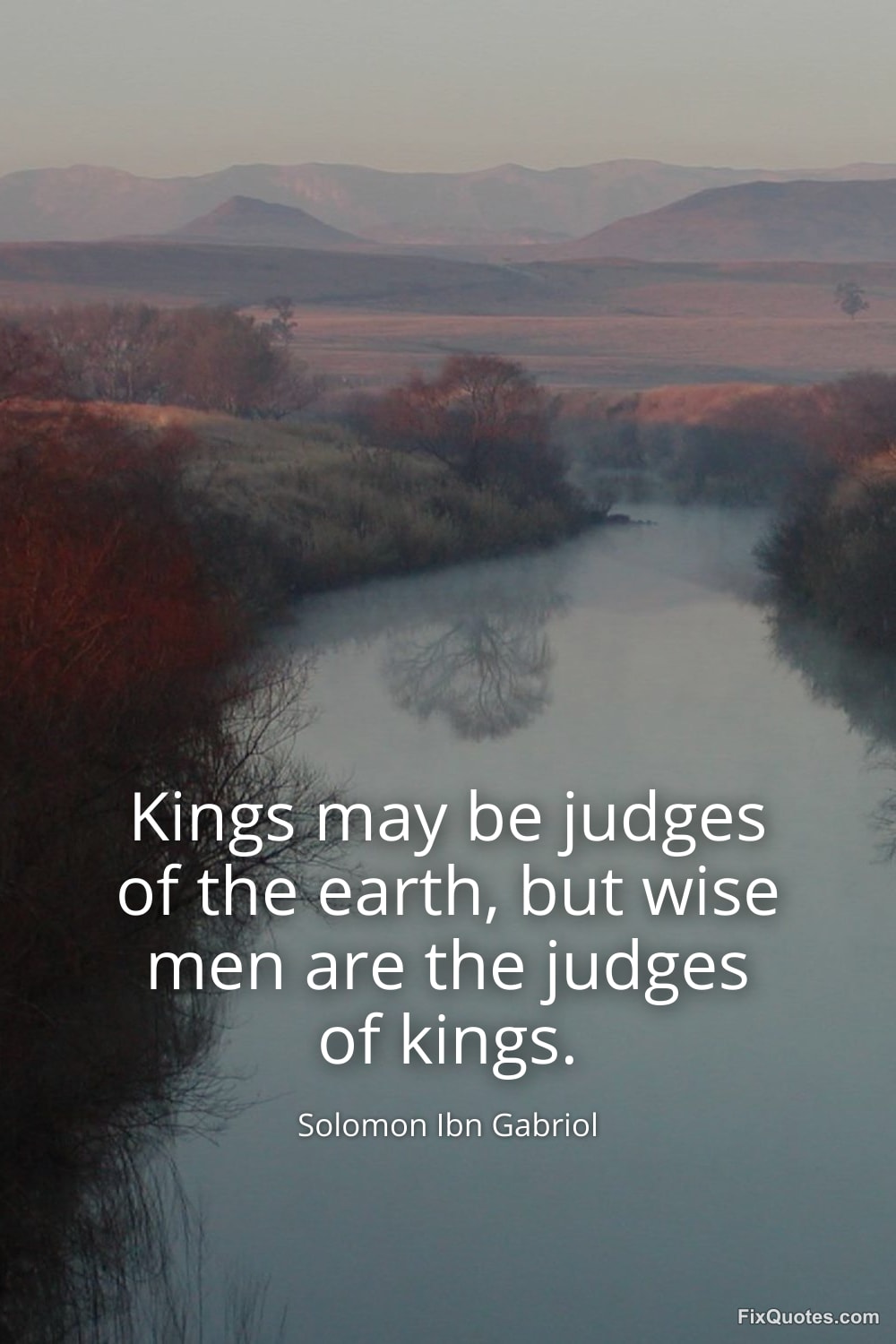
"Kings may be judges of the earth, but wise men are the judges of kings"
About this Quote
As a poet-philosopher writing under Islamic Spain’s shifting patronage politics, Ibn Gabirol knew the delicate dance: depend on elites, distrust them, and survive by sharpening language into something portable. “Wise men” functions as more than a compliment to scholars; it’s a political technology. Wisdom becomes an alternative authority structure, one that can’t be inherited, conquered, or enforced with soldiers. That’s the subtext: a quiet anti-absolutism spoken in the only register available to someone without an army.
The phrasing also dodges direct sedition. He doesn’t call kings illegitimate; he relativizes them. Kings judge “the earth” (the material, the immediate), while wise men judge kings (the ethical, the historical). It’s a division of domains that flatters rulers just enough to pass, while installing an older, sharper sovereign: conscience, articulated by those trained to see through spectacle. In one sentence, governance becomes temporary; judgment becomes permanent.
Quote Details
| Topic | Wisdom |
|---|---|
| Source | Help us find the source |
| Cite |
Citation Formats
APA Style (7th ed.)
Gabriol, Solomon Ibn. (2026, January 17). Kings may be judges of the earth, but wise men are the judges of kings. FixQuotes. https://fixquotes.com/quotes/kings-may-be-judges-of-the-earth-but-wise-men-are-65482/
Chicago Style
Gabriol, Solomon Ibn. "Kings may be judges of the earth, but wise men are the judges of kings." FixQuotes. January 17, 2026. https://fixquotes.com/quotes/kings-may-be-judges-of-the-earth-but-wise-men-are-65482/.
MLA Style (9th ed.)
"Kings may be judges of the earth, but wise men are the judges of kings." FixQuotes, 17 Jan. 2026, https://fixquotes.com/quotes/kings-may-be-judges-of-the-earth-but-wise-men-are-65482/. Accessed 22 Mar. 2026.