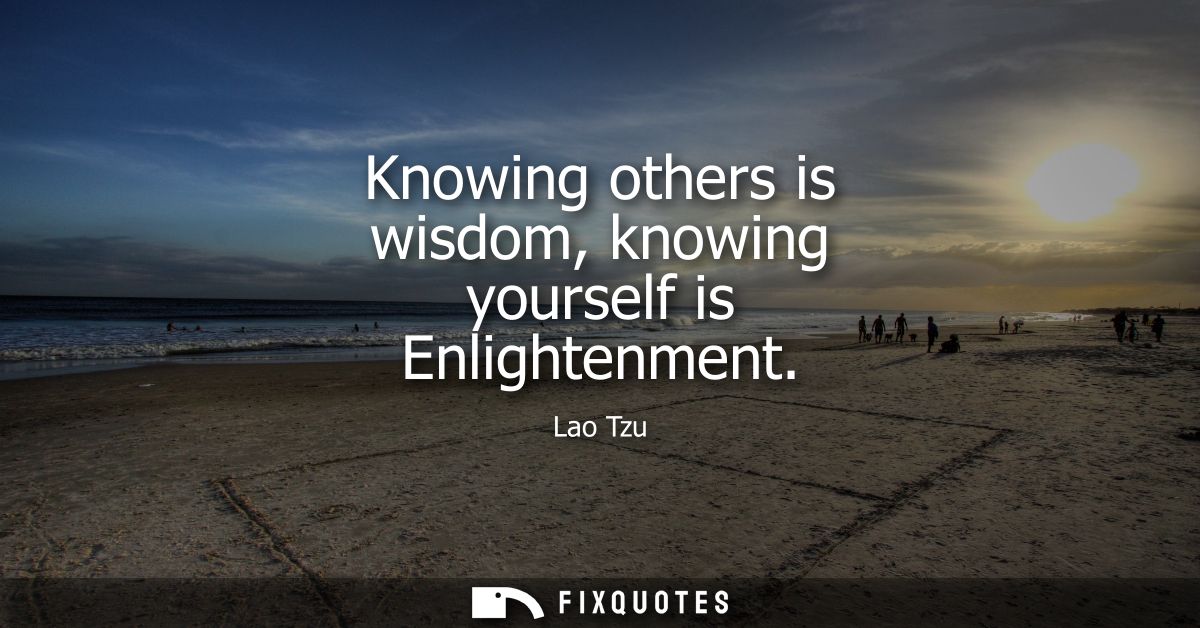
"Knowing others is wisdom, knowing yourself is Enlightenment"
About this Quote
A neat little couplet that flips the usual prestige ladder: social intelligence is useful, but self-knowledge is the thing that breaks the whole game open. Lao Tzu draws a deliberate line between two kinds of mastery. “Knowing others” reads like courtly competence - the ability to predict motives, manage conflict, navigate status. That’s “wisdom” in the worldly sense: portable, practical, and often rewarded. But it still keeps you trapped inside the same maze of appetites, fears, and performances everyone else is running.
“Knowing yourself,” by contrast, points to an inward discipline central to Daoist thought: stripping away the noisy, flattering stories the ego tells so you can see what remains. The subtext is mildly insulting to the aspiring operator. You can be brilliant at reading a room and still be a stranger to the forces steering you - vanity, resentment, the craving to control. Lao Tzu implies that without that interior clarity, your “wisdom” is basically advanced improvisation.
The rhetoric works because it’s austere and hierarchical without sounding preachy. Two parallel clauses, two escalating nouns, one implied verdict. “Enlightenment” isn’t presented as a trophy but as a different mode of being: less grasping, less reactive, more aligned with the Dao. In the Warring States-era context - a world of schemers, ministers, and collapsing norms - the line reads like a quiet refusal of the era’s hustle. Know people if you must; know yourself if you want out.
“Knowing yourself,” by contrast, points to an inward discipline central to Daoist thought: stripping away the noisy, flattering stories the ego tells so you can see what remains. The subtext is mildly insulting to the aspiring operator. You can be brilliant at reading a room and still be a stranger to the forces steering you - vanity, resentment, the craving to control. Lao Tzu implies that without that interior clarity, your “wisdom” is basically advanced improvisation.
The rhetoric works because it’s austere and hierarchical without sounding preachy. Two parallel clauses, two escalating nouns, one implied verdict. “Enlightenment” isn’t presented as a trophy but as a different mode of being: less grasping, less reactive, more aligned with the Dao. In the Warring States-era context - a world of schemers, ministers, and collapsing norms - the line reads like a quiet refusal of the era’s hustle. Know people if you must; know yourself if you want out.
Quote Details
| Topic | Wisdom |
|---|---|
| Source | Tao Te Ching (Dao De Jing), verse 33 — commonly rendered 'He who knows others is wise; he who knows himself is enlightened.' Attributed to Laozi (Lao Tzu). |
| Cite |
Citation Formats
APA Style (7th ed.)
Tzu, Lao. (2026, January 15). Knowing others is wisdom, knowing yourself is Enlightenment. FixQuotes. https://fixquotes.com/quotes/knowing-others-is-wisdom-knowing-yourself-is-28407/
Chicago Style
Tzu, Lao. "Knowing others is wisdom, knowing yourself is Enlightenment." FixQuotes. January 15, 2026. https://fixquotes.com/quotes/knowing-others-is-wisdom-knowing-yourself-is-28407/.
MLA Style (9th ed.)
"Knowing others is wisdom, knowing yourself is Enlightenment." FixQuotes, 15 Jan. 2026, https://fixquotes.com/quotes/knowing-others-is-wisdom-knowing-yourself-is-28407/. Accessed 12 Feb. 2026.
More Quotes by Lao
Add to List