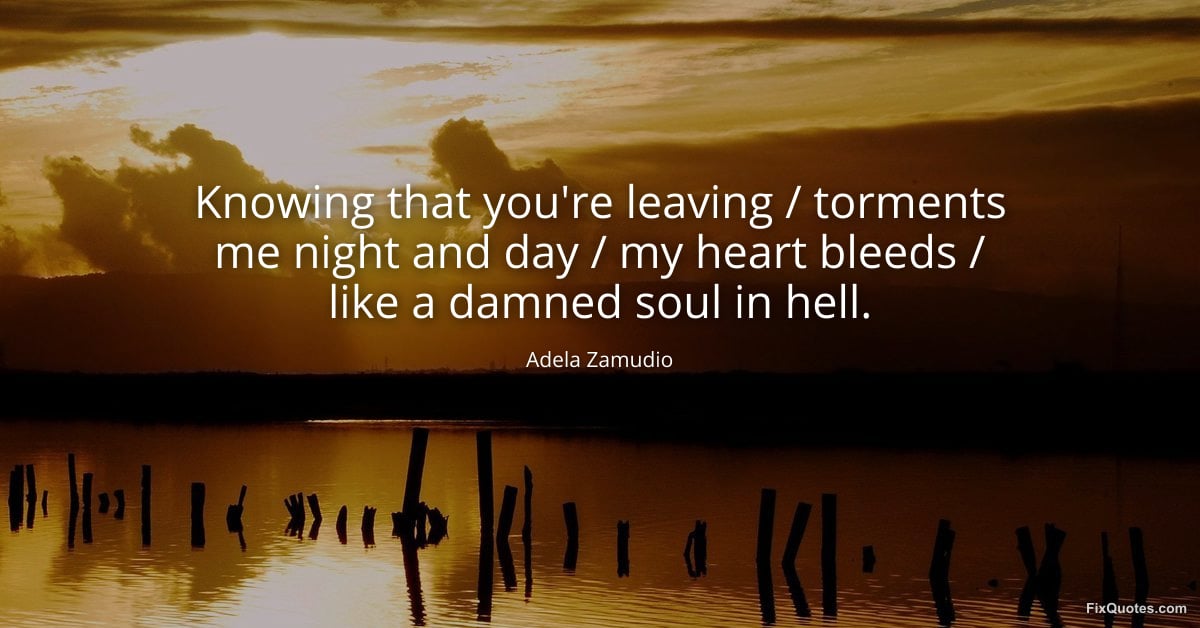
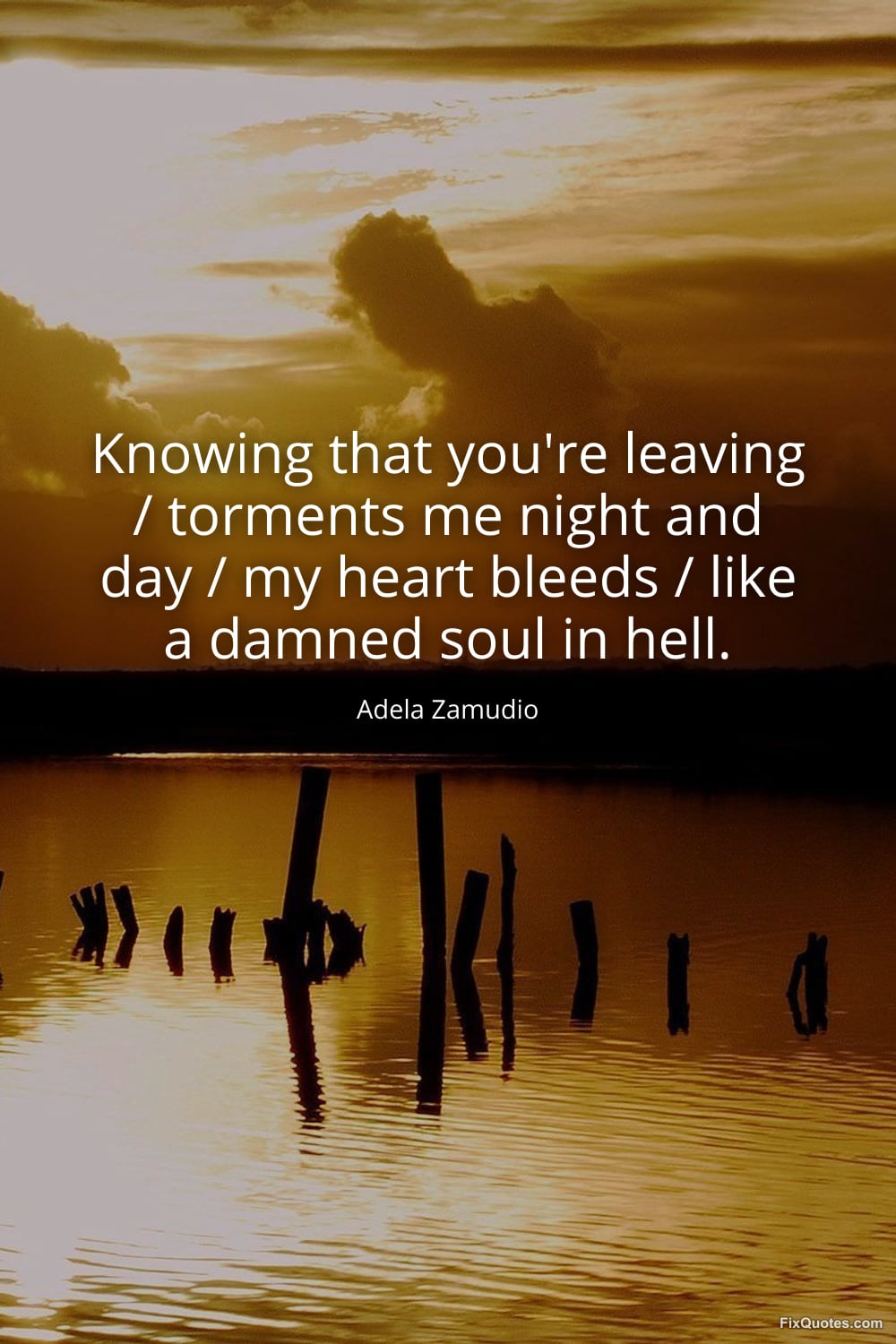
"Knowing that you're leaving / torments me night and day / my heart bleeds / like a damned soul in hell"
About this Quote
What makes the lines effective is their refusal to be coy. There is no polished restraint, no aristocratic distance. The speaker is exposed, almost raw enough to seem dangerous. That intensity fits Zamudio's broader context. Writing in late 19th- and early 20th-century Bolivia, she was a poet and intellectual who often pushed against the moral and social limits placed on women. In that light, the poem's emotional extremity can be read as more than private melodrama. It is also a claim to the seriousness of female desire and grief. The speaker does not minimize her suffering to remain acceptable.
There's a subtle blasphemy in the comparison, too. To invoke hell for erotic loss collapses religious and romantic vocabularies, suggesting that love can rival theology as a source of judgment and pain. That fusion gives the lines their charge. Zamudio makes departure feel not like an unfortunate event but like a sentence passed on the body and soul alike.
Quote Details
| Topic | Heartbreak |
|---|---|
| Source | Forever, translation by Liz Henry [translated] |
| Cite |
Citation Formats
APA Style (7th ed.)
Zamudio, Adela. (2026, March 7). Knowing that you're leaving / torments me night and day / my heart bleeds / like a damned soul in hell. FixQuotes. https://fixquotes.com/quotes/knowing-that-youre-leaving-torments-me-night-185714/
Chicago Style
Zamudio, Adela. "Knowing that you're leaving / torments me night and day / my heart bleeds / like a damned soul in hell." FixQuotes. March 7, 2026. https://fixquotes.com/quotes/knowing-that-youre-leaving-torments-me-night-185714/.
MLA Style (9th ed.)
"Knowing that you're leaving / torments me night and day / my heart bleeds / like a damned soul in hell." FixQuotes, 7 Mar. 2026, https://fixquotes.com/quotes/knowing-that-youre-leaving-torments-me-night-185714/. Accessed 7 Mar. 2026.