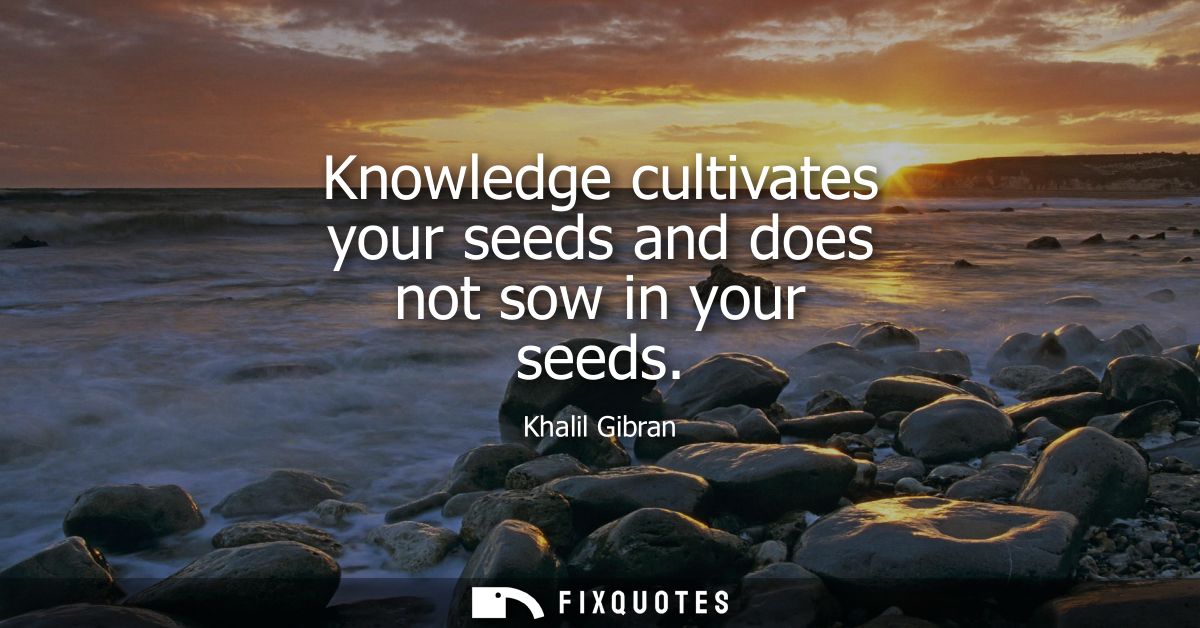
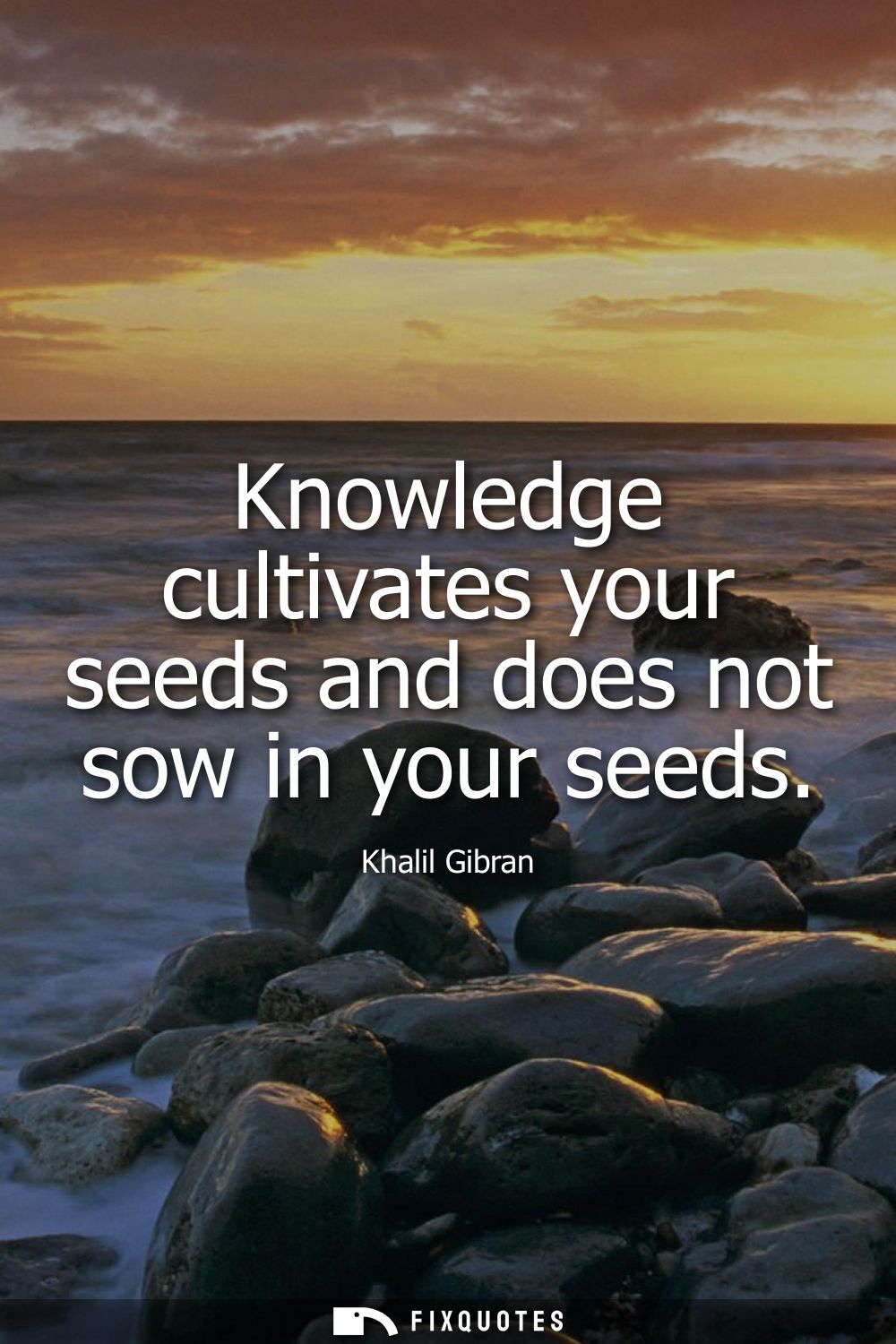
"Knowledge cultivates your seeds and does not sow in your seeds"
About this Quote
Gibran’s line turns learning into gardening advice, then immediately refuses the fantasy that someone else can plant your life for you. “Knowledge cultivates” is a deliberately modest verb: it suggests tending, loosening soil, pulling weeds, giving light. Useful, patient work. But the second clause snaps shut the common expectation that wisdom arrives as a delivery. It “does not sow” because the decisive act - choosing what to grow, risking the first push into the ground - remains stubbornly personal.
The subtext is almost parental in its firmness. Gibran is warning against the seductive passivity of being “taught.” You can collect facts, maxims, even spiritual insight, and still avoid the moment where you commit to an aim, a love, a craft, a belief. In that sense, the quote reads like a rebuke to credentialism before credentialism had a name: education can refine your capacities without supplying your purpose.
Context matters. Gibran, writing as a diasporic Lebanese-American poet in the early 20th century, was steeped in both Romantic individualism and spiritual instruction. In The Prophet and related work, he repeatedly frames wisdom as something that awakens what’s already inside you rather than installing a new self from the outside. That’s why the metaphor lands: seeds are innate potential, not imported goods.
Its quiet power comes from the friction between comfort and responsibility. Knowledge helps. It also refuses to absolve you.
The subtext is almost parental in its firmness. Gibran is warning against the seductive passivity of being “taught.” You can collect facts, maxims, even spiritual insight, and still avoid the moment where you commit to an aim, a love, a craft, a belief. In that sense, the quote reads like a rebuke to credentialism before credentialism had a name: education can refine your capacities without supplying your purpose.
Context matters. Gibran, writing as a diasporic Lebanese-American poet in the early 20th century, was steeped in both Romantic individualism and spiritual instruction. In The Prophet and related work, he repeatedly frames wisdom as something that awakens what’s already inside you rather than installing a new self from the outside. That’s why the metaphor lands: seeds are innate potential, not imported goods.
Its quiet power comes from the friction between comfort and responsibility. Knowledge helps. It also refuses to absolve you.
Quote Details
| Topic | Knowledge |
|---|---|
| Source | Help us find the source |
| Cite |
Citation Formats
APA Style (7th ed.)
Gibran, Kahlil. (2026, January 17). Knowledge cultivates your seeds and does not sow in your seeds. FixQuotes. https://fixquotes.com/quotes/knowledge-cultivates-your-seeds-and-does-not-sow-36518/
Chicago Style
Gibran, Kahlil. "Knowledge cultivates your seeds and does not sow in your seeds." FixQuotes. January 17, 2026. https://fixquotes.com/quotes/knowledge-cultivates-your-seeds-and-does-not-sow-36518/.
MLA Style (9th ed.)
"Knowledge cultivates your seeds and does not sow in your seeds." FixQuotes, 17 Jan. 2026, https://fixquotes.com/quotes/knowledge-cultivates-your-seeds-and-does-not-sow-36518/. Accessed 27 Mar. 2026.
More Quotes by Kahlil
Add to List