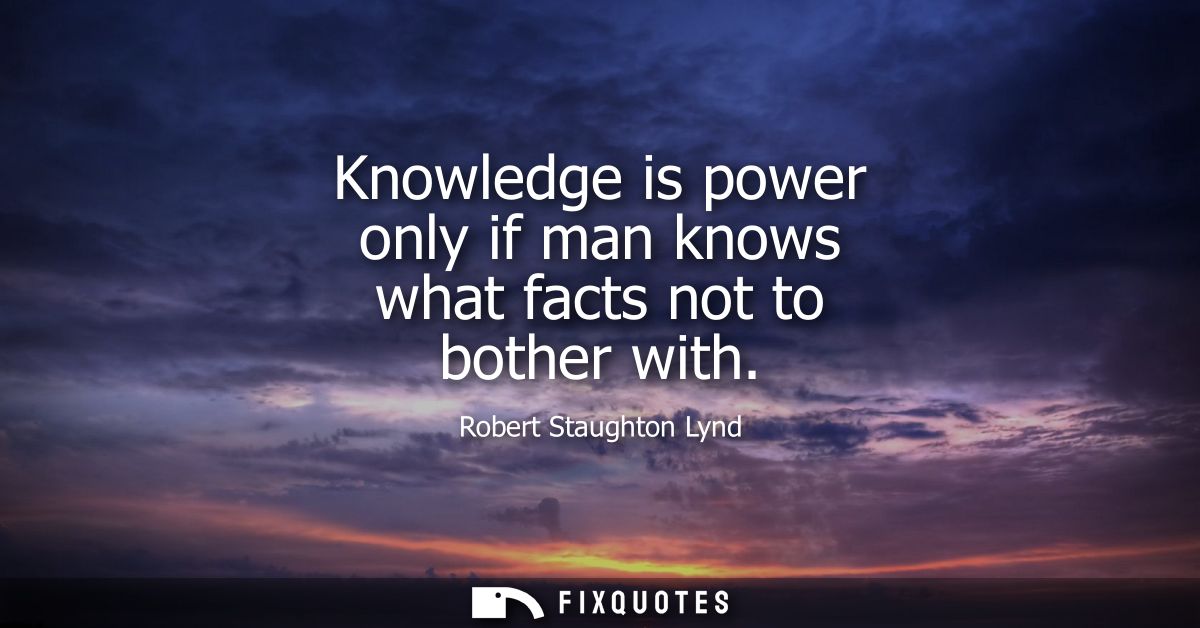
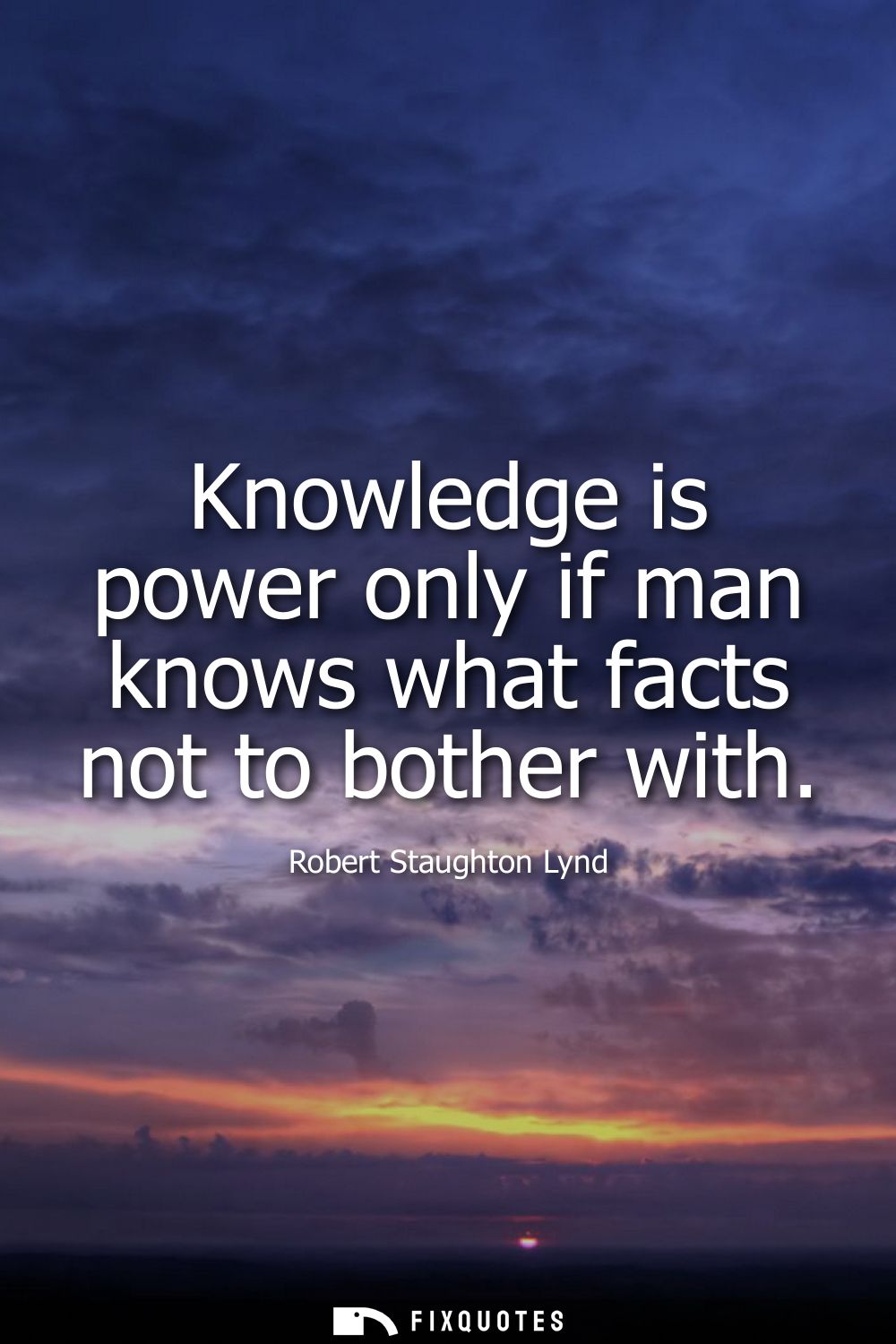
"Knowledge is power only if man knows what facts not to bother with"
About this Quote
A century into mass literacy, Lynd is already warning that information isn’t enlightenment; it’s raw material, and raw material can bury you. “Knowledge is power only if…” flips the familiar slogan into a conditional trap: power doesn’t come from accumulating facts, it comes from selective attention. The jab is aimed at the modern faith that more data automatically means more agency. Lynd’s sociologist’s eye is on the social machinery behind “facts”: who produces them, who circulates them, and who benefits when people confuse being informed with being capable.
The line’s sly force is in the phrase “not to bother with.” That’s not anti-intellectualism; it’s a critique of misdirected labor. “Bother” evokes the daily grind of reading, sorting, and worrying. Lynd is implying that institutions can weaponize trivia, noise, and endless “updates” to keep citizens busy but not effective. If everything is urgent, nothing is actionable. The subtext is that distraction is a political economy, not just a personal failing.
Context matters: Lynd co-authored the Middletown studies, documenting how American life was being reshaped by consumer culture, media, and organizational power. In that world, facts proliferate - advertising claims, news snippets, bureaucratic records - while decision-making concentrates elsewhere. His quote is a compact theory of attention as a civic resource. Real power requires not just knowing, but knowing what to ignore, because ignorance can be imposed, but so can relevance.
The line’s sly force is in the phrase “not to bother with.” That’s not anti-intellectualism; it’s a critique of misdirected labor. “Bother” evokes the daily grind of reading, sorting, and worrying. Lynd is implying that institutions can weaponize trivia, noise, and endless “updates” to keep citizens busy but not effective. If everything is urgent, nothing is actionable. The subtext is that distraction is a political economy, not just a personal failing.
Context matters: Lynd co-authored the Middletown studies, documenting how American life was being reshaped by consumer culture, media, and organizational power. In that world, facts proliferate - advertising claims, news snippets, bureaucratic records - while decision-making concentrates elsewhere. His quote is a compact theory of attention as a civic resource. Real power requires not just knowing, but knowing what to ignore, because ignorance can be imposed, but so can relevance.
Quote Details
| Topic | Knowledge |
|---|
More Quotes by Robert
Add to List