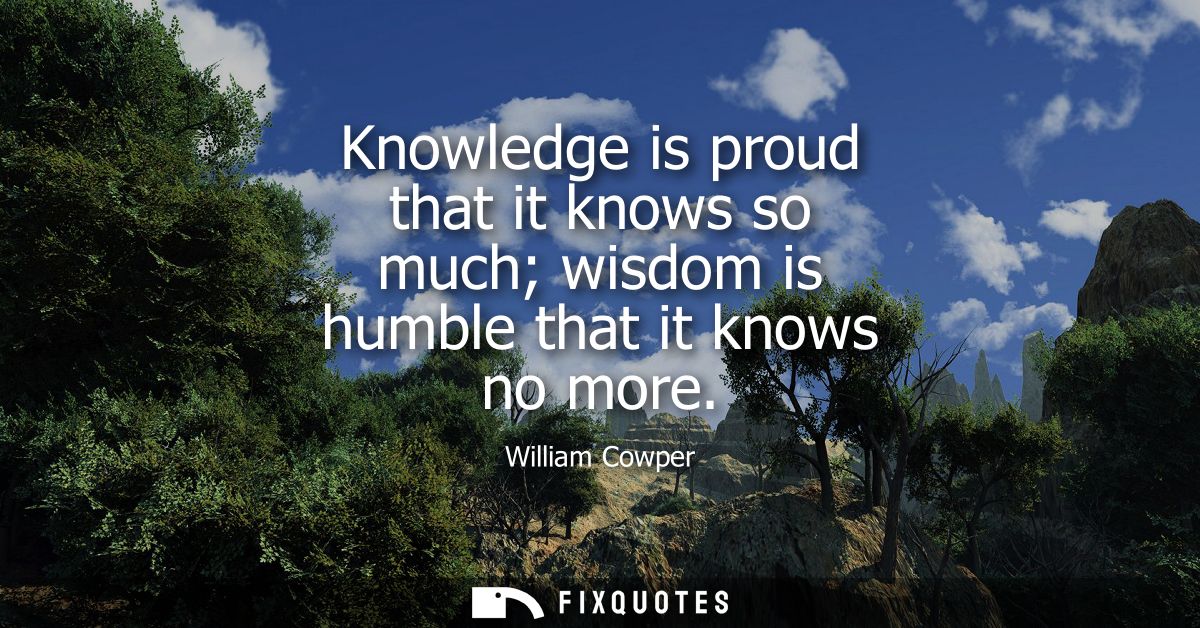
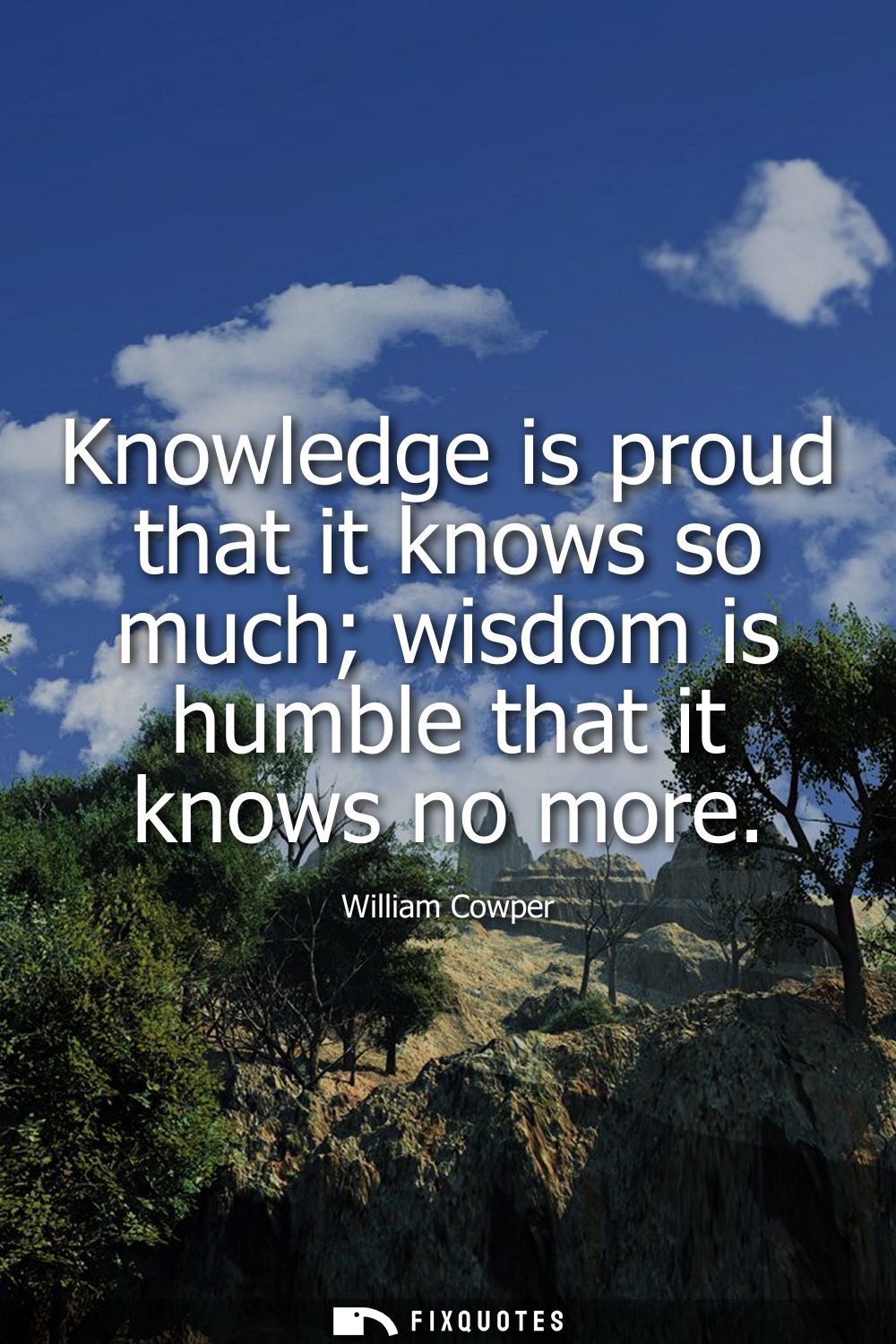
"Knowledge is proud that it knows so much; wisdom is humble that it knows no more"
About this Quote
The mechanics are elegantly balanced. Cowper sets up a parallel structure - “Knowledge is...; wisdom is...” - then flips the emotional valence: pride versus humility. The trick is that both are “about knowing,” but they behave differently under pressure. Knowledge is expansive; wisdom is boundary-aware. That final phrase, “knows no more,” is doing the real work. It suggests that wisdom is defined less by accumulation than by restraint: knowing where your understanding stops, and refusing to paper over that edge with bravado.
Context matters. Cowper lived in an era intoxicated by systems, classifications, and the promise that reason could map the world cleanly. As a poet with a deeply religious sensibility and a life marked by mental anguish, he had reasons to distrust the idea that intellect alone equals mastery. The subtext is a moral warning: pride in knowing is often just fear of not knowing, dressed up as authority. Wisdom doesn’t just admit limits; it builds character around them.
Quote Details
| Topic | Wisdom |
|---|---|
| Source | Help us find the source |
| Cite |
Citation Formats
APA Style (7th ed.)
Cowper, William. (2026, January 15). Knowledge is proud that it knows so much; wisdom is humble that it knows no more. FixQuotes. https://fixquotes.com/quotes/knowledge-is-proud-that-it-knows-so-much-wisdom-2538/
Chicago Style
Cowper, William. "Knowledge is proud that it knows so much; wisdom is humble that it knows no more." FixQuotes. January 15, 2026. https://fixquotes.com/quotes/knowledge-is-proud-that-it-knows-so-much-wisdom-2538/.
MLA Style (9th ed.)
"Knowledge is proud that it knows so much; wisdom is humble that it knows no more." FixQuotes, 15 Jan. 2026, https://fixquotes.com/quotes/knowledge-is-proud-that-it-knows-so-much-wisdom-2538/. Accessed 12 Feb. 2026.