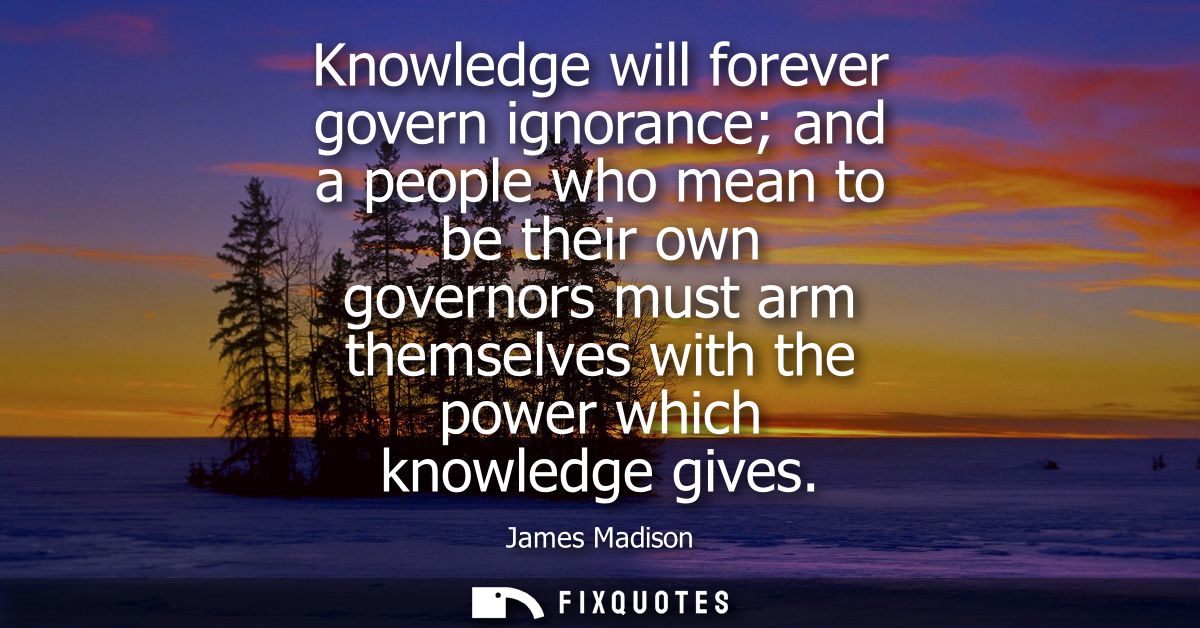
"Knowledge will forever govern ignorance; and a people who mean to be their own governors must arm themselves with the power which knowledge gives"
About this Quote
The second clause tightens the screw. “A people who mean to be their own governors” implies that self-rule is not a default condition but an ongoing choice, almost a discipline. Madison’s verb is martial - “arm.” Knowledge isn’t decorative; it’s a weapon citizens need because the opponents aren’t hypothetical. In the early American republic, Madison watched factions, demagogues, and self-interested elites jostle to steer a new constitutional order. He’d helped design a system built on checks and balances precisely because he didn’t trust virtue to hold under pressure. This line is the citizen-side complement to that architecture: institutions can restrain power only so far; an uninformed electorate hands power away with a ballot.
Subtextually, the quote is also a rebuke to complacency. Madison is telling ordinary people that freedom comes with homework. Read the laws. Track the money. Understand the arguments. Otherwise, “ignorance” becomes a kind of permission slip for manipulation - not because the public is bad, but because politics is competitive and knowledge is leverage.
Quote Details
| Topic | Knowledge |
|---|---|
| Source | Help us find the source |
| Cite |
Citation Formats
APA Style (7th ed.)
Madison, James. (2026, January 16). Knowledge will forever govern ignorance; and a people who mean to be their own governors must arm themselves with the power which knowledge gives. FixQuotes. https://fixquotes.com/quotes/knowledge-will-forever-govern-ignorance-and-a-137520/
Chicago Style
Madison, James. "Knowledge will forever govern ignorance; and a people who mean to be their own governors must arm themselves with the power which knowledge gives." FixQuotes. January 16, 2026. https://fixquotes.com/quotes/knowledge-will-forever-govern-ignorance-and-a-137520/.
MLA Style (9th ed.)
"Knowledge will forever govern ignorance; and a people who mean to be their own governors must arm themselves with the power which knowledge gives." FixQuotes, 16 Jan. 2026, https://fixquotes.com/quotes/knowledge-will-forever-govern-ignorance-and-a-137520/. Accessed 5 Mar. 2026.