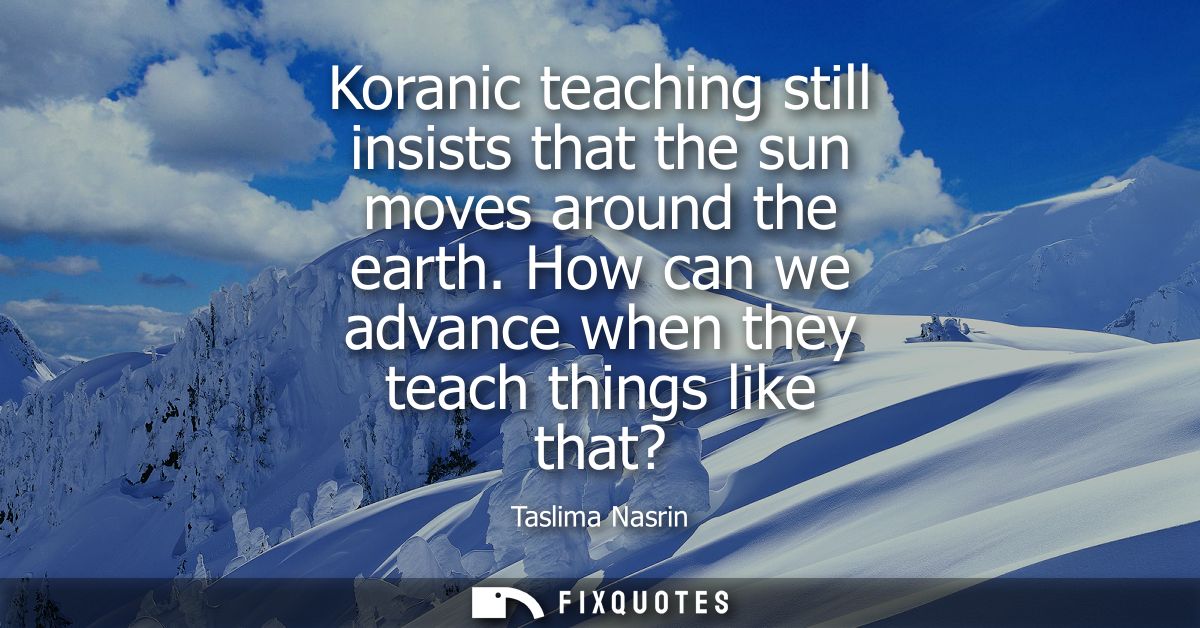
"Koranic teaching still insists that the sun moves around the earth. How can we advance when they teach things like that?"
About this Quote
The subtext is her long-running critique of religious authority in Muslim-majority societies, where scripture is not just spiritual but political. “They teach things like that” isn’t really about astronomy; it’s about the social machinery that turns interpretation into discipline. In Nasrin’s world, the cost of that machinery is measured in censorship, threats, and the narrowing of women’s lives. Her “we” is doing heavy work too, positioning the speaker with a public locked in a tug-of-war between scientific literacy and clerical gatekeeping.
Context matters because the line also courts backlash. Muslims can reasonably point out that the Quran’s language is often read as phenomenological (“the sun rises”) rather than a literal scientific claim, and that Islamic scholarship historically included serious astronomy. Nasrin knows this; she’s not unaware, she’s escalating. The intent is to dramatize how literalism and institutionalized deference can freeze a culture’s relationship to evidence - and how easily “faith” becomes a shield for power.
Quote Details
| Topic | Quran |
|---|---|
| Source | Help us find the source |
| Cite |
Citation Formats
APA Style (7th ed.)
Nasrin, Taslima. (2026, January 16). Koranic teaching still insists that the sun moves around the earth. How can we advance when they teach things like that? FixQuotes. https://fixquotes.com/quotes/koranic-teaching-still-insists-that-the-sun-moves-112890/
Chicago Style
Nasrin, Taslima. "Koranic teaching still insists that the sun moves around the earth. How can we advance when they teach things like that?" FixQuotes. January 16, 2026. https://fixquotes.com/quotes/koranic-teaching-still-insists-that-the-sun-moves-112890/.
MLA Style (9th ed.)
"Koranic teaching still insists that the sun moves around the earth. How can we advance when they teach things like that?" FixQuotes, 16 Jan. 2026, https://fixquotes.com/quotes/koranic-teaching-still-insists-that-the-sun-moves-112890/. Accessed 31 Mar. 2026.