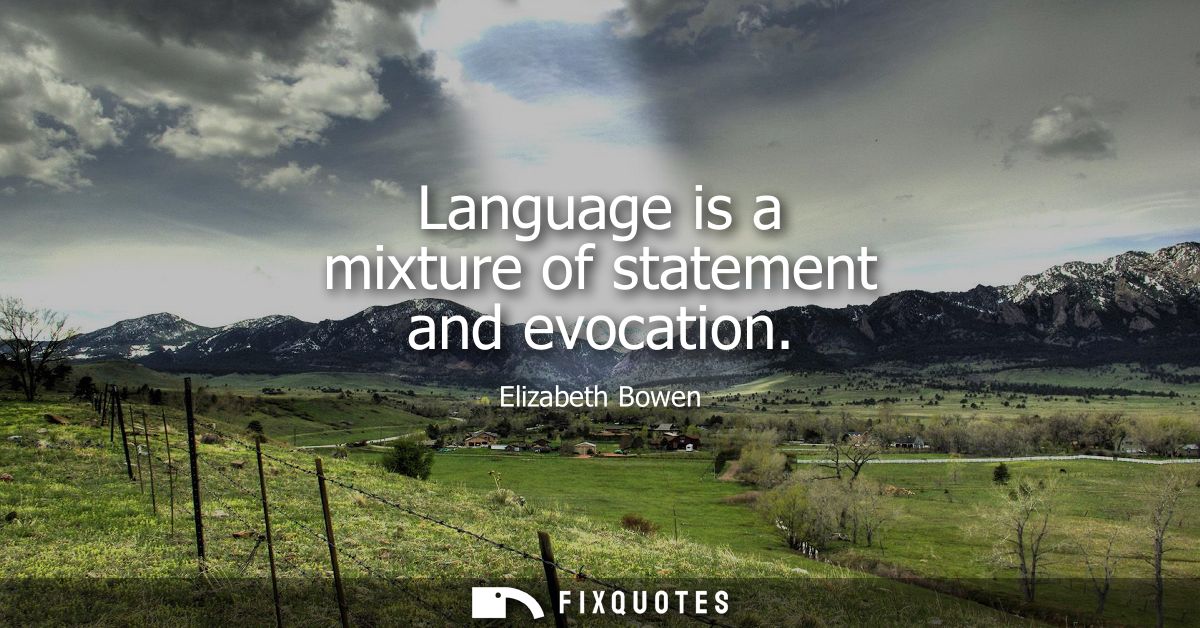
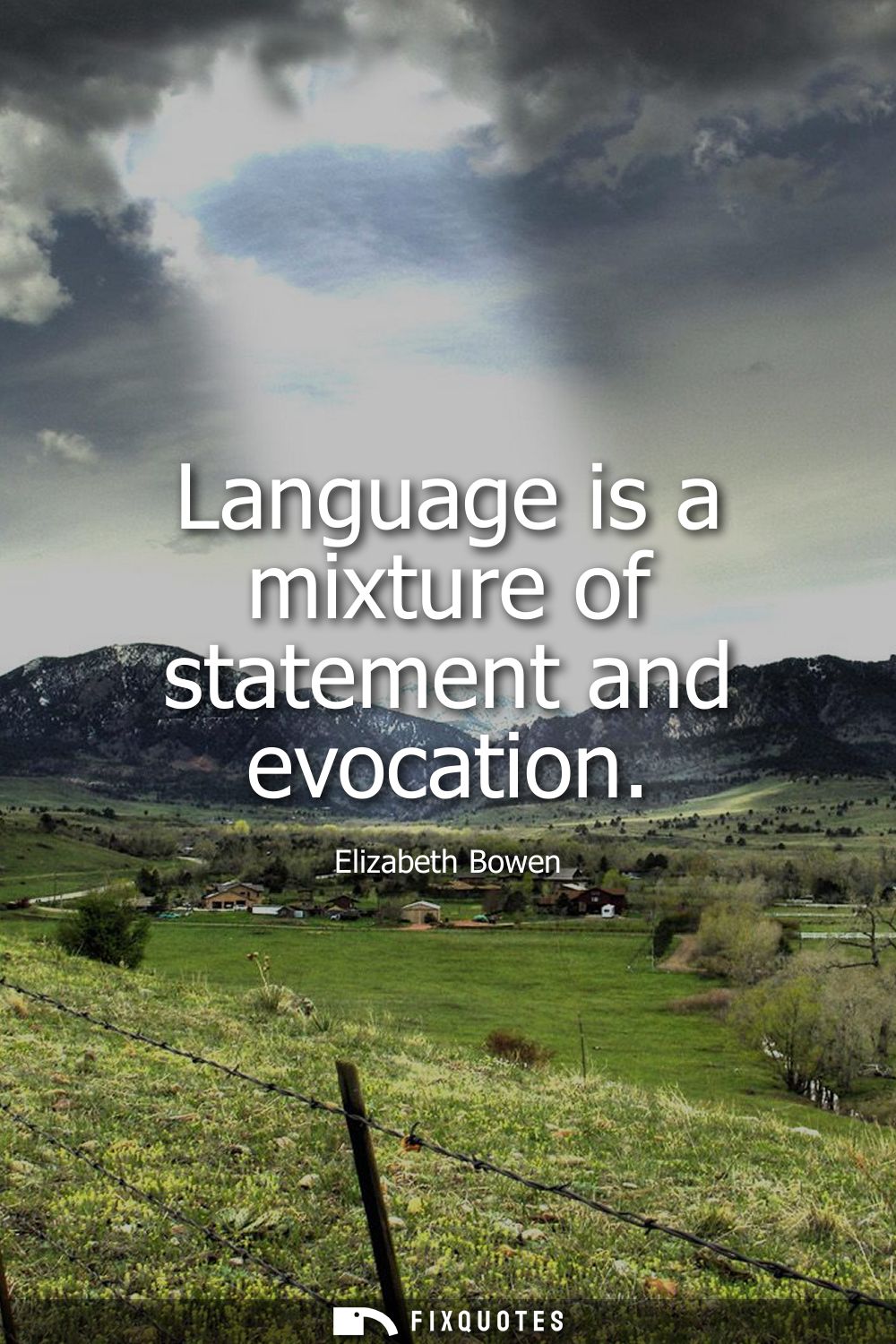
"Language is a mixture of statement and evocation"
About this Quote
Bowen’s line cuts against the fantasy that language is a clean delivery system for facts. “Statement” is the part we like to pretend is neutral: the report, the claim, the thing that can be verified or argued. “Evocation” is the shadow-content that rides alongside it: mood, class signal, intimacy, threat, nostalgia, the whole atmospheric charge words carry because they’ve been lived in before they’re spoken.
The intent is almost craft-manifesto. As a novelist, Bowen is alert to how prose works not just by informing but by summoning: a room feels “close” and suddenly you’re breathing differently; a character says “I’m fine” and the sentence is doing two jobs, the public alibi and the private leak. The subtext is a warning to readers and writers alike: if you treat language as pure statement, you will misread people and you will write dead scenes. Most human communication happens in the evoked register, where what’s unsaid is often the point.
Context matters. Bowen wrote through the convulsions of two world wars, Anglo-Irish tension, and the social rearrangements of a collapsing empire. In that world, understatement wasn’t merely style; it was survival and etiquette, a way to speak around trauma, desire, and political fear. Her fiction is full of conversations where the real action is in the temperature of a phrase, the choice of a euphemism, the careful vagueness. The line works because it names that double-action plainly: every sentence is both message and spell, and pretending otherwise is how power hides in “just words.”
The intent is almost craft-manifesto. As a novelist, Bowen is alert to how prose works not just by informing but by summoning: a room feels “close” and suddenly you’re breathing differently; a character says “I’m fine” and the sentence is doing two jobs, the public alibi and the private leak. The subtext is a warning to readers and writers alike: if you treat language as pure statement, you will misread people and you will write dead scenes. Most human communication happens in the evoked register, where what’s unsaid is often the point.
Context matters. Bowen wrote through the convulsions of two world wars, Anglo-Irish tension, and the social rearrangements of a collapsing empire. In that world, understatement wasn’t merely style; it was survival and etiquette, a way to speak around trauma, desire, and political fear. Her fiction is full of conversations where the real action is in the temperature of a phrase, the choice of a euphemism, the careful vagueness. The line works because it names that double-action plainly: every sentence is both message and spell, and pretending otherwise is how power hides in “just words.”
Quote Details
| Topic | Writing |
|---|---|
| Source | Help us find the source |
| Cite |
Citation Formats
APA Style (7th ed.)
Bowen, Elizabeth. (2026, January 18). Language is a mixture of statement and evocation. FixQuotes. https://fixquotes.com/quotes/language-is-a-mixture-of-statement-and-evocation-23788/
Chicago Style
Bowen, Elizabeth. "Language is a mixture of statement and evocation." FixQuotes. January 18, 2026. https://fixquotes.com/quotes/language-is-a-mixture-of-statement-and-evocation-23788/.
MLA Style (9th ed.)
"Language is a mixture of statement and evocation." FixQuotes, 18 Jan. 2026, https://fixquotes.com/quotes/language-is-a-mixture-of-statement-and-evocation-23788/. Accessed 26 Mar. 2026.
More Quotes by Elizabeth
Add to List