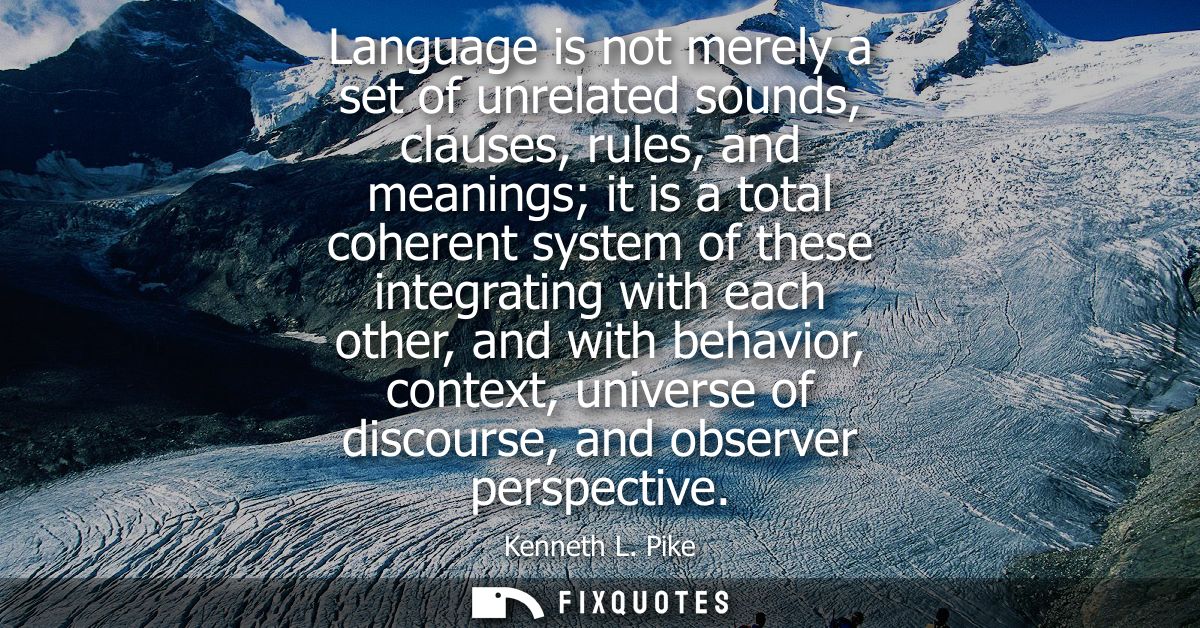
"Language is not merely a set of unrelated sounds, clauses, rules, and meanings; it is a total coherent system of these integrating with each other, and with behavior, context, universe of discourse, and observer perspective"
About this Quote
Pike refuses the comforting fiction that language is a tidy box of words plus a grammar handbook. He’s aiming at the reductionism baked into a lot of mid-century linguistics and social science: the urge to treat speech as detachable data, scrubbed clean of bodies, situations, and power. By calling language a "total coherent system", he’s not just praising complexity; he’s warning that if you isolate sounds from use, or rules from social action, you aren’t simplifying the phenomenon-you’re changing what it is.
The sentence is engineered to deny the reader an easy foothold. "Not merely" sets up an enemy: the atomized view of language as "unrelated sounds, clauses, rules, and meanings". That list is deliberately mechanical, like parts laid out on a workbench. Then Pike flips it: everything "integrating with each other" and, crucially, integrating with "behavior, context, universe of discourse, and observer perspective". He sneaks in the explosive claim at the end: the observer is part of the system. Description isn’t neutral; it’s situated. Your categories, your lab conditions, your cultural assumptions-all of it shapes what you think you’re recording.
Read in context, this is a sociologist’s (and Pike’s broader anthropological) insistence that language lives in scenes, not spreadsheets: in who’s speaking, to whom, for what purpose, under what stakes. The subtext is methodological and moral. Get the system wrong, and you misread people-not just their sentences.
The sentence is engineered to deny the reader an easy foothold. "Not merely" sets up an enemy: the atomized view of language as "unrelated sounds, clauses, rules, and meanings". That list is deliberately mechanical, like parts laid out on a workbench. Then Pike flips it: everything "integrating with each other" and, crucially, integrating with "behavior, context, universe of discourse, and observer perspective". He sneaks in the explosive claim at the end: the observer is part of the system. Description isn’t neutral; it’s situated. Your categories, your lab conditions, your cultural assumptions-all of it shapes what you think you’re recording.
Read in context, this is a sociologist’s (and Pike’s broader anthropological) insistence that language lives in scenes, not spreadsheets: in who’s speaking, to whom, for what purpose, under what stakes. The subtext is methodological and moral. Get the system wrong, and you misread people-not just their sentences.
Quote Details
| Topic | Deep |
|---|---|
| Source | Help us find the source |
More Quotes by Kenneth
Add to List