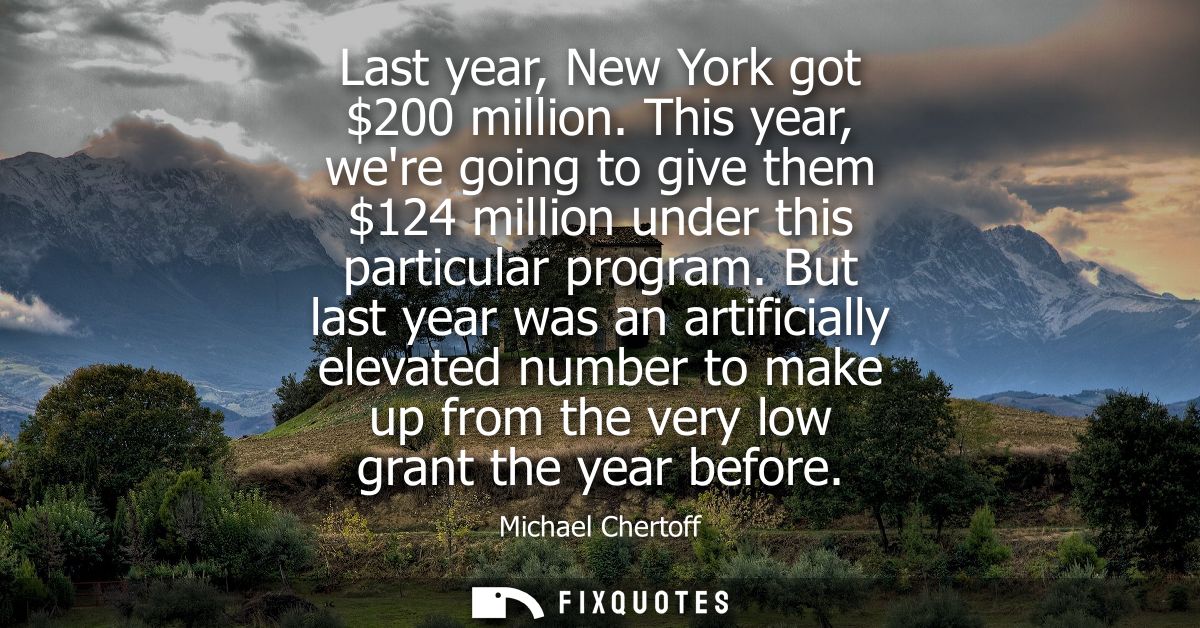
"Last year, New York got $200 million. This year, we're going to give them $124 million under this particular program. But last year was an artificially elevated number to make up from the very low grant the year before"
About this Quote
The subtext is political triage. Post-9/11 New York carried symbolic primacy in homeland security debates, and federal grants became proxy arguments about whose fear counts most. Chertoff, speaking as a steward of a national system, nudges the frame away from iconic targets and toward formulas, baselines, and program rules. “Under this particular program” narrows the battlefield: don’t judge us on the total landscape, judge us inside this one box where the numbers can be defended.
The sentence also smuggles in a lesson about bureaucratic memory. By invoking “the very low grant the year before,” he invites listeners to treat volatility as evidence of prudence rather than inconsistency: spikes and dips aren’t chaos, they’re adjustments. It’s an attempt to convert grievance into bookkeeping, and politics into process - a familiar move for a public servant trying to make an unpopular allocation sound like simple calibration rather than a statement about priorities.
Quote Details
| Topic | Money |
|---|---|
| Source | Help us find the source |
| Cite |
Citation Formats
APA Style (7th ed.)
Chertoff, Michael. (2026, January 16). Last year, New York got $200 million. This year, we're going to give them $124 million under this particular program. But last year was an artificially elevated number to make up from the very low grant the year before. FixQuotes. https://fixquotes.com/quotes/last-year-new-york-got-200-million-this-year-were-88392/
Chicago Style
Chertoff, Michael. "Last year, New York got $200 million. This year, we're going to give them $124 million under this particular program. But last year was an artificially elevated number to make up from the very low grant the year before." FixQuotes. January 16, 2026. https://fixquotes.com/quotes/last-year-new-york-got-200-million-this-year-were-88392/.
MLA Style (9th ed.)
"Last year, New York got $200 million. This year, we're going to give them $124 million under this particular program. But last year was an artificially elevated number to make up from the very low grant the year before." FixQuotes, 16 Jan. 2026, https://fixquotes.com/quotes/last-year-new-york-got-200-million-this-year-were-88392/. Accessed 31 Mar. 2026.