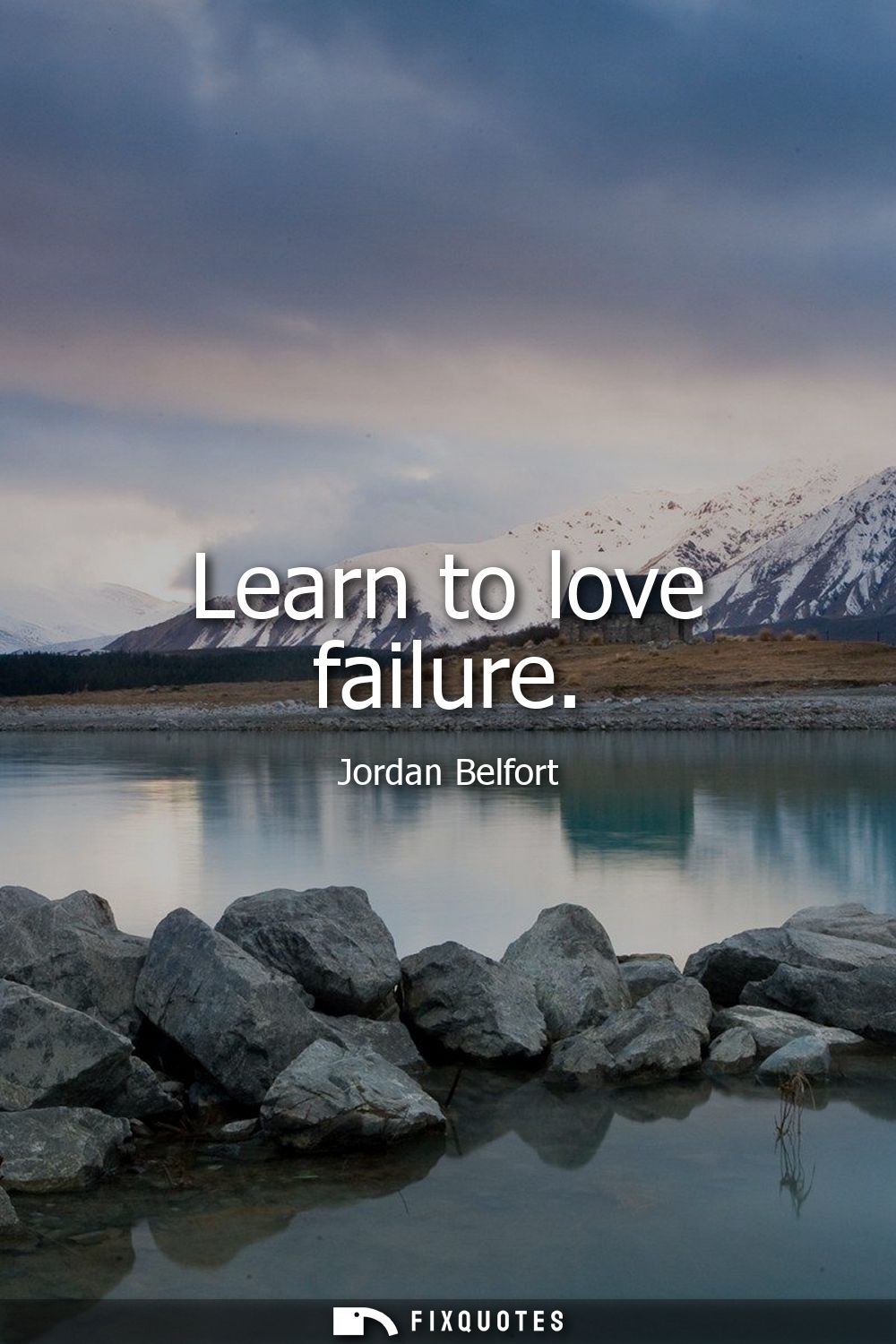
"Learn to love failure"
About this Quote
Spoken like a dare and a loophole at the same time, "Learn to love failure" turns a dreaded endpoint into a lifestyle accessory. Coming from Jordan Belfort, the infamous salesman-turned-author whose brand is built on audacity and reinvention, the line isn’t just motivational: it’s reputational rehab. Belfort’s career arc depends on recasting catastrophe as curriculum, not consequence. If failure is something you can "love", then it stops being an indictment and starts being a tool - a necessary fee you pay on the way to winning.
The phrasing matters. "Learn" implies technique, almost a hustle skill, as if your relationship to loss can be trained like a pitch. "Love" is the twist: not tolerate, not accept, but embrace. That emotional escalation is what sells the idea. It offers a shortcut past shame, the most paralyzing part of failing, and replaces it with a feeling that sounds heroic. It’s self-help with a salesman’s cadence: simple, repeatable, hard to argue with.
The caution is in the subtext. In Belfort’s world, failure can be framed as evidence of risk-taking, even when it’s evidence of recklessness. The quote works because it flatters the listener’s ambition - you’re not stumbling, you’re "learning" - while conveniently blurring the line between a productive setback and a moral or legal collapse. In an era that fetishizes entrepreneurship and personal branding, it’s a mantra that turns accountability into momentum.
The phrasing matters. "Learn" implies technique, almost a hustle skill, as if your relationship to loss can be trained like a pitch. "Love" is the twist: not tolerate, not accept, but embrace. That emotional escalation is what sells the idea. It offers a shortcut past shame, the most paralyzing part of failing, and replaces it with a feeling that sounds heroic. It’s self-help with a salesman’s cadence: simple, repeatable, hard to argue with.
The caution is in the subtext. In Belfort’s world, failure can be framed as evidence of risk-taking, even when it’s evidence of recklessness. The quote works because it flatters the listener’s ambition - you’re not stumbling, you’re "learning" - while conveniently blurring the line between a productive setback and a moral or legal collapse. In an era that fetishizes entrepreneurship and personal branding, it’s a mantra that turns accountability into momentum.
Quote Details
| Topic | Learning from Mistakes |
|---|---|
| Source | Help us find the source |
| Cite |
Citation Formats
APA Style (7th ed.)
Belfort, Jordan. (2026, January 15). Learn to love failure. FixQuotes. https://fixquotes.com/quotes/learn-to-love-failure-172379/
Chicago Style
Belfort, Jordan. "Learn to love failure." FixQuotes. January 15, 2026. https://fixquotes.com/quotes/learn-to-love-failure-172379/.
MLA Style (9th ed.)
"Learn to love failure." FixQuotes, 15 Jan. 2026, https://fixquotes.com/quotes/learn-to-love-failure-172379/. Accessed 4 Mar. 2026.
More Quotes by Jordan
Add to List