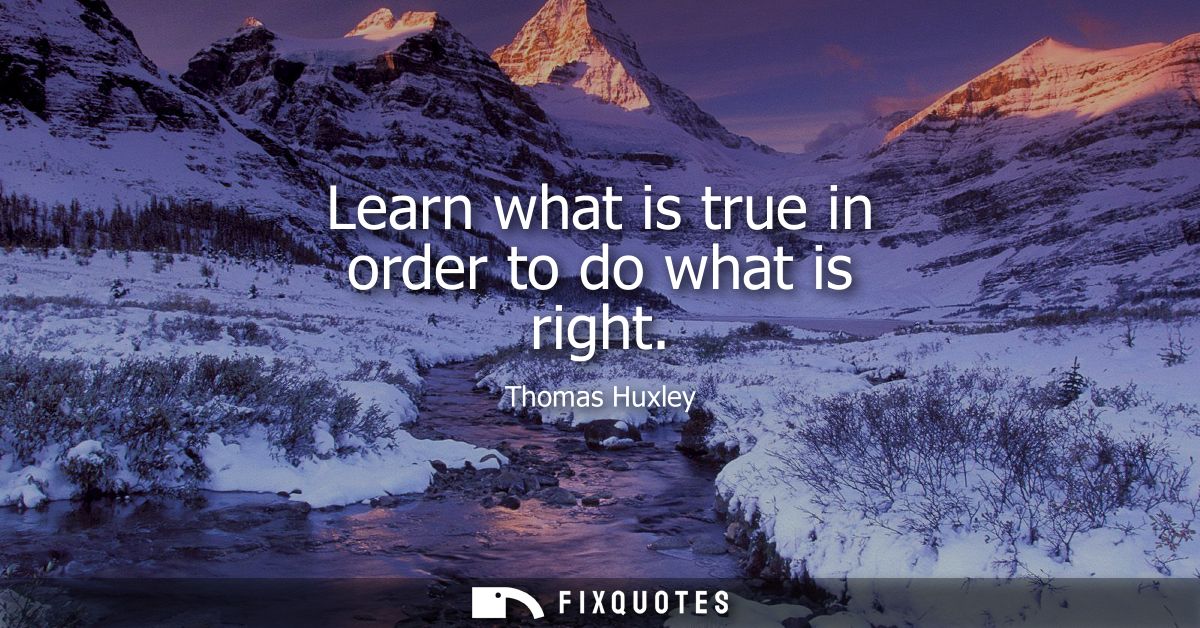
"Learn what is true in order to do what is right"
About this Quote
Huxley’s line reads like a moral slogan, but it’s really a battle plan. “Learn what is true” isn’t inspirational wallpaper coming from a Victorian scientist; it’s a demand that ethics stop floating free of evidence. Huxley earned the nickname “Darwin’s bulldog” by treating public debate as an arena where comfortable beliefs should be forced to meet facts. In that context, truth isn’t a polite, neutral thing. It’s disruptive. It rearranges what society thinks it’s allowed to do.
The craftsmanship is in the tight causal chain: know, therefore act. Huxley links epistemology to responsibility, implying that ignorance isn’t just unfortunate but ethically suspect. “In order to” turns knowledge into a prerequisite for righteousness, not an ornament. The subtext is aimed at the institutions of his day - clergy, politicians, even armchair philosophers - that claimed moral authority while resisting scientific method. If you’re going to legislate, preach, or educate, you don’t get to improvise your “right” from tradition and vibes.
It also carries a warning to science itself. Huxley isn’t saying facts automatically produce goodness; he’s insisting that moral action without an accurate picture of reality becomes performative at best and violent at worst. For a century obsessed with progress, empire, and “civilization,” that’s a pointed corrective: you can’t justify grand projects on sentimental ideals while refusing to check whether your premises are true.
The craftsmanship is in the tight causal chain: know, therefore act. Huxley links epistemology to responsibility, implying that ignorance isn’t just unfortunate but ethically suspect. “In order to” turns knowledge into a prerequisite for righteousness, not an ornament. The subtext is aimed at the institutions of his day - clergy, politicians, even armchair philosophers - that claimed moral authority while resisting scientific method. If you’re going to legislate, preach, or educate, you don’t get to improvise your “right” from tradition and vibes.
It also carries a warning to science itself. Huxley isn’t saying facts automatically produce goodness; he’s insisting that moral action without an accurate picture of reality becomes performative at best and violent at worst. For a century obsessed with progress, empire, and “civilization,” that’s a pointed corrective: you can’t justify grand projects on sentimental ideals while refusing to check whether your premises are true.
Quote Details
| Topic | Ethics & Morality |
|---|---|
| Source | Help us find the source |
| Cite |
Citation Formats
APA Style (7th ed.)
Huxley, Thomas. (2026, January 18). Learn what is true in order to do what is right. FixQuotes. https://fixquotes.com/quotes/learn-what-is-true-in-order-to-do-what-is-right-18009/
Chicago Style
Huxley, Thomas. "Learn what is true in order to do what is right." FixQuotes. January 18, 2026. https://fixquotes.com/quotes/learn-what-is-true-in-order-to-do-what-is-right-18009/.
MLA Style (9th ed.)
"Learn what is true in order to do what is right." FixQuotes, 18 Jan. 2026, https://fixquotes.com/quotes/learn-what-is-true-in-order-to-do-what-is-right-18009/. Accessed 12 Feb. 2026.
More Quotes by Thomas
Add to List