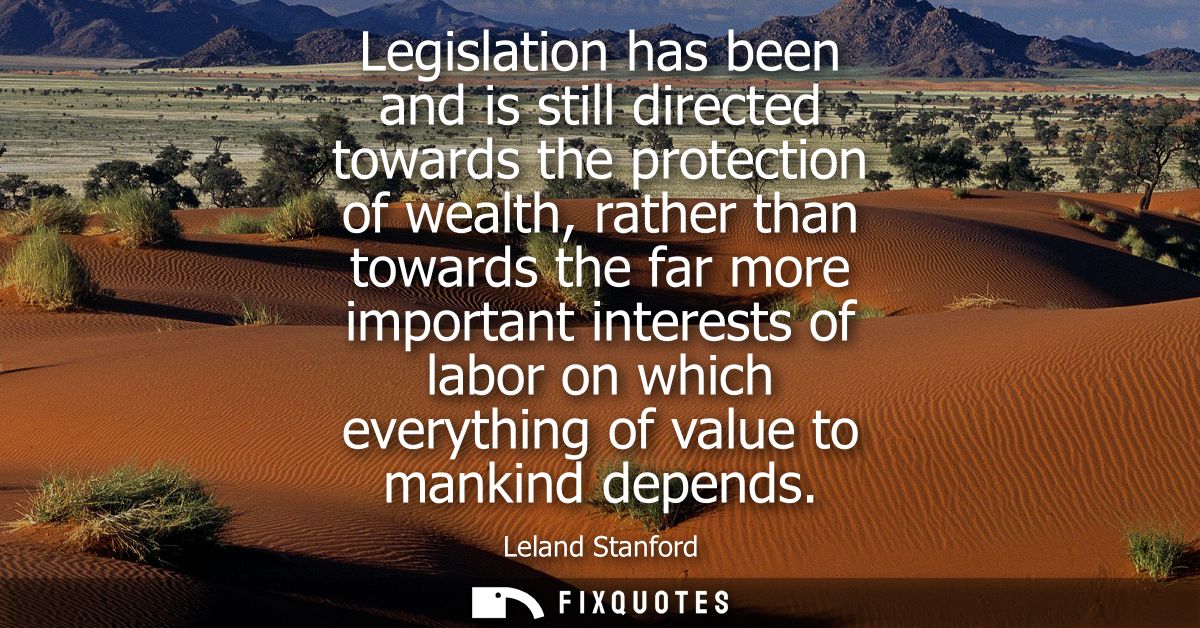
"Legislation has been and is still directed towards the protection of wealth, rather than towards the far more important interests of labor on which everything of value to mankind depends"
About this Quote
The intent reads as both critique and pressure valve. By elevating labor as the "far more important interests" and claiming "everything of value" depends on it, Stanford borrows the moral authority of workers without surrendering control of the system that extracts their value. It’s a rhetorical re-centering: labor as the foundation, wealth as the protected outcome. The subtext is a request for stability. Protect labor not because exploitation is wrong, but because unrest is expensive and governance requires consent. In the Gilded Age context, with strikes, anti-monopoly agitation, and the rising legitimacy of organized labor, this line functions like elite triage: adjust the legal order just enough to keep the engine running.
It also reveals an uncomfortable truth about American policy making that still scans: law often treats wealth as fragile and labor as replaceable. Stanford’s phrasing quietly indicts that hierarchy, even as his own career helped build it.
Quote Details
| Topic | Justice |
|---|---|
| Source | Help us find the source |
| Cite |
Citation Formats
APA Style (7th ed.)
Stanford, Leland. (2026, January 16). Legislation has been and is still directed towards the protection of wealth, rather than towards the far more important interests of labor on which everything of value to mankind depends. FixQuotes. https://fixquotes.com/quotes/legislation-has-been-and-is-still-directed-93353/
Chicago Style
Stanford, Leland. "Legislation has been and is still directed towards the protection of wealth, rather than towards the far more important interests of labor on which everything of value to mankind depends." FixQuotes. January 16, 2026. https://fixquotes.com/quotes/legislation-has-been-and-is-still-directed-93353/.
MLA Style (9th ed.)
"Legislation has been and is still directed towards the protection of wealth, rather than towards the far more important interests of labor on which everything of value to mankind depends." FixQuotes, 16 Jan. 2026, https://fixquotes.com/quotes/legislation-has-been-and-is-still-directed-93353/. Accessed 30 Mar. 2026.