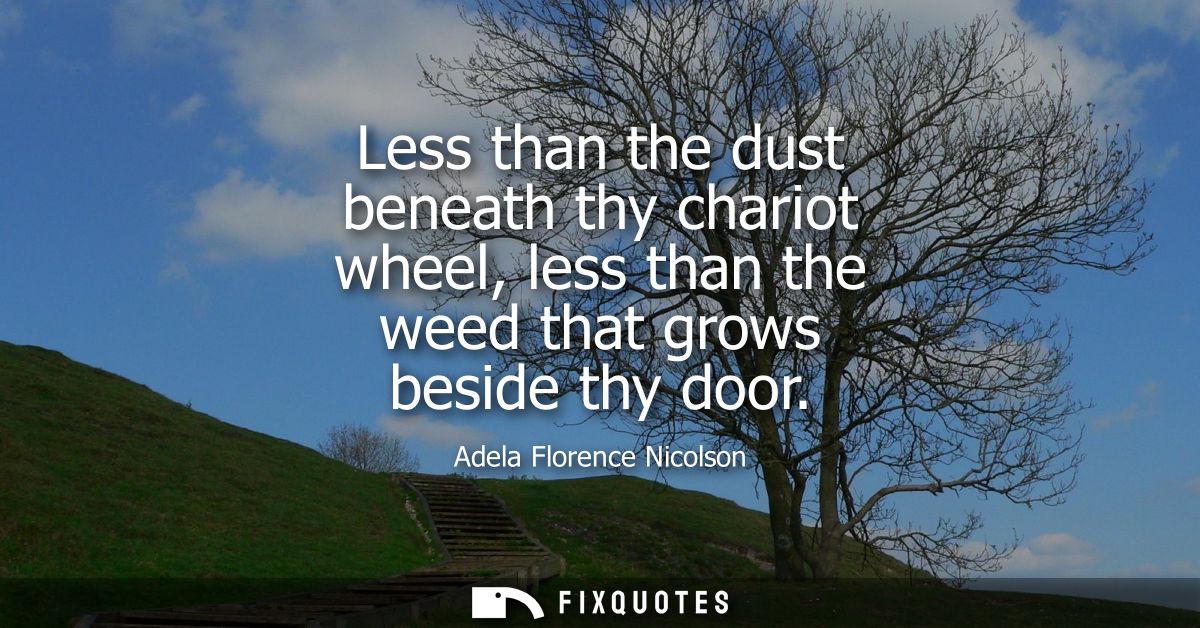
"Less than the dust beneath thy chariot wheel, less than the weed that grows beside thy door"
About this Quote
The intent reads like an offering, but the subtext is more complicated. This is a lover performing humility as a currency, insisting that her desire is so pure it requires no recognition. Yet the very extravagance of abasement becomes its own form of insistence: look how completely I submit; look how much you matter. In that way, the line quietly pressures the beloved to inhabit the grand role assigned to them. Worship can be a leash made of silk.
Context matters with Nicolson: a late-Victorian poet writing under the gendered constraints of empire and respectability, often publishing as “Laurence Hope.” The diction leans deliberately archaic (“thy”), borrowing the authority of devotional and courtly traditions to legitimize feelings that polite society would rather keep unsaid. The brilliance is the double move: she uses the language of submission to smuggle in intensity. Even as the speaker calls herself “less than,” the poem refuses to be small.
Quote Details
| Topic | Romantic |
|---|---|
| Source | Help us find the source |
| Cite |
Citation Formats
APA Style (7th ed.)
Nicolson, Adela Florence. (2026, January 17). Less than the dust beneath thy chariot wheel, less than the weed that grows beside thy door. FixQuotes. https://fixquotes.com/quotes/less-than-the-dust-beneath-thy-chariot-wheel-less-43325/
Chicago Style
Nicolson, Adela Florence. "Less than the dust beneath thy chariot wheel, less than the weed that grows beside thy door." FixQuotes. January 17, 2026. https://fixquotes.com/quotes/less-than-the-dust-beneath-thy-chariot-wheel-less-43325/.
MLA Style (9th ed.)
"Less than the dust beneath thy chariot wheel, less than the weed that grows beside thy door." FixQuotes, 17 Jan. 2026, https://fixquotes.com/quotes/less-than-the-dust-beneath-thy-chariot-wheel-less-43325/. Accessed 27 Mar. 2026.