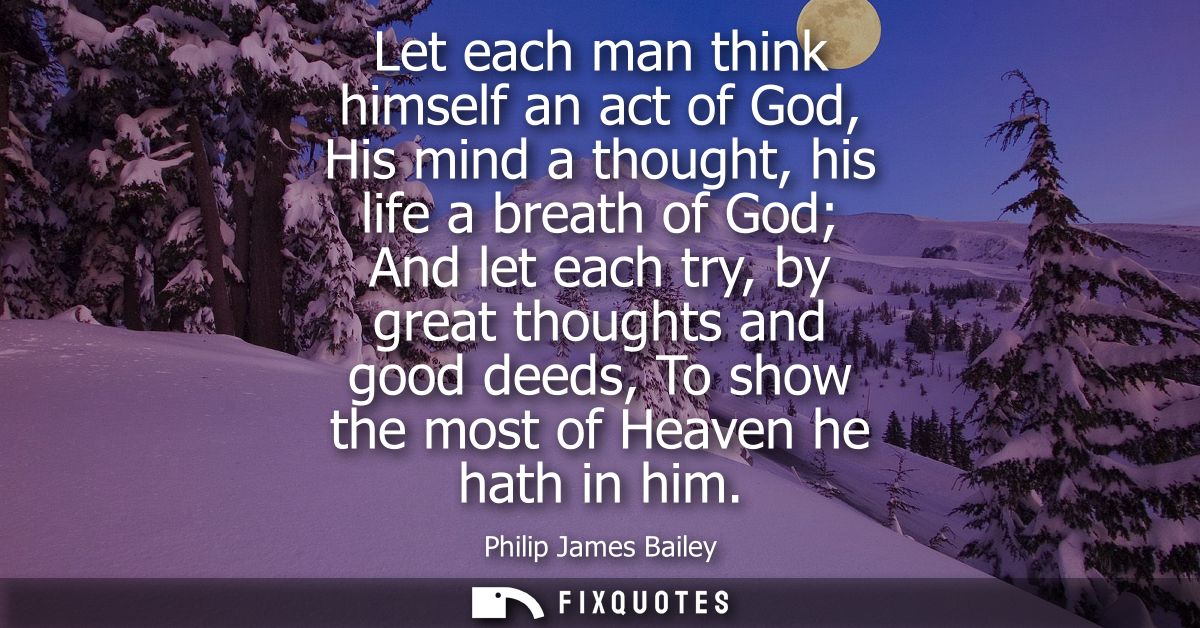
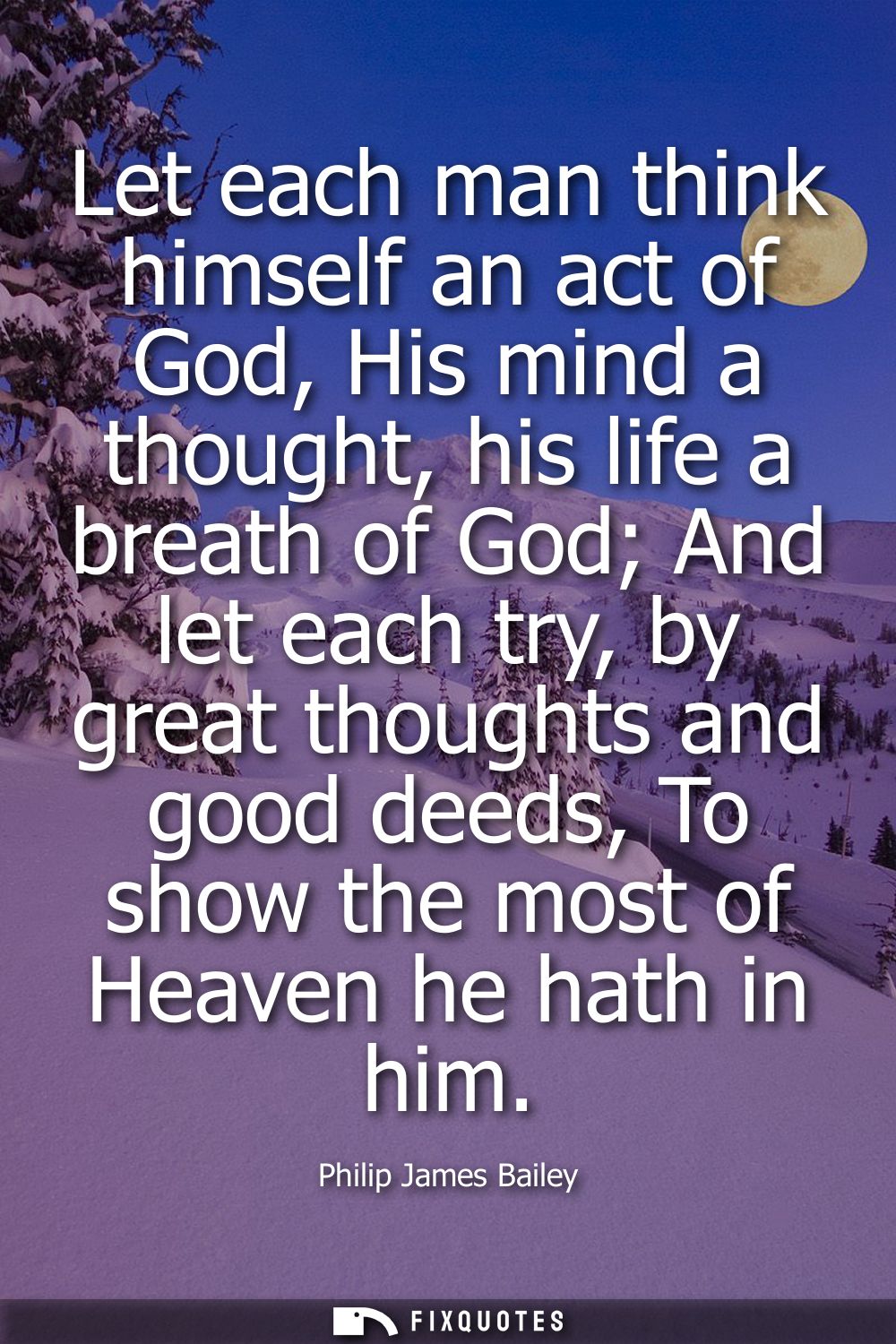
"Let each man think himself an act of God, his mind a thought, his life a breath of God; and let each try, by great thoughts and good deeds, to show the most of heaven he hath in him"
About this Quote
The rhetoric moves in a tight theological chain: act, thought, breath. It’s intimate and bodily. “Breath of God” makes the sacred less cathedral, more bloodstream. Bailey also cleverly turns belief into behavior. The poem doesn’t ask for correct doctrine; it asks for proof-of-work. “Great thoughts and good deeds” is a civic and ethical standard disguised as devotion, a way of baptizing ambition without letting it become vanity.
There’s also a quiet democratizing subtext: “each man” (dated gendering aside) suggests this dignity isn’t reserved for saints, clergy, or geniuses. It’s a universal calling with an aristocratic demand: “show the most.” Heaven becomes not just a destination but a capacity to be expressed, a latent excellence you’re responsible for making legible.
Contextually, Bailey sits near the Romantic afterglow and early Victorian moral earnestness: the soul enlarged by imagination, then disciplined into action. The line walks a fine line between inspirational and dangerous, because if you are “an act of God,” you might confuse self-reliance with self-worship. Bailey’s safeguard is in the pairing: big thinking must be tethered to good doing.
Quote Details
| Topic | God |
|---|---|
| Source | Festus (poem), Philip James Bailey; line from the epic poem Festus (first published 1839; expanded in later editions). |
| Cite |
Citation Formats
APA Style (7th ed.)
Bailey, Philip James. (2026, February 18). Let each man think himself an act of God, his mind a thought, his life a breath of God; and let each try, by great thoughts and good deeds, to show the most of heaven he hath in him. FixQuotes. https://fixquotes.com/quotes/let-each-man-think-himself-an-act-of-god-his-mind-76240/
Chicago Style
Bailey, Philip James. "Let each man think himself an act of God, his mind a thought, his life a breath of God; and let each try, by great thoughts and good deeds, to show the most of heaven he hath in him." FixQuotes. February 18, 2026. https://fixquotes.com/quotes/let-each-man-think-himself-an-act-of-god-his-mind-76240/.
MLA Style (9th ed.)
"Let each man think himself an act of God, his mind a thought, his life a breath of God; and let each try, by great thoughts and good deeds, to show the most of heaven he hath in him." FixQuotes, 18 Feb. 2026, https://fixquotes.com/quotes/let-each-man-think-himself-an-act-of-god-his-mind-76240/. Accessed 14 Mar. 2026.