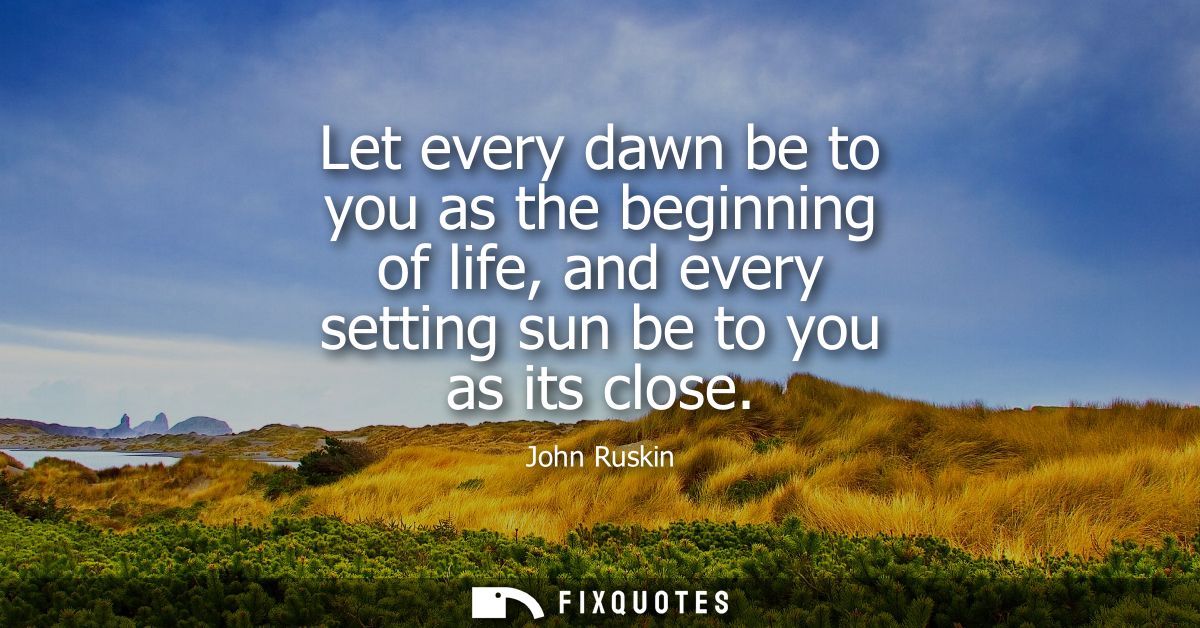
"Let every dawn be to you as the beginning of life, and every setting sun be to you as its close"
About this Quote
The subtext is anti-drift. Industrial modernity was speeding up, turning time into a commodity and people into cogs. Ruskin, a fierce critic of mechanized life and shoddy workmanship, counterprograms that with a ritual of perception. By anchoring meaning to natural light rather than clocks or factories, he quietly rejects the era’s tyrannies: wage time, status time, efficiency time. Nature becomes a metronome for conscience.
It also works rhetorically because it’s symmetrical and unsentimental. “Beginning” and “close” are clean nouns, almost legalistic, giving the sentence a stern clarity. The suggestion is that a good life isn’t one grand narrative; it’s an accumulated practice of beginnings and endings handled well. The day becomes a training ground for mortality, and mortality becomes the pressure that makes the ordinary legible.
Quote Details
| Topic | New Beginnings |
|---|---|
| Source | Verified source: Lectures on Art (Oxford, Hilary Term 1870) (John Ruskin, 1870)
Evidence: Let every dawn of morning be to you as the beginning of life, and every setting sun be to you as its close:, then let every one of these short lives leave its sure record of some kindly thing done for others, some goodly strength or knowledge gained for yourselves; so, from day to day, and strength to strength, you shall build up indeed, by Art, by Thought, and by Just Will, an Ecclesia of England, of which it shall not be said, "See what manner of stones are here," but, "See what manner of men." (Page 85 (in the Project Gutenberg pagination; original print pagination may differ)). This line appears in Ruskin’s primary text "Lectures on Art, Delivered Before the University of Oxford in Hilary Term, 1870" (a work consisting of lectures). In the Project Gutenberg transcription it occurs at the end of the section marked [Pg 85]. Many modern quote versions omit "of morning" and/or the following sentence beginning "then let every one...". I have NOT, in this pass, verified whether an earlier instance exists in an earlier separate publication (e.g., an earlier lecture printing, pamphlet, or the earlier book commonly associated with the line, "The Two Paths"). Goodreads/secondary sites commonly attribute it to "The Two Paths," but those are not primary sources. To determine FIRST publication with high confidence, the next step would be to consult a digitized first edition of "The Two Paths" and/or any 1870 Oxford lecture pamphlet/first printing and compare dates and wording. Other candidates (1) Goodbye, My Yesterday: Hello and Good Morning, My Tomorrow (Charles Konadu-Adjei PhD, 2022) compilation96.9% ... John Ruskin said , " Let every dawn be to you as the beginning of life , and every setting sun be to you as its c... |
| Cite |
Citation Formats
APA Style (7th ed.)
Ruskin, John. (2026, March 2). Let every dawn be to you as the beginning of life, and every setting sun be to you as its close. FixQuotes. https://fixquotes.com/quotes/let-every-dawn-be-to-you-as-the-beginning-of-life-8274/
Chicago Style
Ruskin, John. "Let every dawn be to you as the beginning of life, and every setting sun be to you as its close." FixQuotes. March 2, 2026. https://fixquotes.com/quotes/let-every-dawn-be-to-you-as-the-beginning-of-life-8274/.
MLA Style (9th ed.)
"Let every dawn be to you as the beginning of life, and every setting sun be to you as its close." FixQuotes, 2 Mar. 2026, https://fixquotes.com/quotes/let-every-dawn-be-to-you-as-the-beginning-of-life-8274/. Accessed 7 Apr. 2026.