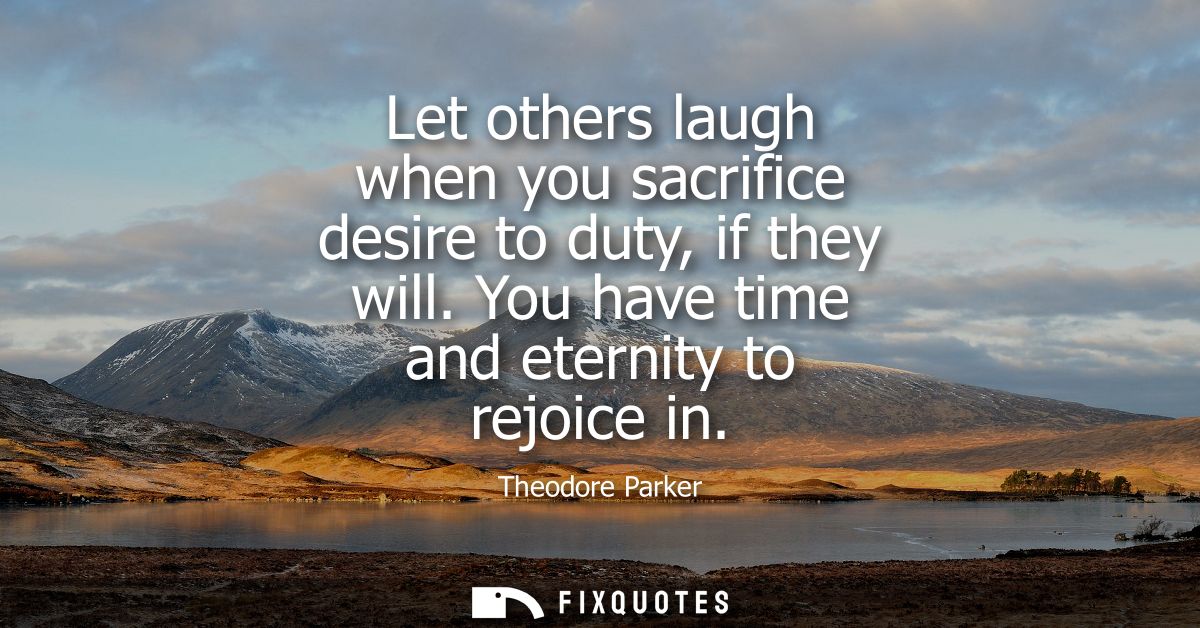
"Let others laugh when you sacrifice desire to duty, if they will. You have time and eternity to rejoice in"
About this Quote
The subtext is a reversal of what “joy” is for. The world offers immediate pleasure and public approval; Parker offers a longer ledger. “Time and eternity” is both pastoral comfort and rhetorical leverage: your reward isn’t just delayed, it’s doubled, stretching from lived experience into the afterlife. That eschatological horizon isn’t mere heaven-talk; it functions as a shield against the tyranny of the present moment, where desire is loud and duty looks like loss.
The line also smuggles in a quiet insult: the laughers are shortsighted. They’re scoring points in the room; you’re playing on a bigger field. Parker’s intent is to make moral seriousness feel not like deprivation, but like a kind of future-proof confidence.
Quote Details
| Topic | Self-Discipline |
|---|---|
| Source | Help us find the source |
| Cite |
Citation Formats
APA Style (7th ed.)
Parker, Theodore. (2026, January 15). Let others laugh when you sacrifice desire to duty, if they will. You have time and eternity to rejoice in. FixQuotes. https://fixquotes.com/quotes/let-others-laugh-when-you-sacrifice-desire-to-9843/
Chicago Style
Parker, Theodore. "Let others laugh when you sacrifice desire to duty, if they will. You have time and eternity to rejoice in." FixQuotes. January 15, 2026. https://fixquotes.com/quotes/let-others-laugh-when-you-sacrifice-desire-to-9843/.
MLA Style (9th ed.)
"Let others laugh when you sacrifice desire to duty, if they will. You have time and eternity to rejoice in." FixQuotes, 15 Jan. 2026, https://fixquotes.com/quotes/let-others-laugh-when-you-sacrifice-desire-to-9843/. Accessed 3 Apr. 2026.