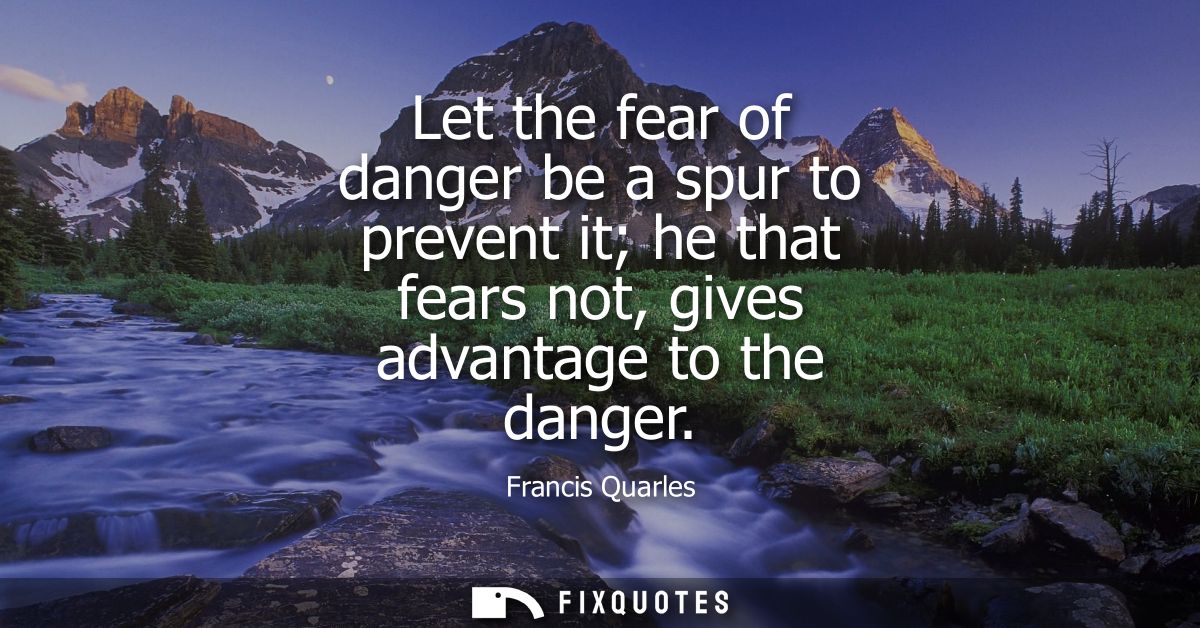
"Let the fear of danger be a spur to prevent it; he that fears not, gives advantage to the danger"
About this Quote
That logic lands with extra force in Quarles’s world. Writing in early 17th-century England, with plague cycles, religious conflict, and looming civil war, he belonged to a culture that read calamity as both material and moral. As a poet known for devotional work, Quarles isn’t offering stoic bravado; he’s pitching a practical piety. Healthy fear becomes a form of vigilance, a disciplined attention to vulnerability. The subtext is Protestant and domestic: guard the soul the way you guard the house. Don’t tempt ruin by pretending you’re above it.
The aphorism’s second clause tightens the screw. “He that fears not, gives advantage” implies a transfer of power: your attitude can strengthen the threat. That’s why the sentence feels modern; it reads like an early critique of performative fearlessness, the kind that masquerades as courage but functions as denial. Quarles isn’t telling you to panic. He’s telling you that risk management starts with admitting risk exists.
Quote Details
| Topic | Fear |
|---|---|
| Source | Help us find the source |
| Cite |
Citation Formats
APA Style (7th ed.)
Quarles, Francis. (2026, January 15). Let the fear of danger be a spur to prevent it; he that fears not, gives advantage to the danger. FixQuotes. https://fixquotes.com/quotes/let-the-fear-of-danger-be-a-spur-to-prevent-it-he-52777/
Chicago Style
Quarles, Francis. "Let the fear of danger be a spur to prevent it; he that fears not, gives advantage to the danger." FixQuotes. January 15, 2026. https://fixquotes.com/quotes/let-the-fear-of-danger-be-a-spur-to-prevent-it-he-52777/.
MLA Style (9th ed.)
"Let the fear of danger be a spur to prevent it; he that fears not, gives advantage to the danger." FixQuotes, 15 Jan. 2026, https://fixquotes.com/quotes/let-the-fear-of-danger-be-a-spur-to-prevent-it-he-52777/. Accessed 25 Mar. 2026.