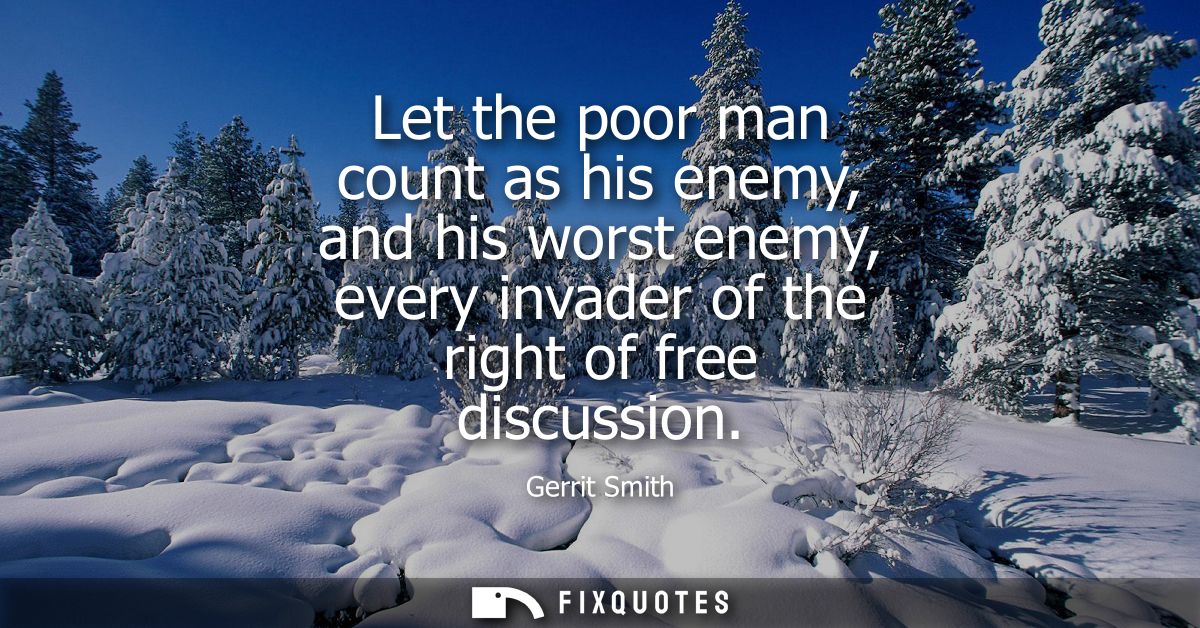
"Let the poor man count as his enemy, and his worst enemy, every invader of the right of free discussion"
About this Quote
The phrasing is deliberately militant: "count as his enemy" and then the escalation to "his worst enemy". Smith is trying to rewire class instincts away from scapegoating sideways (immigrants, other workers, the conveniently visible) and toward the systems and actors that restrict debate. The "invader" is telling: it treats censorship not as a policy dispute but as a trespass, an act of occupation. That moral framing matters because it turns passivity into betrayal; tolerating gag rules becomes a kind of self-harm for the poor.
Context sharpens the stakes. Smith was a radical abolitionist politician in an era when antislavery speech was routinely suppressed: mob attacks on speakers, "gag rules" in Congress to block abolition petitions, postal censorship of abolitionist materials. He'd watched how authorities could maintain slavery and other hierarchies by strangling the argument before it reached a ballot box or a courtroom. The subtext is blunt: if the powerful can control what can be said, they won't need to control what can be voted on.
Quote Details
| Topic | Freedom |
|---|---|
| Source | Help us find the source |
| Cite |
Citation Formats
APA Style (7th ed.)
Smith, Gerrit. (2026, January 16). Let the poor man count as his enemy, and his worst enemy, every invader of the right of free discussion. FixQuotes. https://fixquotes.com/quotes/let-the-poor-man-count-as-his-enemy-and-his-worst-95767/
Chicago Style
Smith, Gerrit. "Let the poor man count as his enemy, and his worst enemy, every invader of the right of free discussion." FixQuotes. January 16, 2026. https://fixquotes.com/quotes/let-the-poor-man-count-as-his-enemy-and-his-worst-95767/.
MLA Style (9th ed.)
"Let the poor man count as his enemy, and his worst enemy, every invader of the right of free discussion." FixQuotes, 16 Jan. 2026, https://fixquotes.com/quotes/let-the-poor-man-count-as-his-enemy-and-his-worst-95767/. Accessed 29 Mar. 2026.