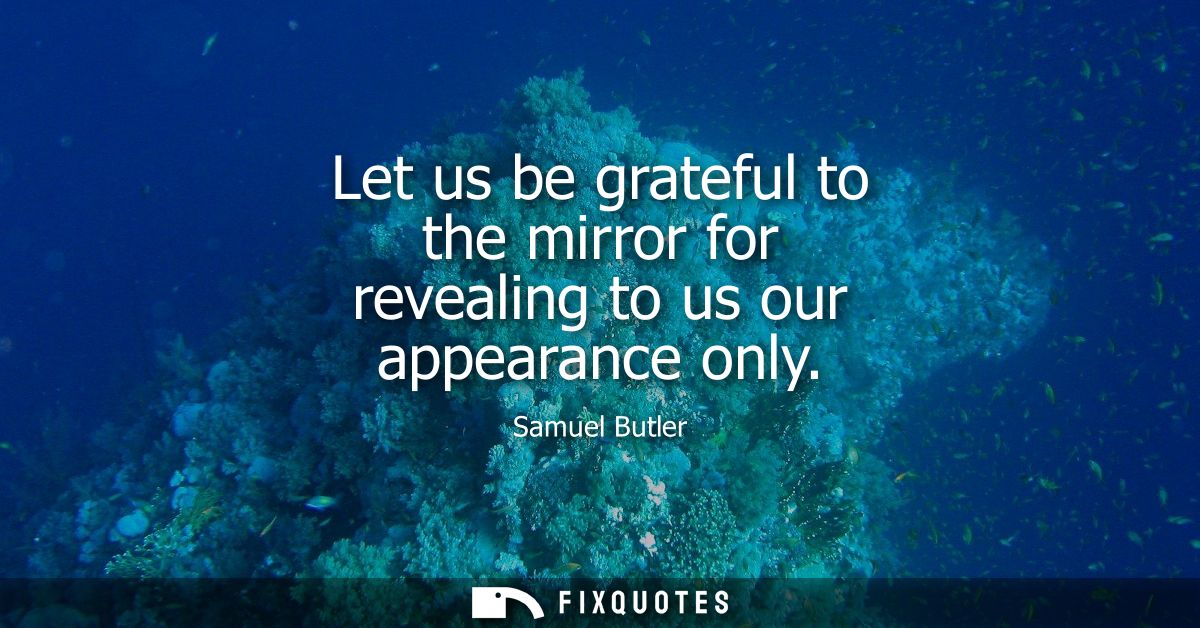
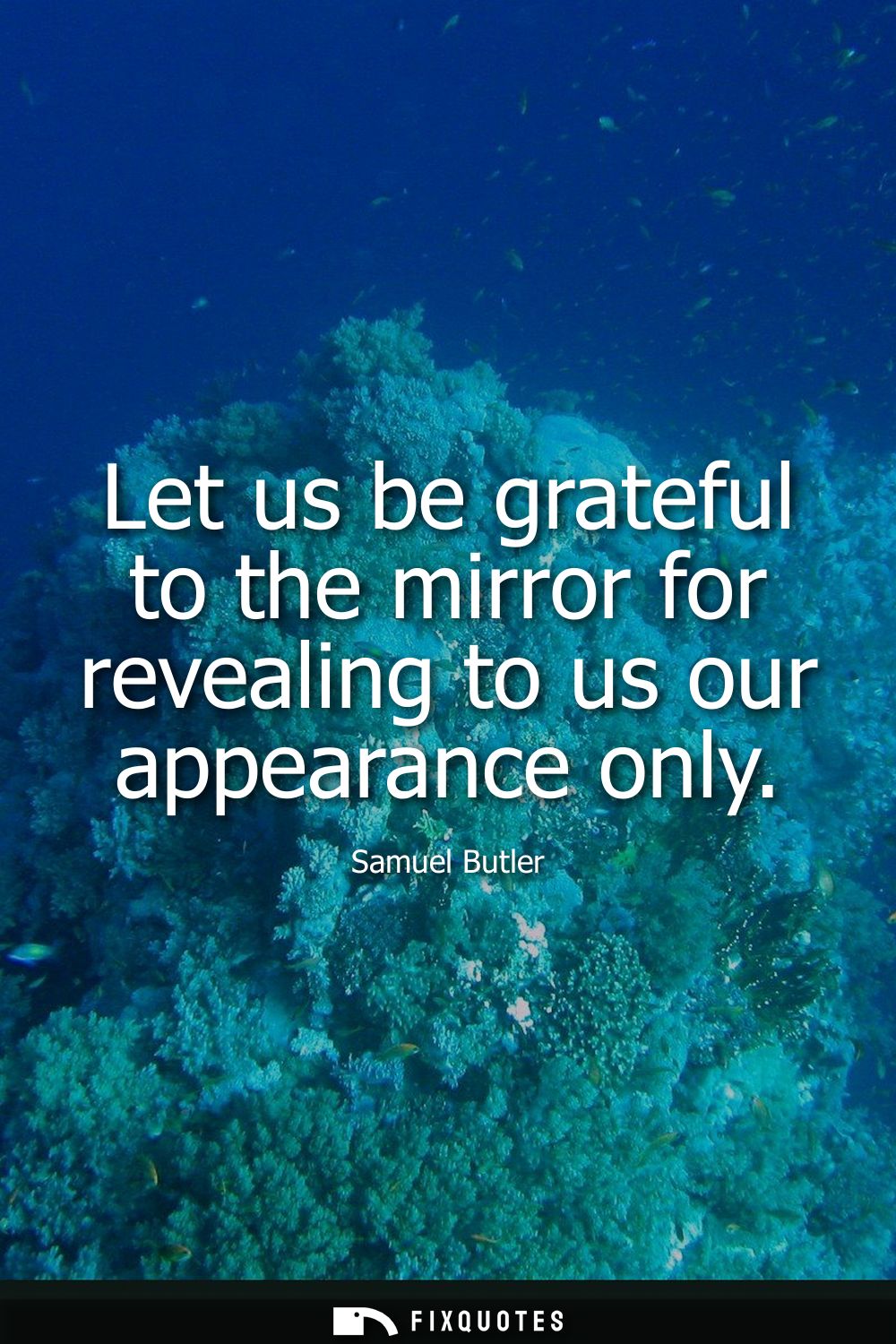
"Let us be grateful to the mirror for revealing to us our appearance only"
About this Quote
The intent is a sideways jab at the Victorian hunger for moral X-rays: the era’s obsession with reading character in faces, posture, physiognomy, even “healthy” complexions. Butler, who spent much of his career skewering piety and social certainty, implies that if mirrors also reflected what we are - motives, vanities, small cruelties, private hypocrisies - society would be unlivable. The line’s elegance comes from its polite wording (“Let us be grateful...”), which mimics the cadence of a sermon, then quietly detonates it. It’s an almost prayerful sentence that refuses spiritual comfort.
Subtext: we prefer manageable truths. Appearance is a criticism we can metabolize; it’s actionable, cosmetic, containable. Inner reality is messier because it implicates choice and responsibility. Butler’s mirror is a satire of self-improvement culture before it had that name: a world eager to correct the visible while keeping the invisible uninspected.
Context sharpens the cynicism. Butler wrote in a period fascinated by Darwinian arguments, moral reform, and the policing of respectability. Against all that confident diagnosing, he offers a bleak kindness: thank God for the dumb mirror. It can’t tell on us. That’s the comfort - and the indictment.
Quote Details
| Topic | Gratitude |
|---|---|
| Source | Help us find the source |
| Cite |
Citation Formats
APA Style (7th ed.)
Butler, Samuel. (2026, January 18). Let us be grateful to the mirror for revealing to us our appearance only. FixQuotes. https://fixquotes.com/quotes/let-us-be-grateful-to-the-mirror-for-revealing-to-18143/
Chicago Style
Butler, Samuel. "Let us be grateful to the mirror for revealing to us our appearance only." FixQuotes. January 18, 2026. https://fixquotes.com/quotes/let-us-be-grateful-to-the-mirror-for-revealing-to-18143/.
MLA Style (9th ed.)
"Let us be grateful to the mirror for revealing to us our appearance only." FixQuotes, 18 Jan. 2026, https://fixquotes.com/quotes/let-us-be-grateful-to-the-mirror-for-revealing-to-18143/. Accessed 4 Apr. 2026.