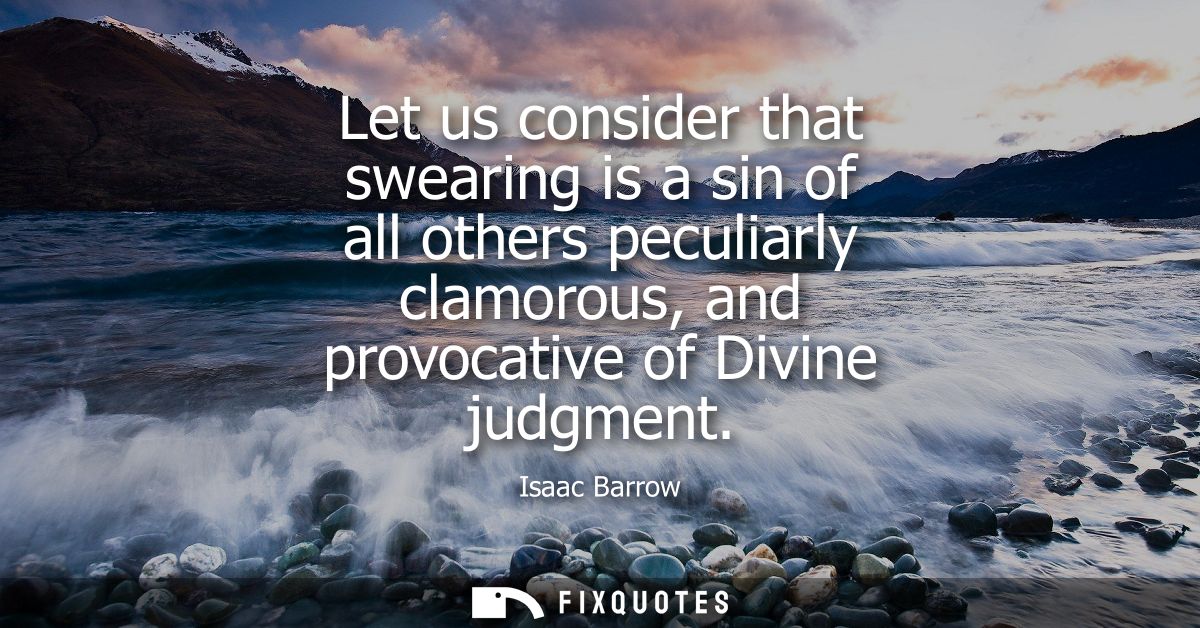
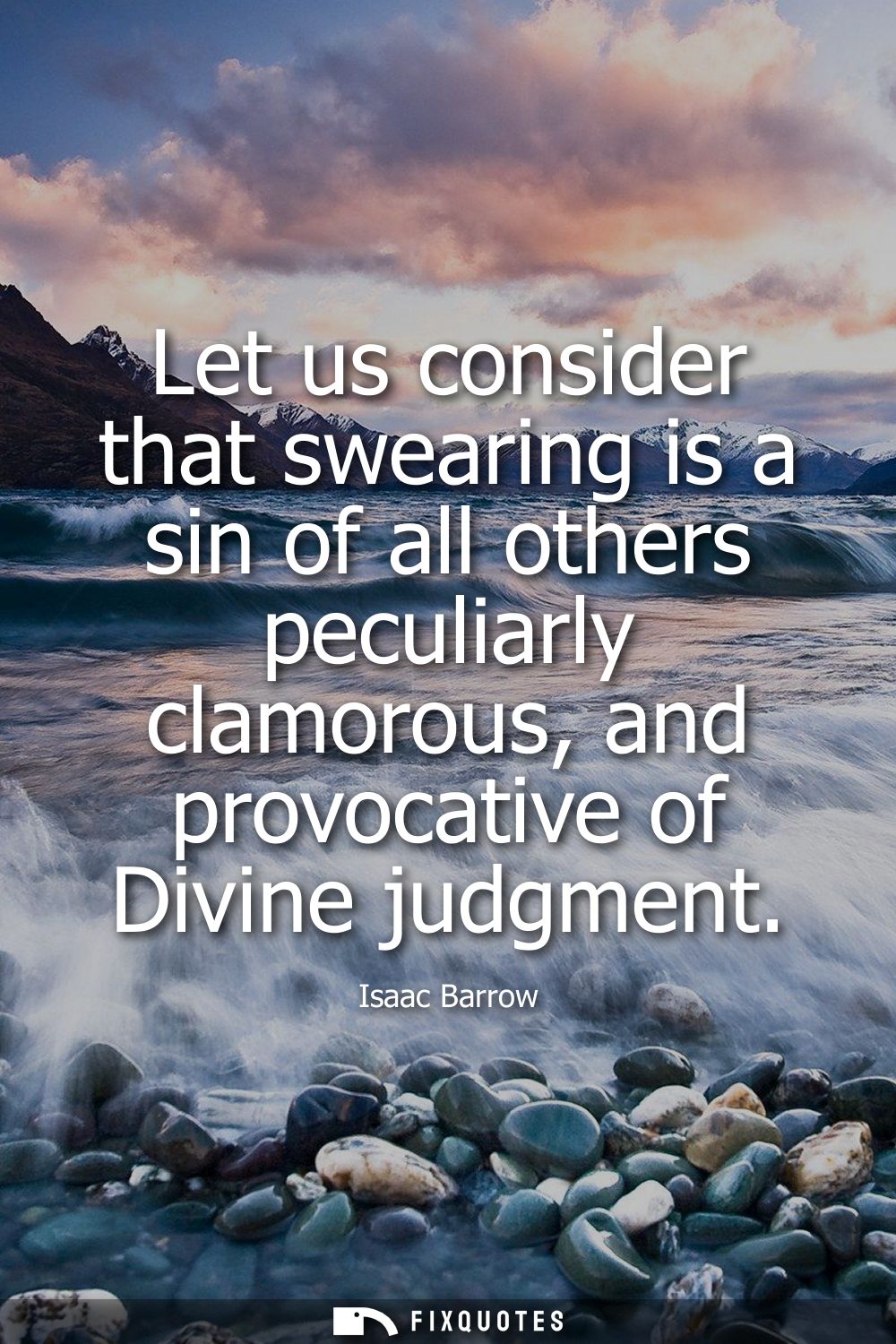
"Let us consider that swearing is a sin of all others peculiarly clamorous, and provocative of Divine judgment"
About this Quote
The line is engineered to make speech feel consequential. “Provocative of Divine judgment” frames blasphemous talk not as harmless venting but as an act that summons response, like banging on heaven’s door. That “provocative” is key: it suggests swearing isn’t passive weakness; it’s aggressive, picking a fight with the moral order. Barrow’s intent is pastoral and disciplinary: to convert a commonplace habit into a high-stakes offense by tying it to immediacy and exposure.
Context matters. Barrow is a 17th-century English divine as well as a mathematician, writing in a post-Civil War, Restoration-era world anxious about social order and moral decay. Policing language was a way of policing society: oaths lubricated violence, masculinity, and tavern culture, and they also threatened a theological regime built on reverent speech. Barrow’s subtext is simple and strategic: if you can’t control your tongue, you can’t claim to be governed at all.
Quote Details
| Topic | God |
|---|---|
| Source | Help us find the source |
| Cite |
Citation Formats
APA Style (7th ed.)
Barrow, Isaac. (2026, January 18). Let us consider that swearing is a sin of all others peculiarly clamorous, and provocative of Divine judgment. FixQuotes. https://fixquotes.com/quotes/let-us-consider-that-swearing-is-a-sin-of-all-20054/
Chicago Style
Barrow, Isaac. "Let us consider that swearing is a sin of all others peculiarly clamorous, and provocative of Divine judgment." FixQuotes. January 18, 2026. https://fixquotes.com/quotes/let-us-consider-that-swearing-is-a-sin-of-all-20054/.
MLA Style (9th ed.)
"Let us consider that swearing is a sin of all others peculiarly clamorous, and provocative of Divine judgment." FixQuotes, 18 Jan. 2026, https://fixquotes.com/quotes/let-us-consider-that-swearing-is-a-sin-of-all-20054/. Accessed 3 Apr. 2026.