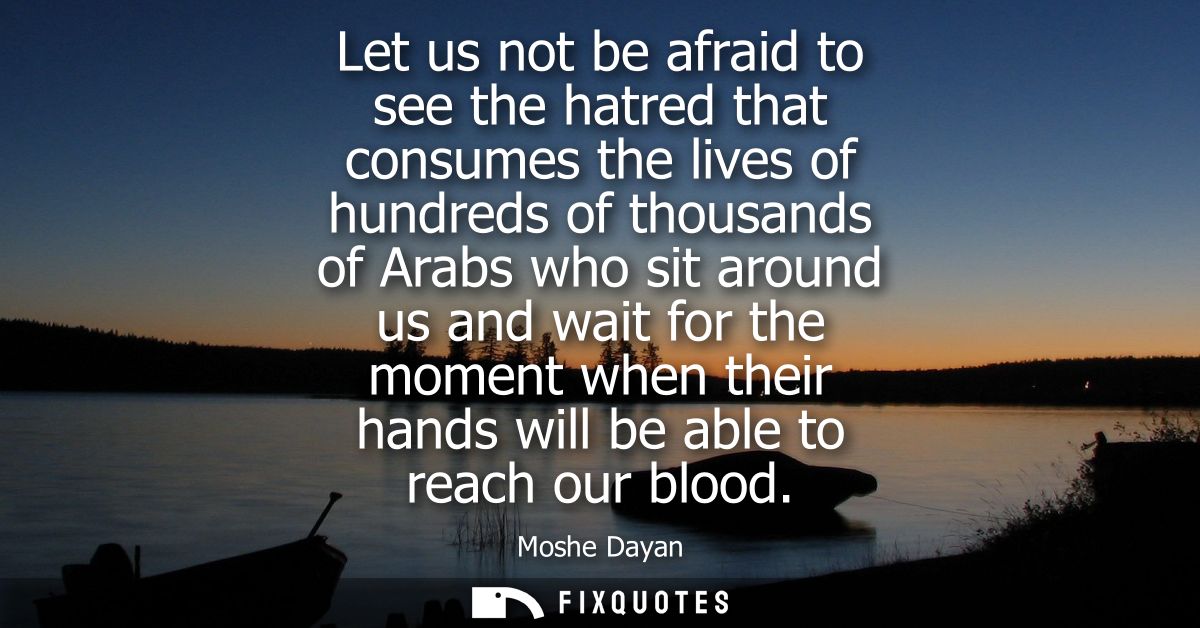
"Let us not be afraid to see the hatred that consumes the lives of hundreds of thousands of Arabs who sit around us and wait for the moment when their hands will be able to reach our blood"
About this Quote
Dayan isn’t asking his audience to feel; he’s ordering them to look. The first move is a moral inversion: “Let us not be afraid” frames clear-eyed suspicion as courage, implying that any softer reading of Arab intent is childish self-deception. Then comes the engine of the line: a totalizing portrait of “hundreds of thousands of Arabs” who “sit around us,” a geographic fact turned into a claustrophobic siege fantasy. The verbs do the political work. They “wait.” They “reach.” It’s patient, bodily, intimate violence - not an argument over borders or rights, but a scenario where the only relevant future is your blood in someone else’s hands.
The subtext is strategic. By casting hatred as the consuming force of Arab life, Dayan preempts empathy and narrows the policy menu: if the other side is defined by permanent, collective animus, then negotiation is theater and restraint becomes recklessness. The phrase “our blood” is tribal, almost liturgical; it fuses personal vulnerability with national identity, recruiting fear into solidarity.
Context matters because Dayan is speaking as a soldier-statesman shaped by Israel’s early decades - raids, reprisals, wars that made insecurity feel structural. His intent isn’t merely descriptive; it’s disciplinary. It trains a public to treat coexistence talk as dangerous naivete, and it supplies an alibi for hard power: we are not choosing aggression, we are choosing survival against an enemy already poised at the skin.
The subtext is strategic. By casting hatred as the consuming force of Arab life, Dayan preempts empathy and narrows the policy menu: if the other side is defined by permanent, collective animus, then negotiation is theater and restraint becomes recklessness. The phrase “our blood” is tribal, almost liturgical; it fuses personal vulnerability with national identity, recruiting fear into solidarity.
Context matters because Dayan is speaking as a soldier-statesman shaped by Israel’s early decades - raids, reprisals, wars that made insecurity feel structural. His intent isn’t merely descriptive; it’s disciplinary. It trains a public to treat coexistence talk as dangerous naivete, and it supplies an alibi for hard power: we are not choosing aggression, we are choosing survival against an enemy already poised at the skin.
Quote Details
| Topic | War |
|---|
More Quotes by Moshe
Add to List