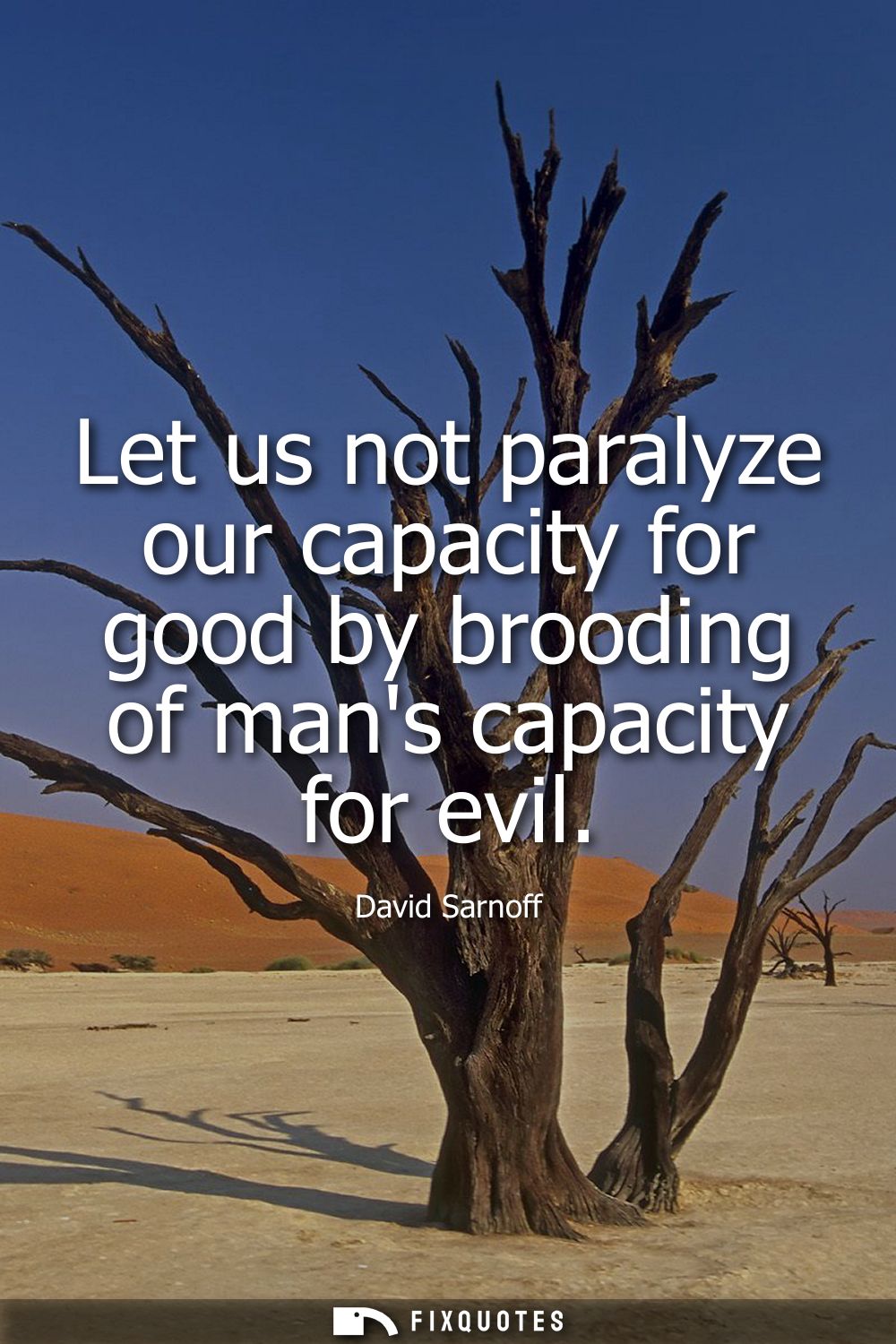
"Let us not paralyze our capacity for good, by brooding of man's capacity for evil"
About this Quote
The subtext is a defense of constructive optimism at a moment when the 20th century kept offering reasons to quit. Sarnoff wasn’t a cloistered philosopher; he helped shape mass communication, an arena where “man’s capacity for evil” is always a live wire: propaganda, panic, demagoguery, the weaponization of attention. A radio executive who lived through world wars, ideological mania, and the industrialization of violence would have understood how easily fear becomes a governing instrument. His warning isn’t naive; it’s strategic. If your imagination fixates on worst-case outcomes, you start pre-emptively censoring ambition, mistrusting institutions, and retreating into cynicism that feels like sophistication.
There’s also an implicit argument about responsibility in technological modernity: tools amplify whatever humans bring to them. Sarnoff’s intent is to keep the “capacity for good” in motion even when the news proves we’re capable of atrocity. It’s a rebuke to the posture of knowingness-the reflex to treat cynicism as moral seriousness. He’s insisting that goodness requires forward momentum, not perfect certainty.
Quote Details
| Topic | Optimism |
|---|---|
| Source | Help us find the source |
| Cite |
Citation Formats
APA Style (7th ed.)
Sarnoff, David. (2026, February 17). Let us not paralyze our capacity for good, by brooding of man's capacity for evil. FixQuotes. https://fixquotes.com/quotes/let-us-not-paralyze-our-capacity-for-good-by-2596/
Chicago Style
Sarnoff, David. "Let us not paralyze our capacity for good, by brooding of man's capacity for evil." FixQuotes. February 17, 2026. https://fixquotes.com/quotes/let-us-not-paralyze-our-capacity-for-good-by-2596/.
MLA Style (9th ed.)
"Let us not paralyze our capacity for good, by brooding of man's capacity for evil." FixQuotes, 17 Feb. 2026, https://fixquotes.com/quotes/let-us-not-paralyze-our-capacity-for-good-by-2596/. Accessed 16 Mar. 2026.