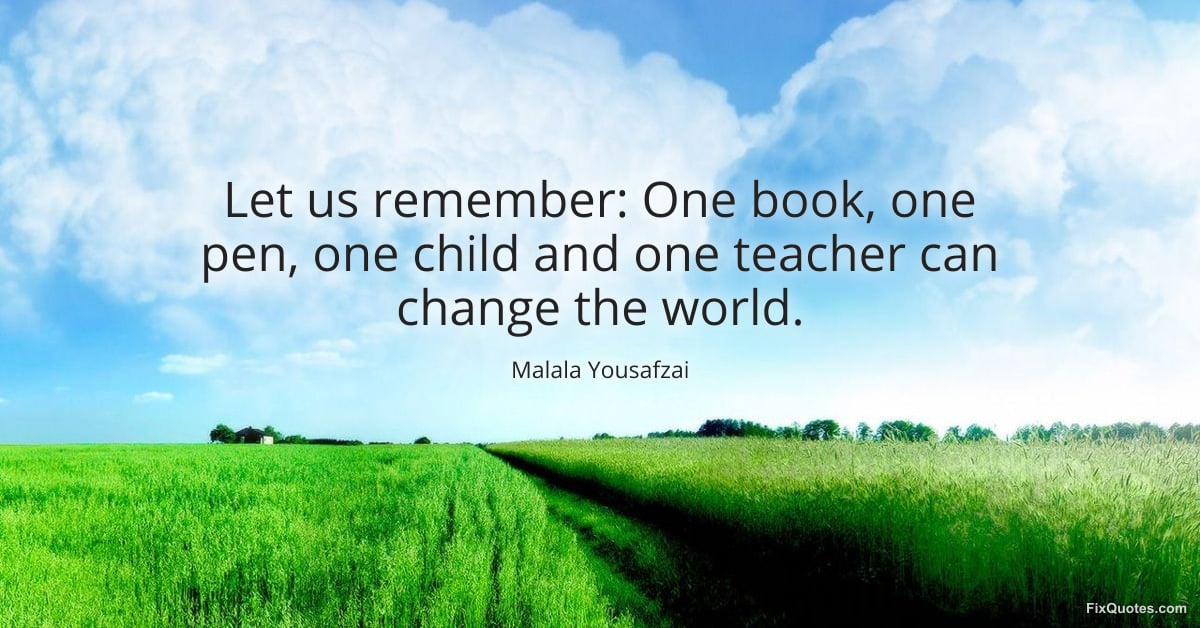
"Let us remember: One book, one pen, one child and one teacher can change the world"
About this Quote
That matters because her words arrive out of lived defiance, not motivational branding. She was targeted by the Taliban for going to school, which gives the sentence a deeper charge. In that context, a book and a pen are not bland symbols of self-improvement; they are threats to authoritarian control. The child is not a sentimental figure either, but a political subject. The teacher becomes more than an instructor - a frontline worker in the struggle over who gets to think, speak, and belong.
The phrasing also resists despair. "Change the world" is a grand claim, but the sentence gets there through modest objects and a single relationship between student and teacher. That is why it travels so well across cultures: it turns education into both a moral right and a practical instrument of liberation. Malala's subtext is clear without being cynical: if extremists fear classrooms, the rest of us should understand just how powerful they are.
Quote Details
| Topic | Teaching |
|---|---|
| Source | Nobel Lecture, Oslo, December 10, 2014 |
| Cite |
Citation Formats
APA Style (7th ed.)
Yousafzai, Malala. (2026, March 20). Let us remember: One book, one pen, one child and one teacher can change the world. FixQuotes. https://fixquotes.com/quotes/let-us-remember-one-book-one-pen-one-child-and-186172/
Chicago Style
Yousafzai, Malala. "Let us remember: One book, one pen, one child and one teacher can change the world." FixQuotes. March 20, 2026. https://fixquotes.com/quotes/let-us-remember-one-book-one-pen-one-child-and-186172/.
MLA Style (9th ed.)
"Let us remember: One book, one pen, one child and one teacher can change the world." FixQuotes, 20 Mar. 2026, https://fixquotes.com/quotes/let-us-remember-one-book-one-pen-one-child-and-186172/. Accessed 20 Mar. 2026.