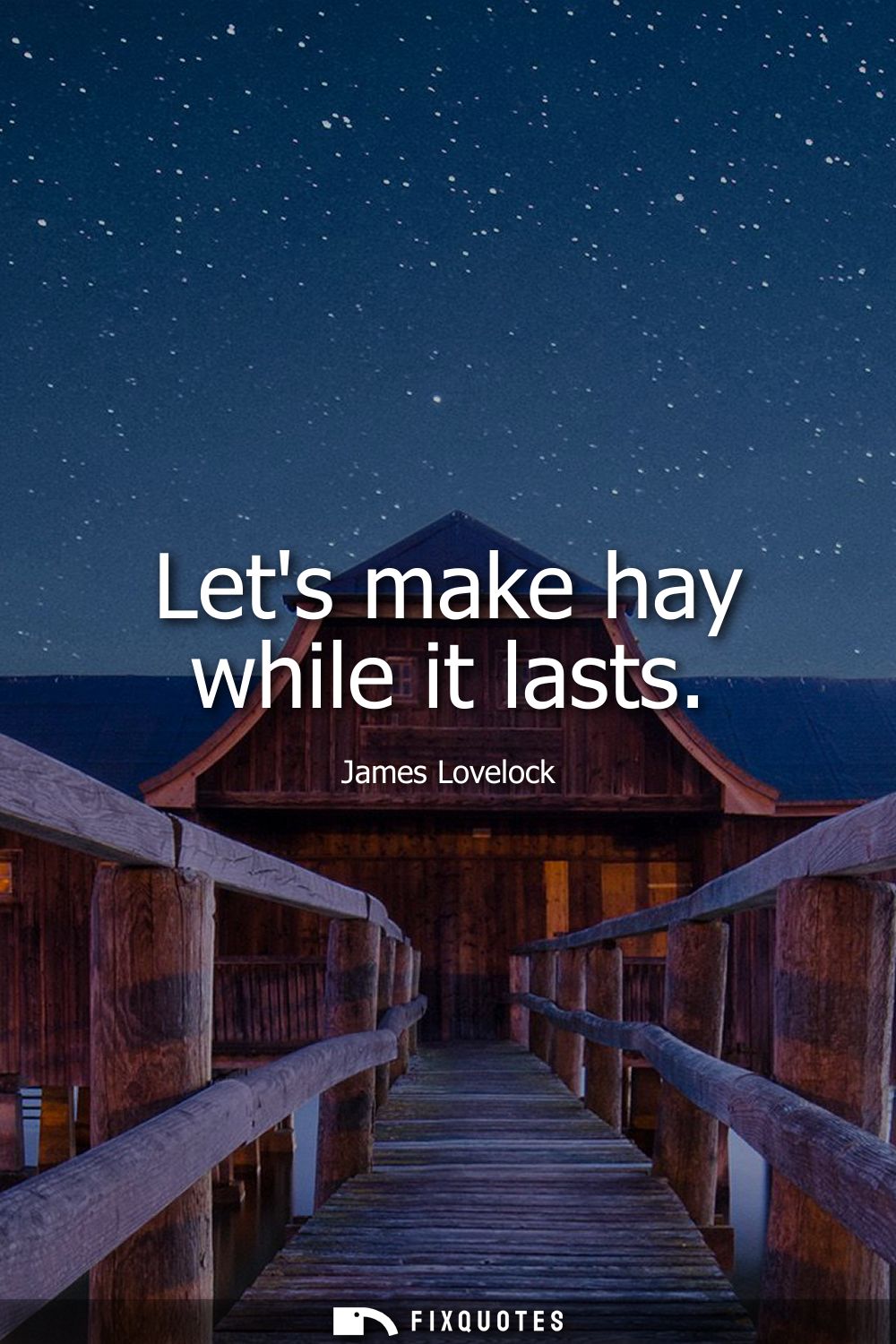
"Let's make hay while it lasts"
About this Quote
"Let's make hay while it lasts" lands with the breezy opportunism of a farm proverb, but in Lovelock's mouth it reads like a darkly efficient climate memo. He wasn't a lifestyle guru preaching hustle; he was the Gaia hypothesis scientist who spent decades warning that Earth behaves less like a passive backdrop and more like a self-regulating system that can, under stress, flip into a new state that doesn't particularly care about human comfort. The folksy cadence is the trick: it lowers your guard, then smuggles in a deadline.
The intent is pragmatic, almost unsentimental. "Make hay" implies work, not virtue. It isn't "save the planet" or "repent". It's: conditions are temporarily favorable; use them. The subtext is that the "it" is stability itself - predictable seasons, cheap energy, political slack, the luxury of slow reform. Lovelock often argued that climate change isn't a problem you solve once with a tidy policy package; it's a narrowing window where the rules of the game are still recognizable. After that, adaptation replaces ambition.
Contextually, it also carries a scientist's impatience with moral theater. He had a reputation for contrarian realism: skeptical of comforting narratives, wary of green utopianism, willing to entertain unpopular tools. The proverb format performs that worldview. It frames the future not as a grand project we control, but as weather: you don't negotiate with it, you watch it, and when the sun is out, you cut fast.
The intent is pragmatic, almost unsentimental. "Make hay" implies work, not virtue. It isn't "save the planet" or "repent". It's: conditions are temporarily favorable; use them. The subtext is that the "it" is stability itself - predictable seasons, cheap energy, political slack, the luxury of slow reform. Lovelock often argued that climate change isn't a problem you solve once with a tidy policy package; it's a narrowing window where the rules of the game are still recognizable. After that, adaptation replaces ambition.
Contextually, it also carries a scientist's impatience with moral theater. He had a reputation for contrarian realism: skeptical of comforting narratives, wary of green utopianism, willing to entertain unpopular tools. The proverb format performs that worldview. It frames the future not as a grand project we control, but as weather: you don't negotiate with it, you watch it, and when the sun is out, you cut fast.
Quote Details
| Topic | Live in the Moment |
|---|---|
| Source | Help us find the source |
| Cite |
Citation Formats
APA Style (7th ed.)
Lovelock, James. (2026, January 18). Let's make hay while it lasts. FixQuotes. https://fixquotes.com/quotes/lets-make-hay-while-it-lasts-18042/
Chicago Style
Lovelock, James. "Let's make hay while it lasts." FixQuotes. January 18, 2026. https://fixquotes.com/quotes/lets-make-hay-while-it-lasts-18042/.
MLA Style (9th ed.)
"Let's make hay while it lasts." FixQuotes, 18 Jan. 2026, https://fixquotes.com/quotes/lets-make-hay-while-it-lasts-18042/. Accessed 12 Feb. 2026.
More Quotes by James
Add to List