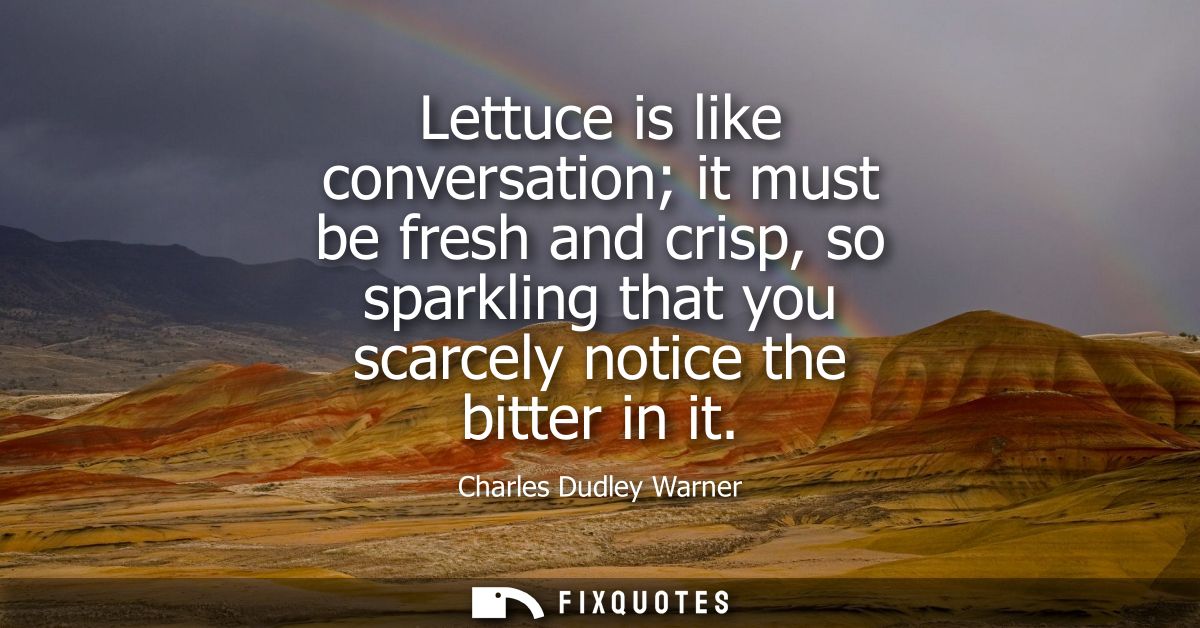
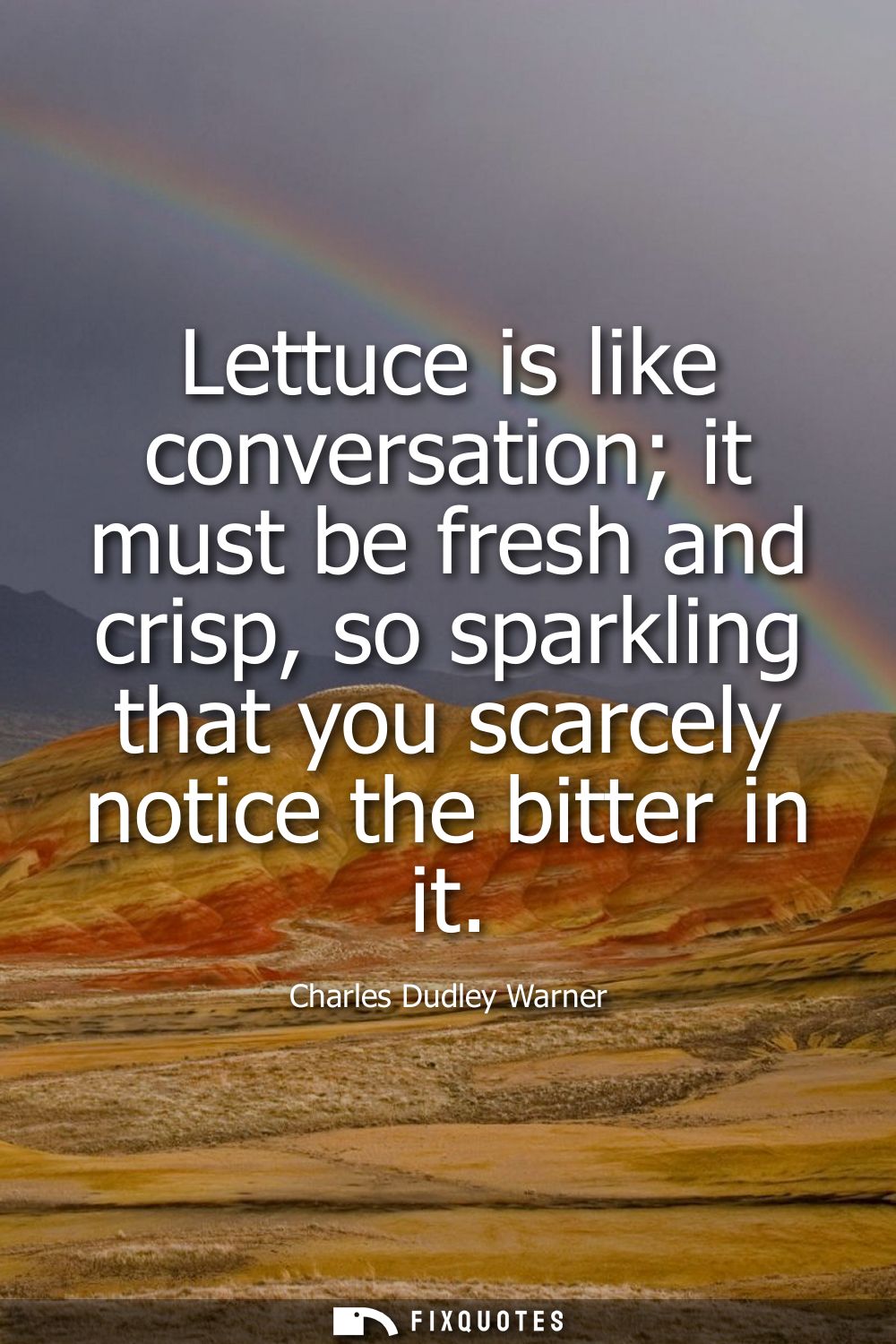
"Lettuce is like conversation; it must be fresh and crisp, so sparkling that you scarcely notice the bitter in it"
About this Quote
Warner’s line flatters polite talk while quietly skewering it: the best conversation, like lettuce, is mostly water and crunch, a disciplined emptiness that reads as virtue. “Fresh and crisp” signals the 19th-century ideal of sociable brightness - quick turns, light touch, no lingering odor of effort. He’s praising a style of speech that performs ease, “sparkling” enough that its sharper notes disappear on the tongue.
That last clause is the barb. He doesn’t deny bitterness; he assumes it’s inevitable. Conversation always contains envy, boredom, status anxiety, little stings of judgment. The trick, in Warner’s social world, is not to eliminate those flavors but to aerate them with charm until you “scarcely notice.” It’s a manual for civility that doubles as an indictment of it: we’re not being authentic, we’re being palatable. The metaphor makes small talk sound like salad-making, which is funny because it reduces high-minded “conversation” to something cultivated, rinsed, and served to please.
As a journalist in the Gilded Age, Warner watched public life professionalize into performance: drawing-room etiquette, political glad-handing, the rise of a media-savvy class. The quote reads like a knowing aside from someone paid to traffic in words yet suspicious of their social uses. His intent isn’t to romanticize talk; it’s to remind you that good conversation often succeeds by hiding its roughness, and that the very smoothness we admire can be a kind of dishonesty practiced in plain sight.
That last clause is the barb. He doesn’t deny bitterness; he assumes it’s inevitable. Conversation always contains envy, boredom, status anxiety, little stings of judgment. The trick, in Warner’s social world, is not to eliminate those flavors but to aerate them with charm until you “scarcely notice.” It’s a manual for civility that doubles as an indictment of it: we’re not being authentic, we’re being palatable. The metaphor makes small talk sound like salad-making, which is funny because it reduces high-minded “conversation” to something cultivated, rinsed, and served to please.
As a journalist in the Gilded Age, Warner watched public life professionalize into performance: drawing-room etiquette, political glad-handing, the rise of a media-savvy class. The quote reads like a knowing aside from someone paid to traffic in words yet suspicious of their social uses. His intent isn’t to romanticize talk; it’s to remind you that good conversation often succeeds by hiding its roughness, and that the very smoothness we admire can be a kind of dishonesty practiced in plain sight.
Quote Details
| Topic | Witty One-Liners |
|---|
More Quotes by Charles
Add to List