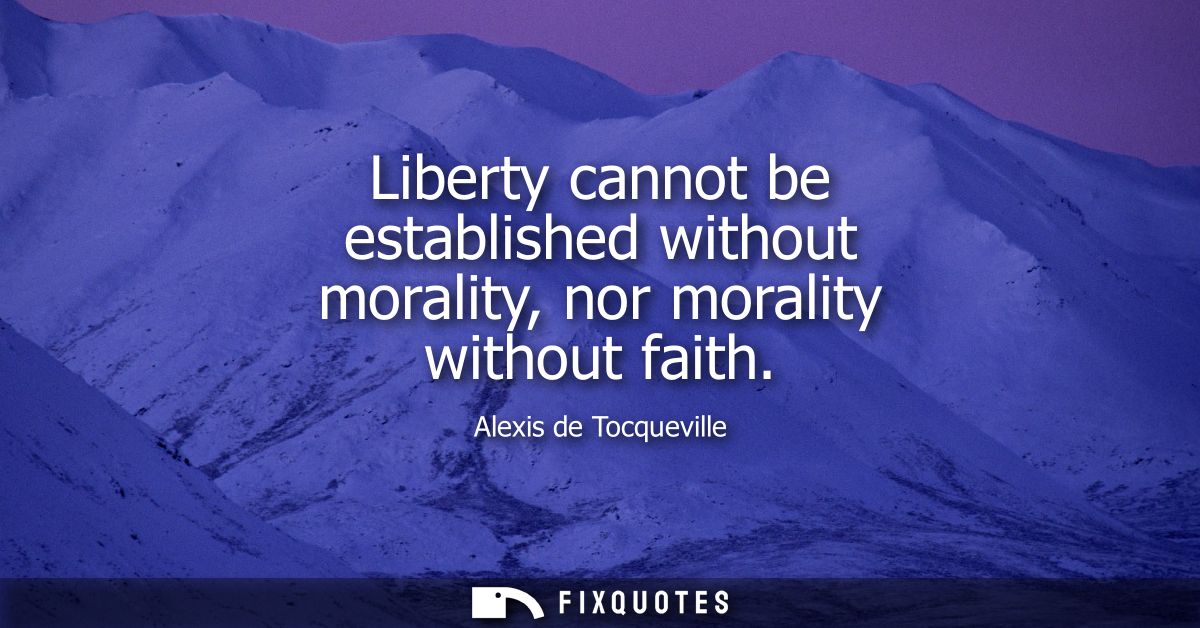
"Liberty cannot be established without morality, nor morality without faith"
About this Quote
The second clause is the sharper provocation. By arguing that morality can’t stand without faith, Tocqueville isn’t doing pious throat-clearing so much as diagnosing a social technology. In early 19th-century America, he saw religion functioning less as clerical domination than as a widely shared restraint: a set of beliefs that moved behavior when the policeman wasn’t looking and when public opinion wasn’t enough. Faith supplies transcendence, which supplies limits, which supplies trust - and trust is what lets citizens accept losing elections, paying taxes, and living next to people they dislike without reaching for coercion.
The subtext is anxious and strategic. Tocqueville feared democracy’s tendency toward individualism and material comfort could hollow out civic duty, leaving isolated citizens ripe for “soft despotism”: a paternal state that manages life precisely because society no longer manages itself. So the line isn’t nostalgia for altar-and-throne; it’s a warning that freedom is expensive. If you won’t pay with internal discipline and shared moral commitments, you’ll pay with control.
Quote Details
| Topic | Freedom |
|---|---|
| Source | Help us find the source |
| Cite |
Citation Formats
APA Style (7th ed.)
Tocqueville, Alexis de. (2026, January 15). Liberty cannot be established without morality, nor morality without faith. FixQuotes. https://fixquotes.com/quotes/liberty-cannot-be-established-without-morality-16721/
Chicago Style
Tocqueville, Alexis de. "Liberty cannot be established without morality, nor morality without faith." FixQuotes. January 15, 2026. https://fixquotes.com/quotes/liberty-cannot-be-established-without-morality-16721/.
MLA Style (9th ed.)
"Liberty cannot be established without morality, nor morality without faith." FixQuotes, 15 Jan. 2026, https://fixquotes.com/quotes/liberty-cannot-be-established-without-morality-16721/. Accessed 4 Mar. 2026.