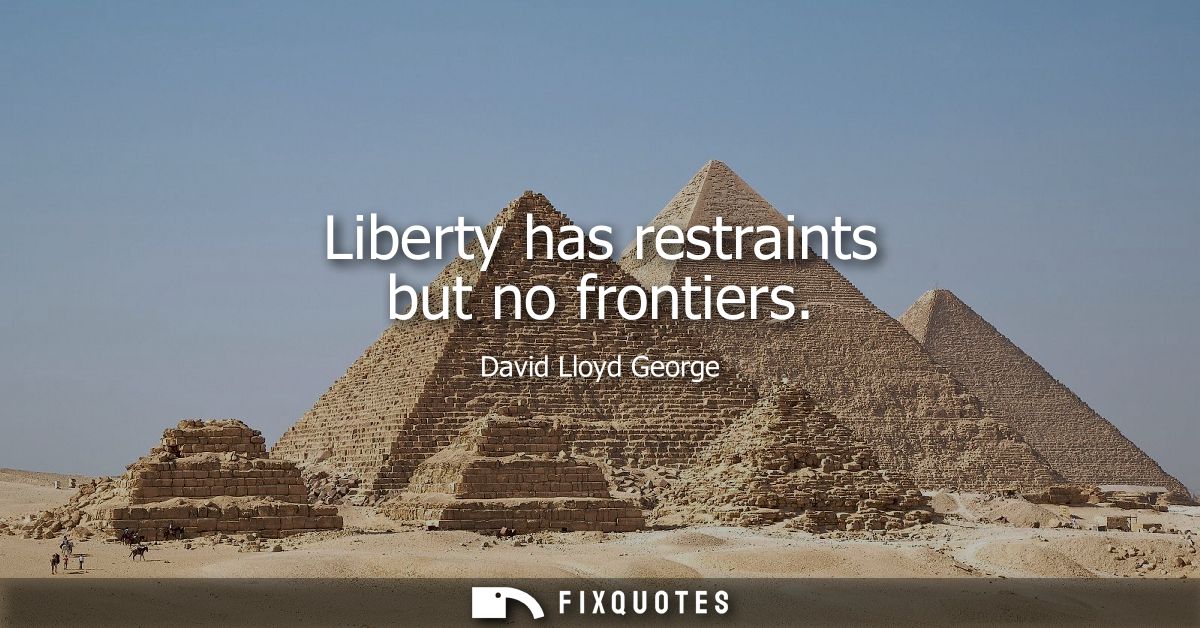
"Liberty has restraints but no frontiers"
About this Quote
Liberty is being sold here as both disciplined and expansive: a force you can fence in morally, but not wall off geographically. Lloyd George, a wartime prime minister and postwar negotiator, knew the double bind of early 20th-century liberalism. Britain was fighting a conflict pitched as a defense of freedom while governing an empire built on coercion. So the line performs a neat rhetorical dodge: it reassures domestic audiences that liberty is not license ("restraints") while keeping the concept available for export, intervention, and universal claims ("no frontiers").
The phrasing is doing quiet political work. "Restraints" suggests self-government, law, and civic responsibility - the kind of freedom that requires institutions and limits, not just slogans. It flatters a parliamentary audience: we are mature enough to regulate ourselves. Then "no frontiers" lifts liberty out of the nation-state, turning it into a moral currency that can justify action beyond borders. That can sound noble (solidarity with oppressed peoples), but it also contains the seed of mission creep: if liberty knows no frontiers, neither might the state's sense of obligation or entitlement to act in its name.
The subtext is strategic universalism. Lloyd George isn't dissolving borders so much as moralizing them: national boundaries may exist, but they should not be allowed to define whose freedom counts. In an era of nationalism and redrawn maps, the sentence tries to make liberal democracy feel like the only story big enough to survive the century's violence.
The phrasing is doing quiet political work. "Restraints" suggests self-government, law, and civic responsibility - the kind of freedom that requires institutions and limits, not just slogans. It flatters a parliamentary audience: we are mature enough to regulate ourselves. Then "no frontiers" lifts liberty out of the nation-state, turning it into a moral currency that can justify action beyond borders. That can sound noble (solidarity with oppressed peoples), but it also contains the seed of mission creep: if liberty knows no frontiers, neither might the state's sense of obligation or entitlement to act in its name.
The subtext is strategic universalism. Lloyd George isn't dissolving borders so much as moralizing them: national boundaries may exist, but they should not be allowed to define whose freedom counts. In an era of nationalism and redrawn maps, the sentence tries to make liberal democracy feel like the only story big enough to survive the century's violence.
Quote Details
| Topic | Freedom |
|---|---|
| Source | Help us find the source |
| Cite |
Citation Formats
APA Style (7th ed.)
George, David Lloyd. (2026, January 17). Liberty has restraints but no frontiers. FixQuotes. https://fixquotes.com/quotes/liberty-has-restraints-but-no-frontiers-38274/
Chicago Style
George, David Lloyd. "Liberty has restraints but no frontiers." FixQuotes. January 17, 2026. https://fixquotes.com/quotes/liberty-has-restraints-but-no-frontiers-38274/.
MLA Style (9th ed.)
"Liberty has restraints but no frontiers." FixQuotes, 17 Jan. 2026, https://fixquotes.com/quotes/liberty-has-restraints-but-no-frontiers-38274/. Accessed 30 Mar. 2026.
More Quotes by David
Add to List