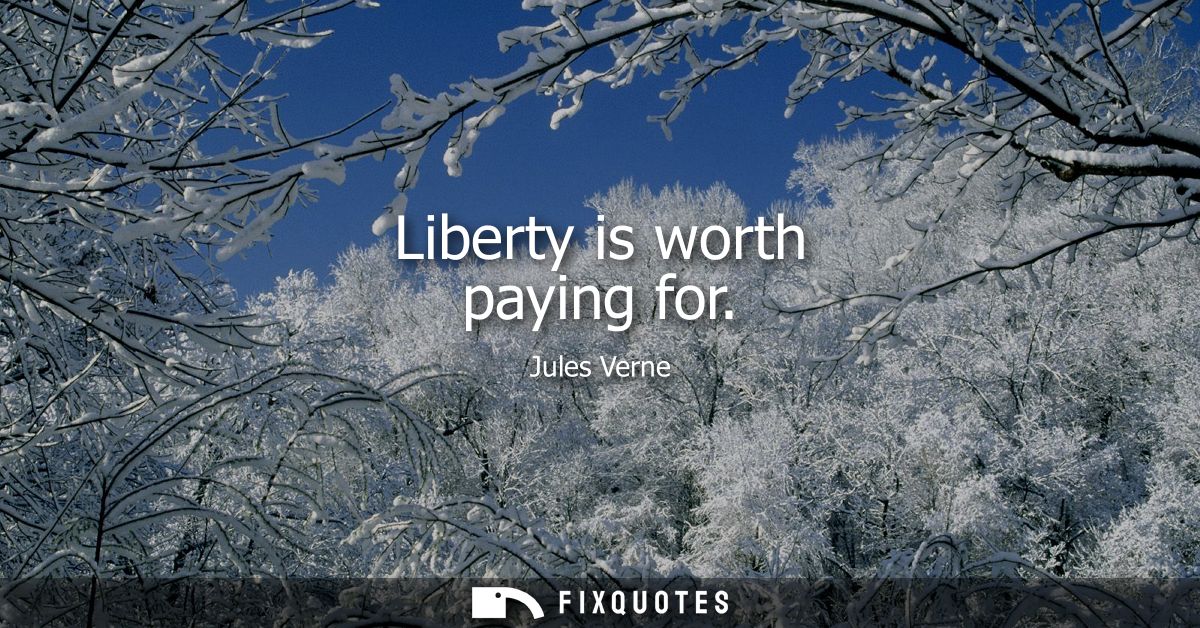
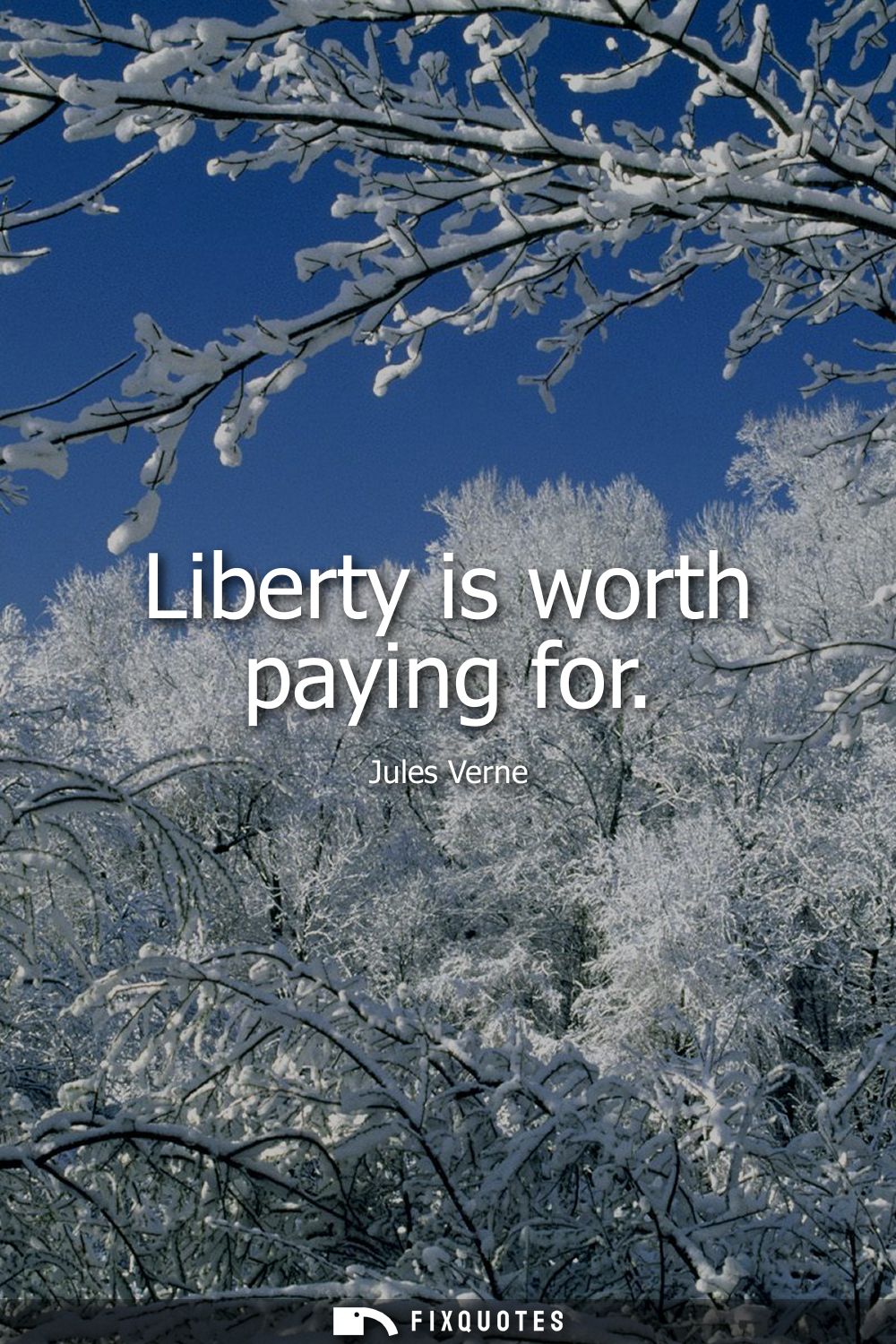
"Liberty is worth paying for"
About this Quote
Liberty is framed here not as a birthright you simply claim, but as an invoice you keep getting, whether you like the terms or not. Verne’s line works because it refuses the lazy romance of freedom as a glowing abstract and drags it into the world of budgets, risk, and sacrifice. “Worth paying for” turns politics into economics: liberty has a price tag, and the real question is whether a society has the appetite to keep funding it when the bill comes due in taxes, unrest, lost comfort, even blood.
The subtext is pointedly anti-naive. Verne wrote in a 19th-century Europe rattled by revolutions, imperial ambition, and rapid industrial change, where “progress” often arrived wearing a uniform or carrying a ledger. In that climate, liberty can’t be treated as the natural endpoint of history; it’s a fragile arrangement constantly threatened by those who promise security or greatness at a discount. The phrasing implies that cheaper alternatives exist - order, empire, compliance - but they’re false bargains that quietly compound interest in the form of repression.
As a novelist steeped in technological wonder and state-sponsored expeditions, Verne understood how easily modernity flatters power. His intent isn’t to glorify suffering; it’s to puncture complacency. The sentence is short, almost commercial, which is exactly why it stings: if you won’t pay for liberty up front, you’ll pay for its absence later, and the receipts are never refundable.
The subtext is pointedly anti-naive. Verne wrote in a 19th-century Europe rattled by revolutions, imperial ambition, and rapid industrial change, where “progress” often arrived wearing a uniform or carrying a ledger. In that climate, liberty can’t be treated as the natural endpoint of history; it’s a fragile arrangement constantly threatened by those who promise security or greatness at a discount. The phrasing implies that cheaper alternatives exist - order, empire, compliance - but they’re false bargains that quietly compound interest in the form of repression.
As a novelist steeped in technological wonder and state-sponsored expeditions, Verne understood how easily modernity flatters power. His intent isn’t to glorify suffering; it’s to puncture complacency. The sentence is short, almost commercial, which is exactly why it stings: if you won’t pay for liberty up front, you’ll pay for its absence later, and the receipts are never refundable.
Quote Details
| Topic | Freedom |
|---|---|
| Source | Help us find the source |
| Cite |
Citation Formats
APA Style (7th ed.)
Verne, Jules. (2026, January 18). Liberty is worth paying for. FixQuotes. https://fixquotes.com/quotes/liberty-is-worth-paying-for-8809/
Chicago Style
Verne, Jules. "Liberty is worth paying for." FixQuotes. January 18, 2026. https://fixquotes.com/quotes/liberty-is-worth-paying-for-8809/.
MLA Style (9th ed.)
"Liberty is worth paying for." FixQuotes, 18 Jan. 2026, https://fixquotes.com/quotes/liberty-is-worth-paying-for-8809/. Accessed 28 Mar. 2026.
More Quotes by Jules
Add to List