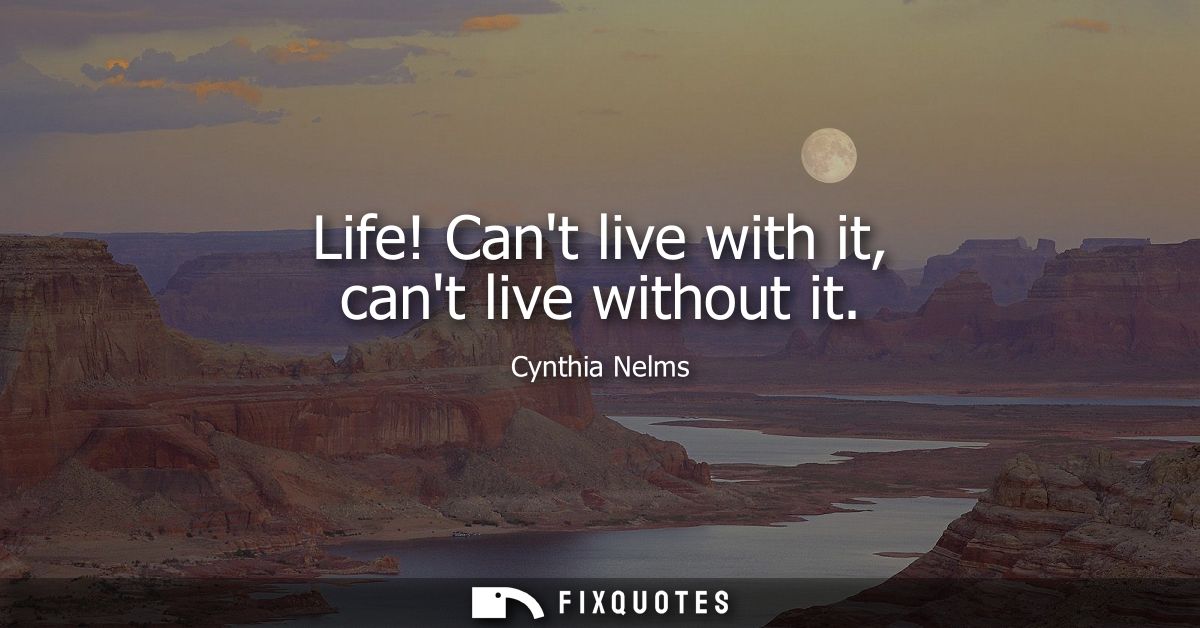
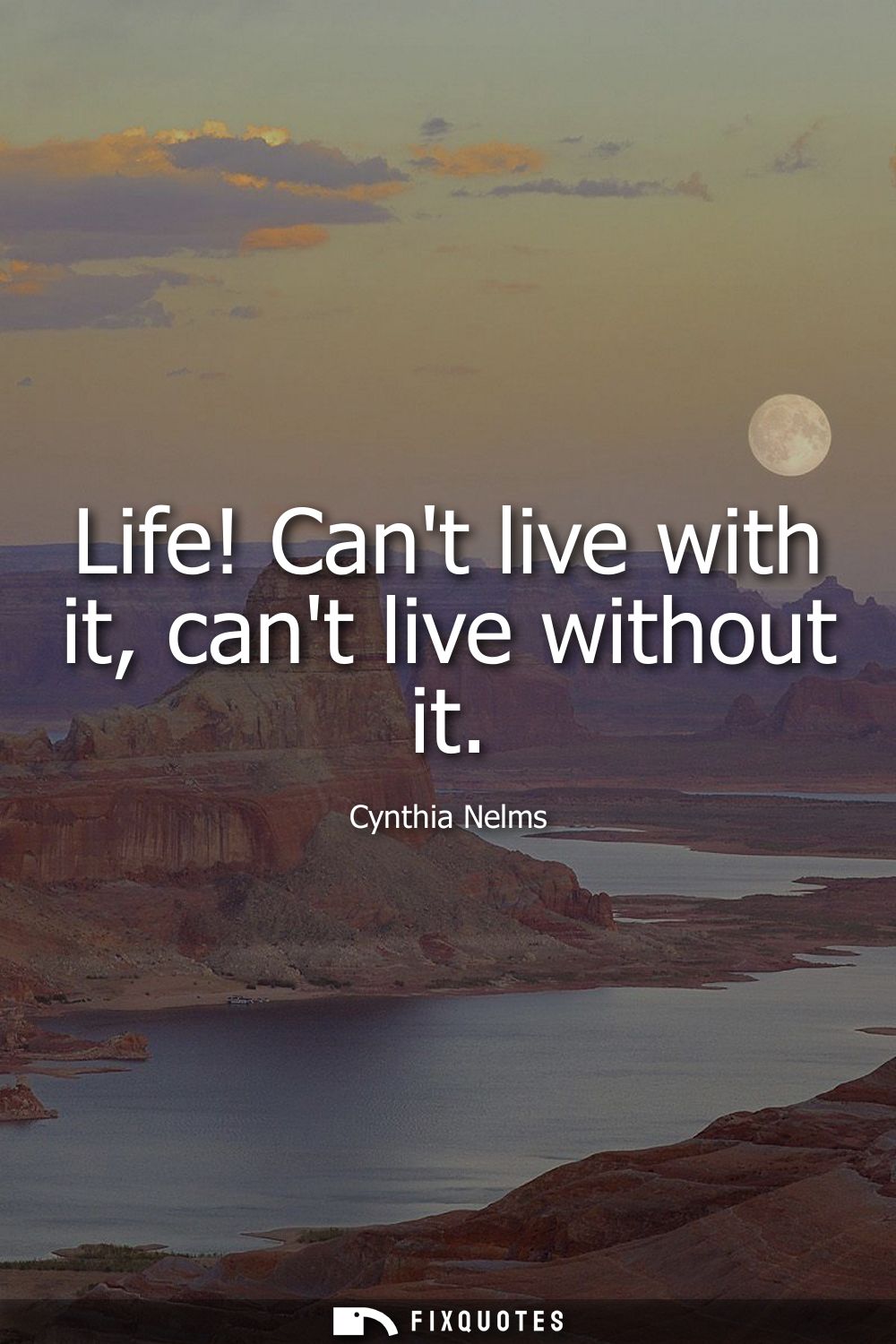
"Life! Can't live with it, can't live without it"
About this Quote
A sigh dressed up as a punchline, Cynthia Nelms' "Life! Can't live with it, can't live without it" turns existential dread into something you can say at the kitchen counter. The exclamation point does a lot of work: it frames "life" not as a gift or a quest, but as a demanding roommate. The line borrows the cadence of romantic complaint ("can't live with him...") and swaps in existence itself, which is why it lands. It takes a too-big subject and shrinks it to the scale of everyday annoyance.
The intent isn't philosophy so much as permission. Nelms gives readers a socially acceptable way to admit the contradiction at the heart of being alive: life is both the source of pain and the only arena where relief, pleasure, meaning, and change are possible. The joke is that the dilemma has no solution, so the only viable response is recognition - maybe even solidarity.
Subtextually, it's a defense against the cultural pressure to present living as either triumph (hustle optimism) or tragedy (doomscroll fatalism). Nelms threads a third path: ambivalence. The line allows for depression without melodrama, gratitude without sanctimony. It's also a miniature critique of self-help language; instead of promising control, it acknowledges the trap: you can't opt out, but you also can't fully opt in without complaint.
Context matters here because Nelms is a contemporary author writing into an era where burnout is normalized and irony is a survival skill. The quip is a coping mechanism that doubles as an honest appraisal: existence is mandatory, messy, and still, absurdly, worth keeping around.
The intent isn't philosophy so much as permission. Nelms gives readers a socially acceptable way to admit the contradiction at the heart of being alive: life is both the source of pain and the only arena where relief, pleasure, meaning, and change are possible. The joke is that the dilemma has no solution, so the only viable response is recognition - maybe even solidarity.
Subtextually, it's a defense against the cultural pressure to present living as either triumph (hustle optimism) or tragedy (doomscroll fatalism). Nelms threads a third path: ambivalence. The line allows for depression without melodrama, gratitude without sanctimony. It's also a miniature critique of self-help language; instead of promising control, it acknowledges the trap: you can't opt out, but you also can't fully opt in without complaint.
Context matters here because Nelms is a contemporary author writing into an era where burnout is normalized and irony is a survival skill. The quip is a coping mechanism that doubles as an honest appraisal: existence is mandatory, messy, and still, absurdly, worth keeping around.
Quote Details
| Topic | Life |
|---|---|
| Source | Help us find the source |
| Cite |
Citation Formats
APA Style (7th ed.)
Nelms, Cynthia. (2026, January 15). Life! Can't live with it, can't live without it. FixQuotes. https://fixquotes.com/quotes/life-cant-live-with-it-cant-live-without-it-110675/
Chicago Style
Nelms, Cynthia. "Life! Can't live with it, can't live without it." FixQuotes. January 15, 2026. https://fixquotes.com/quotes/life-cant-live-with-it-cant-live-without-it-110675/.
MLA Style (9th ed.)
"Life! Can't live with it, can't live without it." FixQuotes, 15 Jan. 2026, https://fixquotes.com/quotes/life-cant-live-with-it-cant-live-without-it-110675/. Accessed 8 Apr. 2026.
More Quotes by Cynthia
Add to List