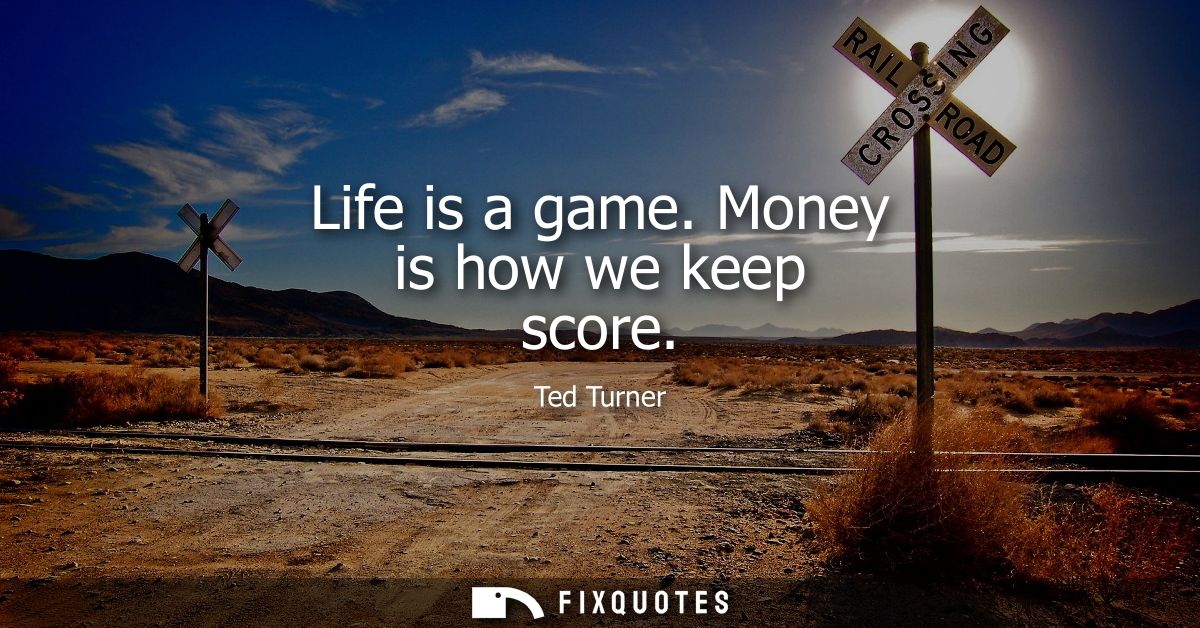
"Life is a game. Money is how we keep score"
About this Quote
Turner’s line has the blunt, boardroom candor of a man who helped turn attention into an industry. Calling life a “game” is not just a cute metaphor; it’s a declaration that the world is legible, winnable, and—crucially—measurable. Games have rules, rivals, and rankings. They reward risk-takers and punish hesitation. Turner, a businessman who built media empires by betting big, frames existence as competition with a scoreboard always visible.
“Money is how we keep score” narrows the field of human value to a single, quantifiable metric. The intent is both pragmatic and provocative: pragmatic because money is the most portable form of proof in a capitalist society, provocative because it dares you to argue with the clarity of numbers. The subtext is where it bites. If money is the score, then morality, craft, relationships, even public service become side quests unless they convert into financial outcomes. It’s a worldview that flatters winners as “high scorers” and quietly blames losers for losing, as if structural inequality were just poor strategy.
The line also works as a cultural tell from late-20th-century American triumphalism, when markets were treated as merit machines and tycoons became folk heroes. Turner isn’t describing life so much as selling a philosophy: adopt the game mentality, accept the scoreboard, and you’ll stop asking whether the rules are fair. That’s the power—and the danger—of making money the only language that counts.
“Money is how we keep score” narrows the field of human value to a single, quantifiable metric. The intent is both pragmatic and provocative: pragmatic because money is the most portable form of proof in a capitalist society, provocative because it dares you to argue with the clarity of numbers. The subtext is where it bites. If money is the score, then morality, craft, relationships, even public service become side quests unless they convert into financial outcomes. It’s a worldview that flatters winners as “high scorers” and quietly blames losers for losing, as if structural inequality were just poor strategy.
The line also works as a cultural tell from late-20th-century American triumphalism, when markets were treated as merit machines and tycoons became folk heroes. Turner isn’t describing life so much as selling a philosophy: adopt the game mentality, accept the scoreboard, and you’ll stop asking whether the rules are fair. That’s the power—and the danger—of making money the only language that counts.
Quote Details
| Topic | Money |
|---|---|
| Source | Verified source: Sports Illustrated: Going Real Strawwng (Ted Turner, 1978)
Evidence: Life is a game, but the way to keep score is money.. This is the earliest primary publication instance I could verify online. It appears in a Sports Illustrated profile of Ted Turner dated August 21, 1978, presented as a direct quote (“who says,” followed by the quote). This wording is extremely close to the commonly-circulated variant “Life is a game. Money is how we keep score.” I was not able (in web-accessible primary sources) to find an earlier instance of the exact two-sentence wording, nor to confirm a first appearance in Turner’s own book/speech/interview transcript. A later, commonly cited venue is a Playboy profile/interview associated with the August 1983 issue, but I did not locate a primary text scan/transcript confirming the exact quote wording there. Other candidates (1) Uncle John's Bathroom Reader Quintessential Collection of... (Bathroom Readers' Institute, 2012) compilation95.0% ... Life is a game . Money is how we keep score . " -Garth Brooks -Ted Turner " The person who does not know how to l... |
| Cite |
Citation Formats
APA Style (7th ed.)
Turner, Ted. (2026, February 10). Life is a game. Money is how we keep score. FixQuotes. https://fixquotes.com/quotes/life-is-a-game-money-is-how-we-keep-score-121885/
Chicago Style
Turner, Ted. "Life is a game. Money is how we keep score." FixQuotes. February 10, 2026. https://fixquotes.com/quotes/life-is-a-game-money-is-how-we-keep-score-121885/.
MLA Style (9th ed.)
"Life is a game. Money is how we keep score." FixQuotes, 10 Feb. 2026, https://fixquotes.com/quotes/life-is-a-game-money-is-how-we-keep-score-121885/. Accessed 30 Mar. 2026.
More Quotes by Ted
Add to List