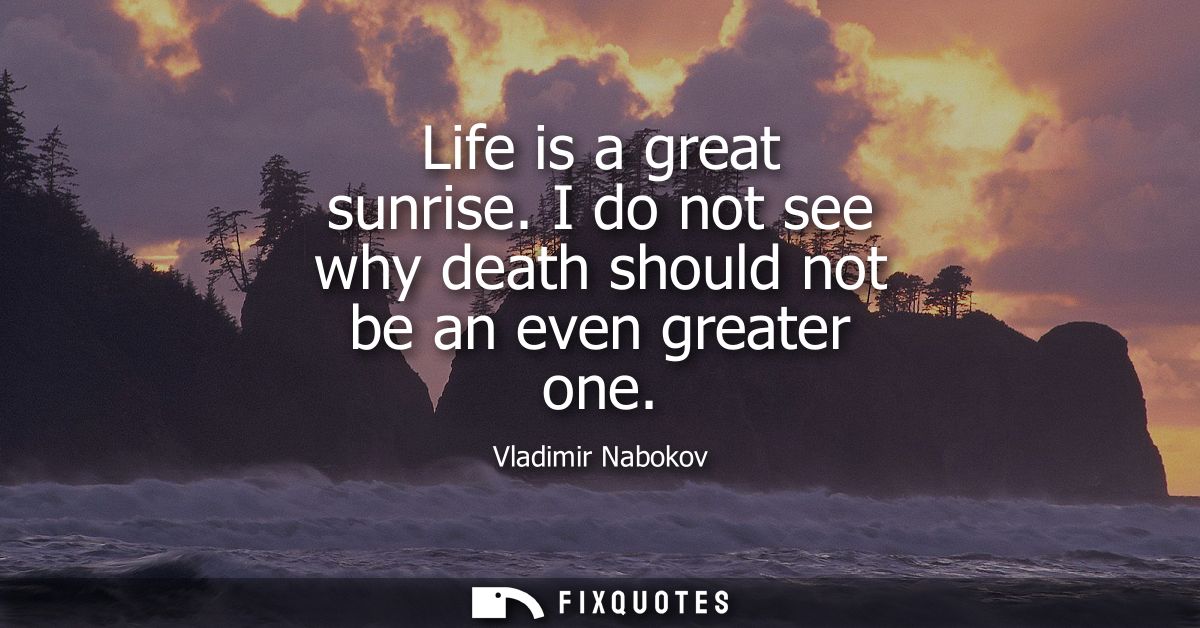
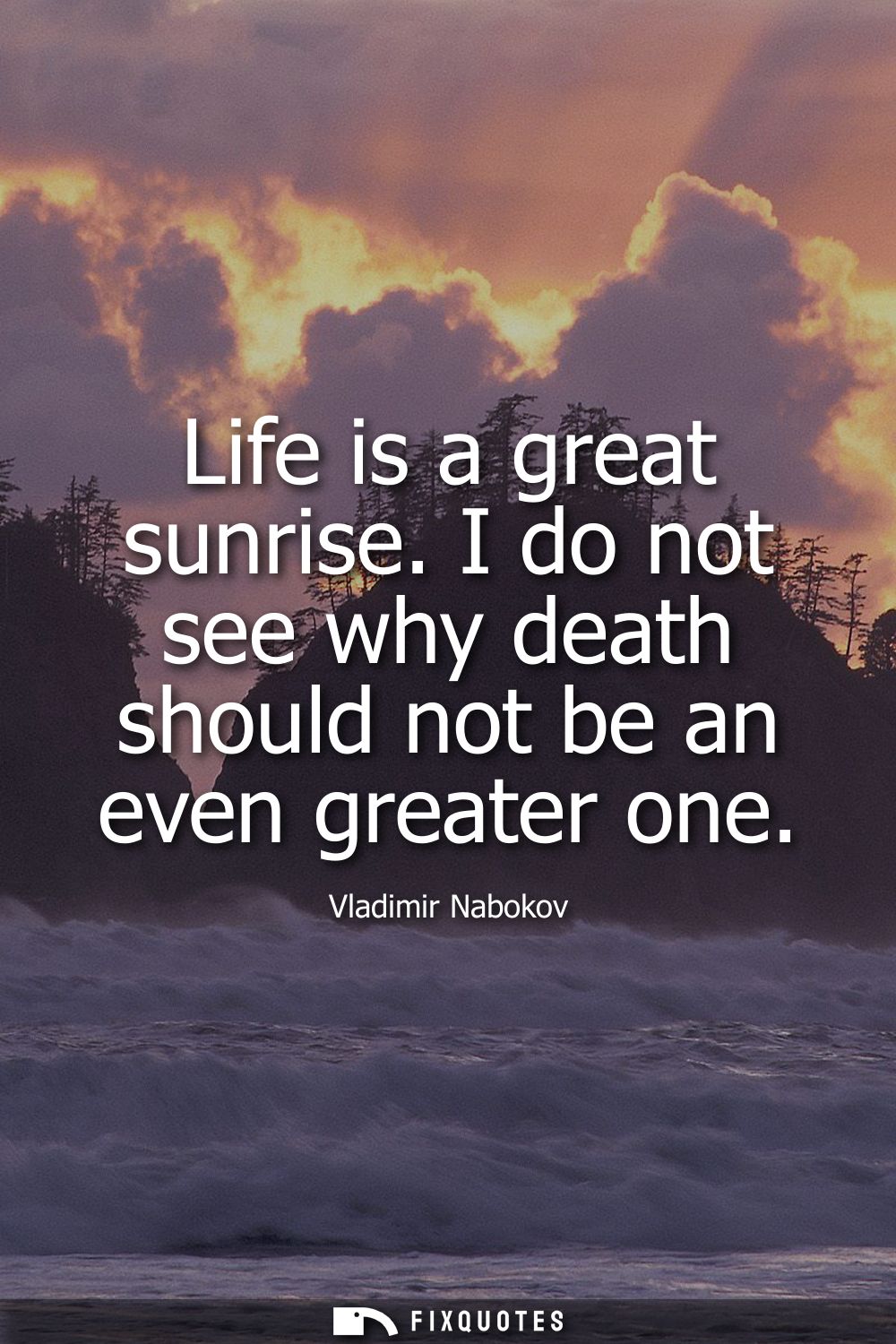
"Life is a great sunrise. I do not see why death should not be an even greater one"
About this Quote
The subtext is both defiance and style. Nabokov hated the idea of being reduced to a moral lesson, yet he also refused the modern habit of treating mortality as a purely clinical shutdown. By framing death as “an even greater” sunrise, he flips the typical metaphor (death as sunset) and turns the end of consciousness into an expansion rather than a diminishment. It’s an aesthetic argument: our terror may be less a fact than a failure of imagination, a refusal to grant the unknown any beauty.
Context matters. Nabokov was an exile twice over, a man whose life was violently interrupted by history, and whose art fixated on perception - the bright, exacting pleasures of seeing. The line reads like an artist’s last gambit: if existence is measured by luminosity, then perhaps the final threshold deserves the most daring image available.
Quote Details
| Topic | Mortality |
|---|---|
| Source | Evidence:
... Life is a great sunrise . I do not see why death should not be an even greater one . ” - Vladimir Nabokov " When we remember we are all mad , the mysteries disappear and life stands explained . " Mark Twain " Never be bullied into ... |
| Cite |
Citation Formats
APA Style (7th ed.)
Nabokov, Vladimir. (2026, March 15). Life is a great sunrise. I do not see why death should not be an even greater one. FixQuotes. https://fixquotes.com/quotes/life-is-a-great-sunrise-i-do-not-see-why-death-10610/
Chicago Style
Nabokov, Vladimir. "Life is a great sunrise. I do not see why death should not be an even greater one." FixQuotes. March 15, 2026. https://fixquotes.com/quotes/life-is-a-great-sunrise-i-do-not-see-why-death-10610/.
MLA Style (9th ed.)
"Life is a great sunrise. I do not see why death should not be an even greater one." FixQuotes, 15 Mar. 2026, https://fixquotes.com/quotes/life-is-a-great-sunrise-i-do-not-see-why-death-10610/. Accessed 3 Apr. 2026.