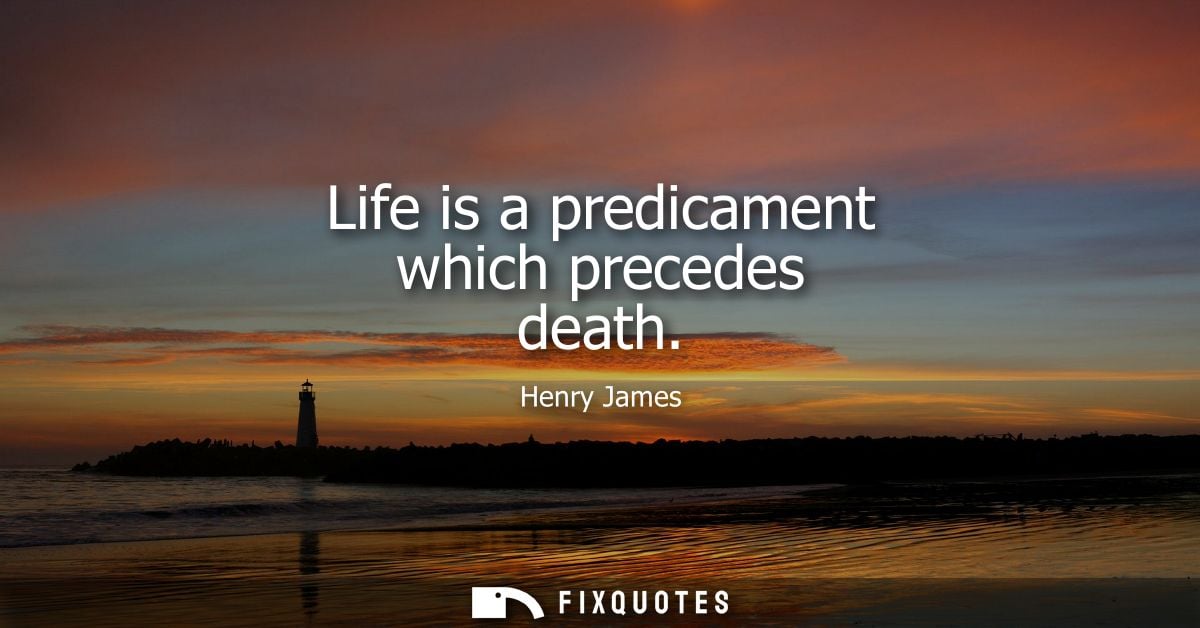
"Life is a predicament which precedes death"
About this Quote
Henry James treats existence less like a grand adventure than a social situation you’ve already mishandled by the time you arrive. Calling life a “predicament” drains it of the sentimental glow Victorian culture loved to drape over it. A predicament isn’t tragedy with trumpets; it’s the tight, humiliating fix you can’t elegantly talk your way out of. That word choice is classic James: psychological realism with a faintly comic chill, the sense that the soul’s real drama happens in cramped parlors and inside half-spoken sentences.
The verb “precedes” does quiet work. It refuses consolation, but it also refuses melodrama. Death isn’t a punishment or a moral climax; it’s simply the next appointment on the calendar. Life becomes the awkward interval before the inevitable, a stretch of time defined not by heroic meaning but by constraint, choice, misreading, and consequence. In James’s world, people don’t just suffer; they negotiate, and they often negotiate badly. That’s the predicament: consciousness itself, the burden of perceiving too much and acting too late.
Context matters. James wrote amid the late-19th-century shift from religious certainty to modern doubt, and alongside the rise of the novel as an instrument for mapping interior life. The line reads like an anti-epigraph to the American self-help creed. It suggests adulthood is learning that freedom is partial, motives are mixed, and “living” often feels like managing the fallout of simply being here.
The verb “precedes” does quiet work. It refuses consolation, but it also refuses melodrama. Death isn’t a punishment or a moral climax; it’s simply the next appointment on the calendar. Life becomes the awkward interval before the inevitable, a stretch of time defined not by heroic meaning but by constraint, choice, misreading, and consequence. In James’s world, people don’t just suffer; they negotiate, and they often negotiate badly. That’s the predicament: consciousness itself, the burden of perceiving too much and acting too late.
Context matters. James wrote amid the late-19th-century shift from religious certainty to modern doubt, and alongside the rise of the novel as an instrument for mapping interior life. The line reads like an anti-epigraph to the American self-help creed. It suggests adulthood is learning that freedom is partial, motives are mixed, and “living” often feels like managing the fallout of simply being here.
Quote Details
| Topic | Mortality |
|---|---|
| Source | Later attribution: Humorous Wit (Djamel Ouis, 2020) modern compilationISBN: 9781782225829 · ID: c7zXDwAAQBAJ
Evidence:
... Life is a predicament which precedes death. Henry James Life's too short for chess. Henry James The great use of life is to spend it for something that will outlast it. William James Life: a race against death ... The best one doesn't ... |
| Cite |
Citation Formats
APA Style (7th ed.)
James, Henry. (2026, February 15). Life is a predicament which precedes death. FixQuotes. https://fixquotes.com/quotes/life-is-a-predicament-which-precedes-death-60418/
Chicago Style
James, Henry. "Life is a predicament which precedes death." FixQuotes. February 15, 2026. https://fixquotes.com/quotes/life-is-a-predicament-which-precedes-death-60418/.
MLA Style (9th ed.)
"Life is a predicament which precedes death." FixQuotes, 15 Feb. 2026, https://fixquotes.com/quotes/life-is-a-predicament-which-precedes-death-60418/. Accessed 3 Apr. 2026.
More Quotes by Henry
Add to List