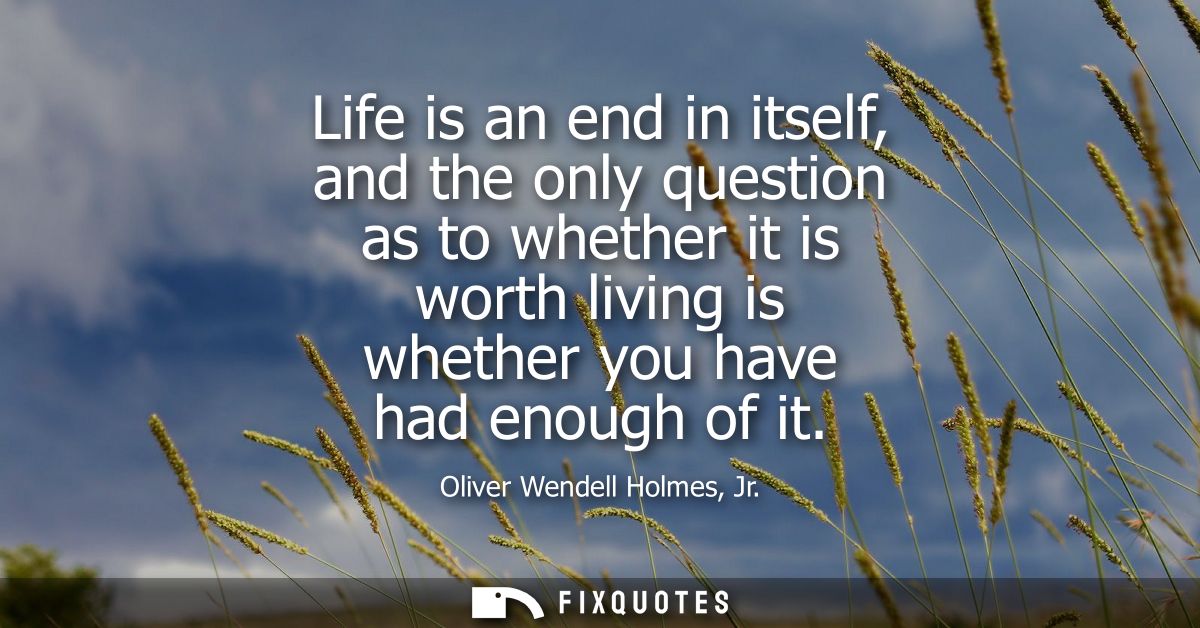
"Life is an end in itself, and the only question as to whether it is worth living is whether you have had enough of it"
About this Quote
The syntax is a quiet dare. Calling life “an end in itself” strips away comforting teleology - no cosmic mission statement, no moral accounting that guarantees the effort pays out. Then he reduces the supposedly grand philosophical question (“is it worth living?”) to something almost physical: appetite, saturation, “enough.” It’s a deliberately deflating move, and it lands because it treats the debate as less metaphysical than psychological. The subtext is that many arguments about “worth” are really arguments about fatigue, boredom, trauma, or disappointment - states the law can’t redeem and philosophy often romanticizes.
Context matters: Holmes was a skeptic about absolutes, famously wary of turning personal certainties into public coercion. Read that way, the quote also resists the culture’s demand for performance-purpose. You don’t have to justify existence with productivity or virtue. The only honest metric is whether you still want it. It’s bracing, even a little ruthless, but it’s also quietly liberating: life isn’t a case to be proven; it’s an experience you either continue to consent to or you don’t.
Quote Details
| Topic | Meaning of Life |
|---|---|
| Source | Help us find the source |
| Cite |
Citation Formats
APA Style (7th ed.)
Jr., Oliver Wendell Holmes. (2026, January 16). Life is an end in itself, and the only question as to whether it is worth living is whether you have had enough of it. FixQuotes. https://fixquotes.com/quotes/life-is-an-end-in-itself-and-the-only-question-as-90102/
Chicago Style
Jr., Oliver Wendell Holmes. "Life is an end in itself, and the only question as to whether it is worth living is whether you have had enough of it." FixQuotes. January 16, 2026. https://fixquotes.com/quotes/life-is-an-end-in-itself-and-the-only-question-as-90102/.
MLA Style (9th ed.)
"Life is an end in itself, and the only question as to whether it is worth living is whether you have had enough of it." FixQuotes, 16 Jan. 2026, https://fixquotes.com/quotes/life-is-an-end-in-itself-and-the-only-question-as-90102/. Accessed 2 Apr. 2026.