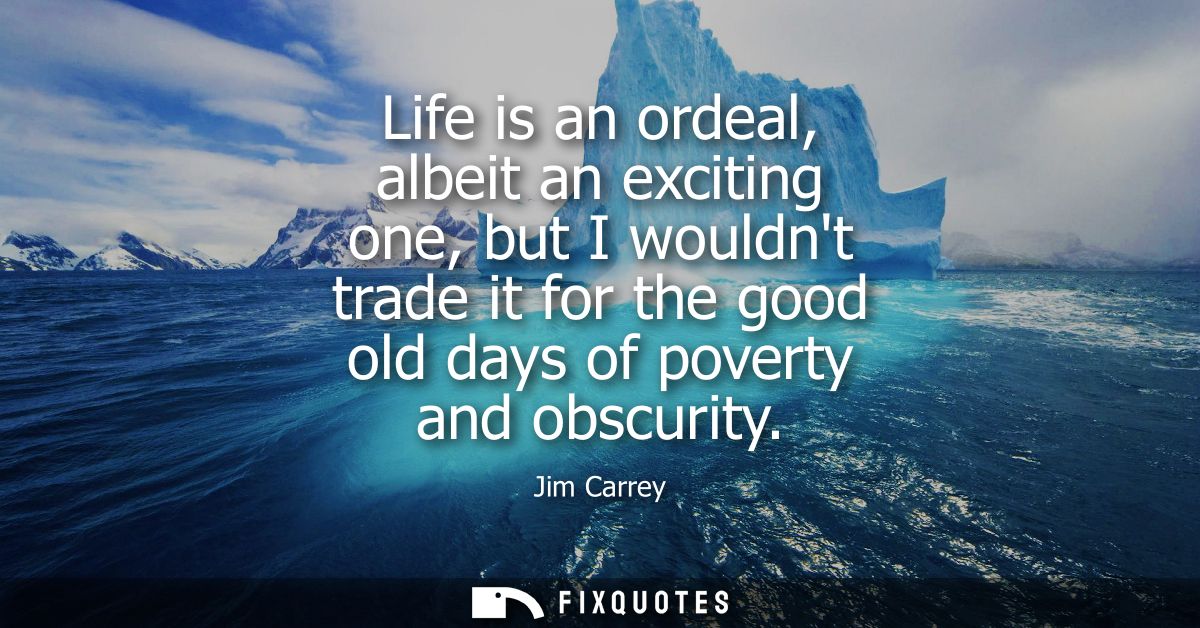
"Life is an ordeal, albeit an exciting one, but I wouldn't trade it for the good old days of poverty and obscurity"
About this Quote
The real sting is in “the good old days of poverty and obscurity.” That’s a jab at nostalgia culture, the kind that romanticizes struggle as if being broke was a charming aesthetic rather than a grinding limit on choices. Carrey’s sarcasm is protective: it keeps him from sounding ungrateful while also refusing the moralizing trope that hardship builds character in some pure, redeeming way. The “good old days” aren’t good - they’re just familiar, and people love familiar.
Context matters because Carrey’s persona has always been elasticity: the rubber-faced comedian who turns discomfort into spectacle. Here, he’s doing a quieter version of that act, stretching between two truths that rarely get to share a stage. Success doesn’t cancel suffering, but poverty isn’t a spiritual cleanse either. The subtext reads like a warning to both audiences: don’t assume money fixes you, and don’t pretend lack is noble.
Quote Details
| Topic | Life |
|---|---|
| Source | Help us find the source |
| Cite |
Citation Formats
APA Style (7th ed.)
Carrey, Jim. (2026, January 18). Life is an ordeal, albeit an exciting one, but I wouldn't trade it for the good old days of poverty and obscurity. FixQuotes. https://fixquotes.com/quotes/life-is-an-ordeal-albeit-an-exciting-one-but-i-7765/
Chicago Style
Carrey, Jim. "Life is an ordeal, albeit an exciting one, but I wouldn't trade it for the good old days of poverty and obscurity." FixQuotes. January 18, 2026. https://fixquotes.com/quotes/life-is-an-ordeal-albeit-an-exciting-one-but-i-7765/.
MLA Style (9th ed.)
"Life is an ordeal, albeit an exciting one, but I wouldn't trade it for the good old days of poverty and obscurity." FixQuotes, 18 Jan. 2026, https://fixquotes.com/quotes/life-is-an-ordeal-albeit-an-exciting-one-but-i-7765/. Accessed 3 Apr. 2026.