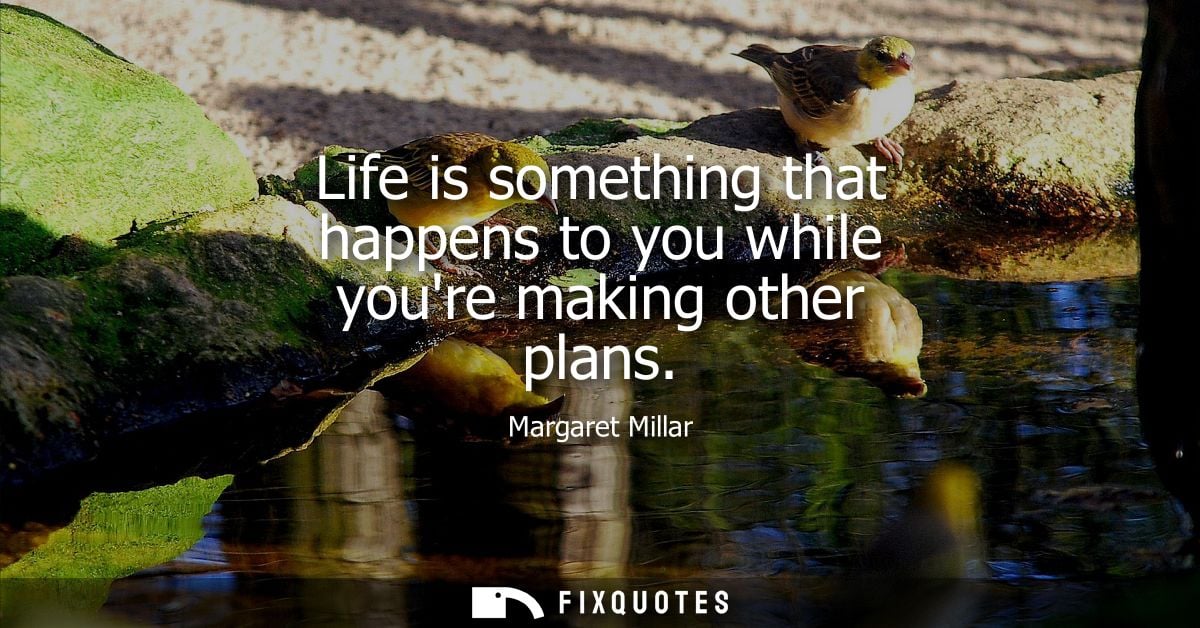
"Life is something that happens to you while you're making other plans"
About this Quote
The subtext isn’t anti-ambition so much as anti-illusion. Plans are not condemned for being plans; they’re indicted for being a form of procrastination dressed as prudence. The quote needles a certain middle-class faith in scheduling as virtue, in deferred living as responsibility. It suggests that the real plot is running off-camera while you polish your outline.
Context matters: Millar wrote psychological suspense where ordinary surfaces conceal volatile interiors. Her characters often build tidy narratives about themselves, then watch them collapse under pressure, coincidence, desire. Read through that lens, the quote becomes a warning about narrative blindness: the human tendency to treat contingency as an interruption rather than the main event.
It also works because it’s scalable. It fits the small tragedies (a friendship neglected, a child suddenly grown) and the large ones (illness, economic shock, war) without changing a word. That portability is the trick: it feels like a truism until you realize it’s a rebuke, aimed at anyone who confuses preparation with living.
Quote Details
| Topic | Live in the Moment |
|---|---|
| Source | Help us find the source |
| Cite |
Citation Formats
APA Style (7th ed.)
Millar, Margaret. (2026, January 15). Life is something that happens to you while you're making other plans. FixQuotes. https://fixquotes.com/quotes/life-is-something-that-happens-to-you-while-youre-169207/
Chicago Style
Millar, Margaret. "Life is something that happens to you while you're making other plans." FixQuotes. January 15, 2026. https://fixquotes.com/quotes/life-is-something-that-happens-to-you-while-youre-169207/.
MLA Style (9th ed.)
"Life is something that happens to you while you're making other plans." FixQuotes, 15 Jan. 2026, https://fixquotes.com/quotes/life-is-something-that-happens-to-you-while-youre-169207/. Accessed 12 Feb. 2026.