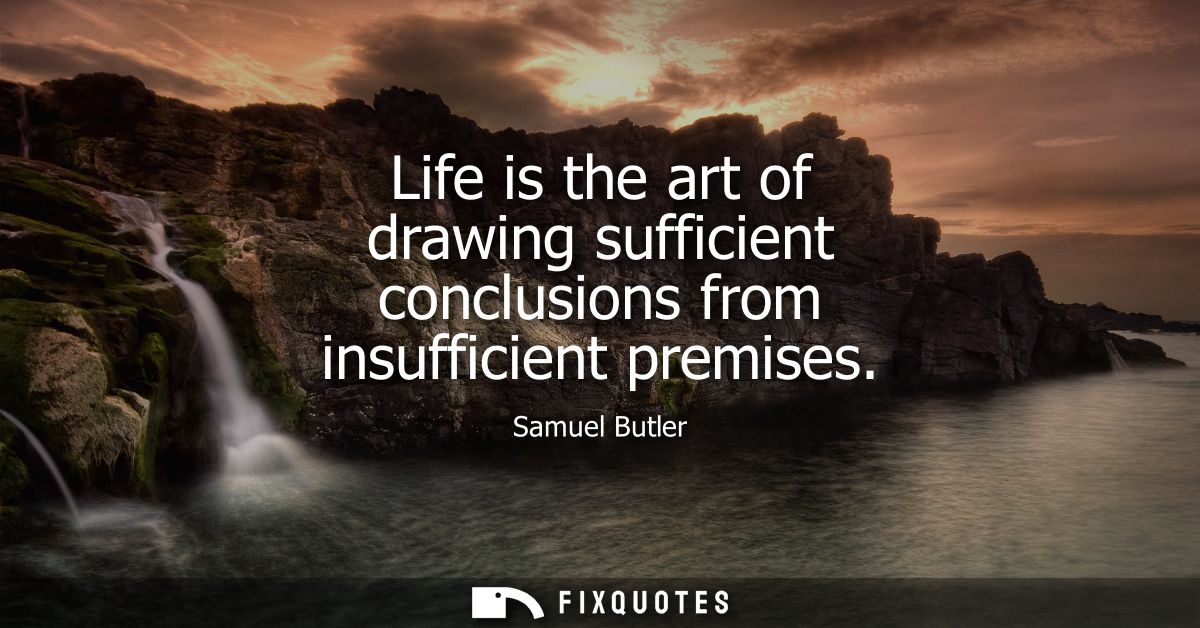
"Life is the art of drawing sufficient conclusions from insufficient premises"
About this Quote
The subtext has teeth. Butler frames everyday reasoning as a creative act, which flatters human ingenuity while quietly exposing its fragility. “Insufficient premises” suggests not only limited information but compromised starting points: biased upbringing, shaky memories, inherited dogma, social pressure. In that sense, the quote isn’t just epistemology; it’s cultural critique. The world hands you a partial script and demands a convincing performance.
Context matters, too. Butler wrote against the grain of his era’s confidence in progress, systems, and moral certainties. Victorian Britain loved its grand explanations - religious, scientific, imperial. Butler, skeptical of received truths (including orthodox Christianity and simple Darwinian triumphalism), turns the rationalist posture inside out: reason is less a judge delivering verdicts than a working artist making sketches from fragments.
What makes the aphorism endure is its calibrated modesty. It doesn’t celebrate ignorance; it names the human condition: needing to be decisive while knowing you’re guessing.
Quote Details
| Topic | Wisdom |
|---|---|
| Source | Help us find the source |
| Cite |
Citation Formats
APA Style (7th ed.)
Butler, Samuel. (2026, January 15). Life is the art of drawing sufficient conclusions from insufficient premises. FixQuotes. https://fixquotes.com/quotes/life-is-the-art-of-drawing-sufficient-conclusions-41865/
Chicago Style
Butler, Samuel. "Life is the art of drawing sufficient conclusions from insufficient premises." FixQuotes. January 15, 2026. https://fixquotes.com/quotes/life-is-the-art-of-drawing-sufficient-conclusions-41865/.
MLA Style (9th ed.)
"Life is the art of drawing sufficient conclusions from insufficient premises." FixQuotes, 15 Jan. 2026, https://fixquotes.com/quotes/life-is-the-art-of-drawing-sufficient-conclusions-41865/. Accessed 15 Mar. 2026.