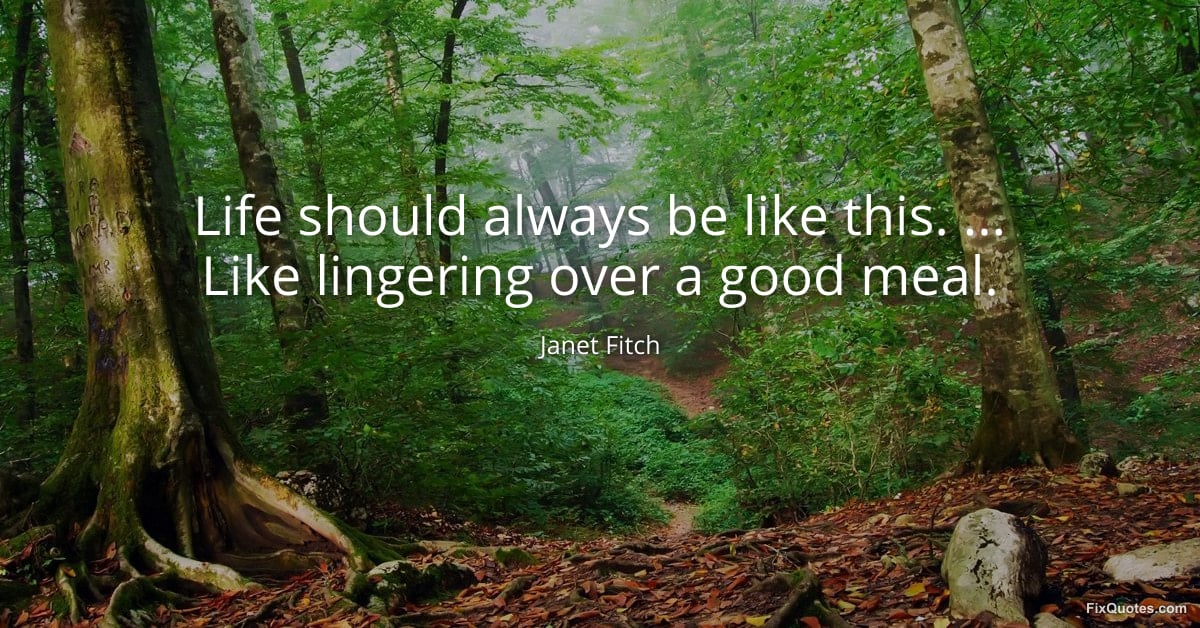
"Life should always be like this. ... Like lingering over a good meal"
About this Quote
Fitch’s line lands like a small act of rebellion: a demand that life be tasted, not consumed. “Life should always be like this” sounds innocent until you notice the insistence in “should” - an argument with reality disguised as a sigh. She’s not describing a moment; she’s trying to hold it in place, as if naming it could keep the world from speeding up again.
The second sentence does the real work. “Like lingering over a good meal” frames pleasure as a practice, not a reward. Lingering implies time you choose to spend “wasting,” attention you refuse to optimize. In a culture trained to treat meals as fuel and leisure as something you earn, Fitch turns slowness into a moral stance. The meal is also social and sensory: warmth, conversation, appetite, the body allowed to be present. It’s an image of abundance without extravagance - not a banquet, just “good,” which is crucial. The fantasy isn’t luxury; it’s permission.
As a novelist, Fitch understands the psychology of the pause: you don’t cling to joy because it’s perfect, you cling because you know it’s temporary. The ellipsis is the tell - a breath, a hesitation, the speaker reaching for a metaphor that can carry what direct language can’t. Underneath the coziness is a sharper anxiety: life rarely cooperates. The line works because it admits that, then quietly refuses to accept it.
The second sentence does the real work. “Like lingering over a good meal” frames pleasure as a practice, not a reward. Lingering implies time you choose to spend “wasting,” attention you refuse to optimize. In a culture trained to treat meals as fuel and leisure as something you earn, Fitch turns slowness into a moral stance. The meal is also social and sensory: warmth, conversation, appetite, the body allowed to be present. It’s an image of abundance without extravagance - not a banquet, just “good,” which is crucial. The fantasy isn’t luxury; it’s permission.
As a novelist, Fitch understands the psychology of the pause: you don’t cling to joy because it’s perfect, you cling because you know it’s temporary. The ellipsis is the tell - a breath, a hesitation, the speaker reaching for a metaphor that can carry what direct language can’t. Underneath the coziness is a sharper anxiety: life rarely cooperates. The line works because it admits that, then quietly refuses to accept it.
Quote Details
| Topic | Live in the Moment |
|---|---|
| Source | Help us find the source |
| Cite |
Citation Formats
APA Style (7th ed.)
Fitch, Janet. (2026, January 11). Life should always be like this. ... Like lingering over a good meal. FixQuotes. https://fixquotes.com/quotes/life-should-always-be-like-this-like-lingering-183841/
Chicago Style
Fitch, Janet. "Life should always be like this. ... Like lingering over a good meal." FixQuotes. January 11, 2026. https://fixquotes.com/quotes/life-should-always-be-like-this-like-lingering-183841/.
MLA Style (9th ed.)
"Life should always be like this. ... Like lingering over a good meal." FixQuotes, 11 Jan. 2026, https://fixquotes.com/quotes/life-should-always-be-like-this-like-lingering-183841/. Accessed 12 Feb. 2026.
More Quotes by Janet
Add to List