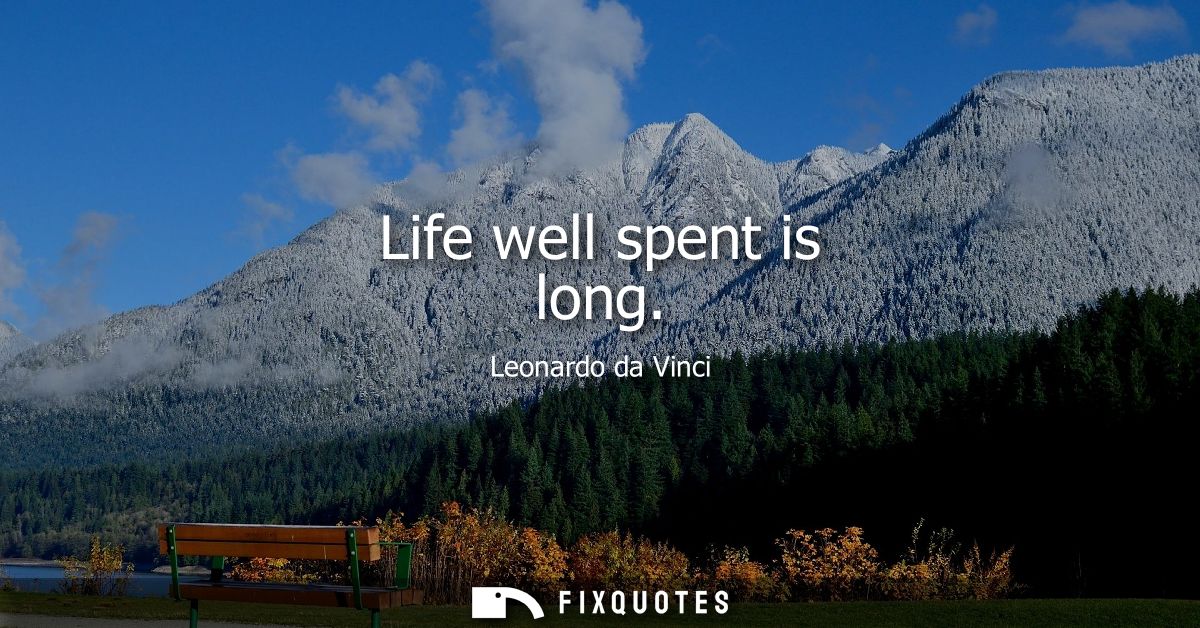
"Life well spent is long"
About this Quote
“Life well spent is long” is Renaissance minimalism with a moral edge: time isn’t measured by calendars but by density. Coming from Leonardo da Vinci, the line reads less like a soothing proverb and more like a working principle from a man who treated every hour as raw material. The intent feels almost corrective, aimed at people who fear brevity or chase longevity as a kind of trophy. Leonardo flips the anxiety. A shorter life, if packed with attention and craft, can out-length a long one squandered on repetition.
The subtext is about agency. “Well spent” frames life as a budget: you allocate it, waste it, invest it. That language belongs to an era when patronage, workshops, and civic ambition turned creativity into an economy. Leonardo’s own career - perpetually unfinished canvases, obsessive notebooks, engineering schemes years ahead of their utility - makes the line sharper. He wasn’t advocating tidy productivity; he was defending the idea that curiosity and rigor create their own duration. A day spent truly seeing, testing, drawing, revising expands in memory and consequence.
Context matters: late 15th-century Italy was crowded with plague cycles, political churn, and fragile life expectancy. Against that backdrop, the quote isn’t naive about death; it’s defiant toward it. Leonardo offers a pragmatic immortality: not endless years, but years that accumulate meaning, leaving artifacts - drawings, designs, ideas - that keep time moving after the body stops.
The subtext is about agency. “Well spent” frames life as a budget: you allocate it, waste it, invest it. That language belongs to an era when patronage, workshops, and civic ambition turned creativity into an economy. Leonardo’s own career - perpetually unfinished canvases, obsessive notebooks, engineering schemes years ahead of their utility - makes the line sharper. He wasn’t advocating tidy productivity; he was defending the idea that curiosity and rigor create their own duration. A day spent truly seeing, testing, drawing, revising expands in memory and consequence.
Context matters: late 15th-century Italy was crowded with plague cycles, political churn, and fragile life expectancy. Against that backdrop, the quote isn’t naive about death; it’s defiant toward it. Leonardo offers a pragmatic immortality: not endless years, but years that accumulate meaning, leaving artifacts - drawings, designs, ideas - that keep time moving after the body stops.
Quote Details
| Topic | Meaning of Life |
|---|---|
| Source | Help us find the source |
| Cite |
Citation Formats
APA Style (7th ed.)
Vinci, Leonardo da. (2026, January 18). Life well spent is long. FixQuotes. https://fixquotes.com/quotes/life-well-spent-is-long-8310/
Chicago Style
Vinci, Leonardo da. "Life well spent is long." FixQuotes. January 18, 2026. https://fixquotes.com/quotes/life-well-spent-is-long-8310/.
MLA Style (9th ed.)
"Life well spent is long." FixQuotes, 18 Jan. 2026, https://fixquotes.com/quotes/life-well-spent-is-long-8310/. Accessed 5 Mar. 2026.
More Quotes by Leonardo
Add to List