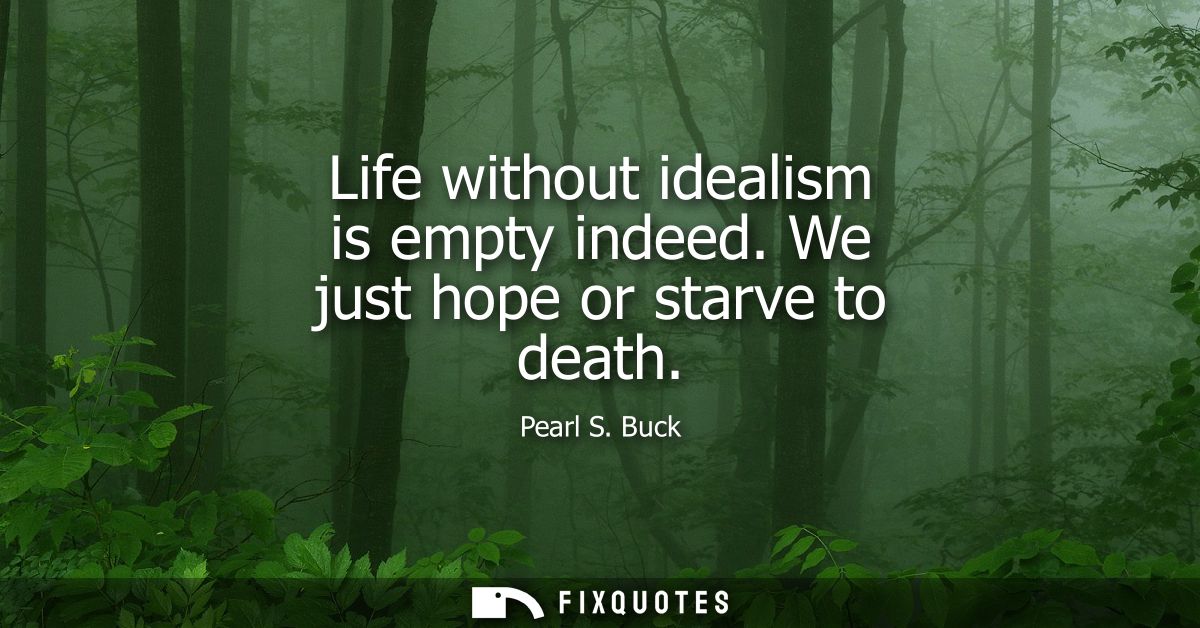
"Life without idealism is empty indeed. We just hope or starve to death"
About this Quote
Buck’s line treats idealism less like a noble accessory and more like basic nutrition: you don’t “believe in it” so much as you live on it. The sting is in the pairing of “empty” with “indeed,” a small intensifier that makes the judgment feel settled, almost clinical. Then she pivots to a blunt, bodily alternative: “We just hope or starve to death.” Hope isn’t framed as optimism or positivity; it’s the minimum ration that keeps a person from spiritual malnutrition.
The intent is quietly argumentative. Buck is warning against a modern temptation to equate realism with wisdom and to dismiss ideals as childish. Her subtext says the opposite: cynicism can be sophisticated and still be lethal. “Just” is doing a lot of work here, stripping away romantic complexity. No grand third option, no heroic stoicism. Either you maintain a vision of something better, or you wither.
Context matters. Buck’s fiction often sits with ordinary people in conditions of upheaval and scarcity, where “idealism” can sound like a luxury until you notice it’s what allows endurance to mean something more than mere survival. In the early 20th century - war, displacement, the churn of social change - she saw how quickly a life can become all appetite and no purpose, all coping and no direction. The line works because it refuses to flatter the reader: without ideals, you don’t become hardheaded; you become hollow. Hope, for Buck, is not a mood. It’s a discipline that keeps the human story from collapsing into hunger.
The intent is quietly argumentative. Buck is warning against a modern temptation to equate realism with wisdom and to dismiss ideals as childish. Her subtext says the opposite: cynicism can be sophisticated and still be lethal. “Just” is doing a lot of work here, stripping away romantic complexity. No grand third option, no heroic stoicism. Either you maintain a vision of something better, or you wither.
Context matters. Buck’s fiction often sits with ordinary people in conditions of upheaval and scarcity, where “idealism” can sound like a luxury until you notice it’s what allows endurance to mean something more than mere survival. In the early 20th century - war, displacement, the churn of social change - she saw how quickly a life can become all appetite and no purpose, all coping and no direction. The line works because it refuses to flatter the reader: without ideals, you don’t become hardheaded; you become hollow. Hope, for Buck, is not a mood. It’s a discipline that keeps the human story from collapsing into hunger.
Quote Details
| Topic | Meaning of Life |
|---|---|
| Source | Help us find the source |
| Cite |
Citation Formats
APA Style (7th ed.)
Buck, Pearl S. (2026, January 15). Life without idealism is empty indeed. We just hope or starve to death. FixQuotes. https://fixquotes.com/quotes/life-without-idealism-is-empty-indeed-we-just-85406/
Chicago Style
Buck, Pearl S. "Life without idealism is empty indeed. We just hope or starve to death." FixQuotes. January 15, 2026. https://fixquotes.com/quotes/life-without-idealism-is-empty-indeed-we-just-85406/.
MLA Style (9th ed.)
"Life without idealism is empty indeed. We just hope or starve to death." FixQuotes, 15 Jan. 2026, https://fixquotes.com/quotes/life-without-idealism-is-empty-indeed-we-just-85406/. Accessed 29 Mar. 2026.
More Quotes by Pearl
Add to List