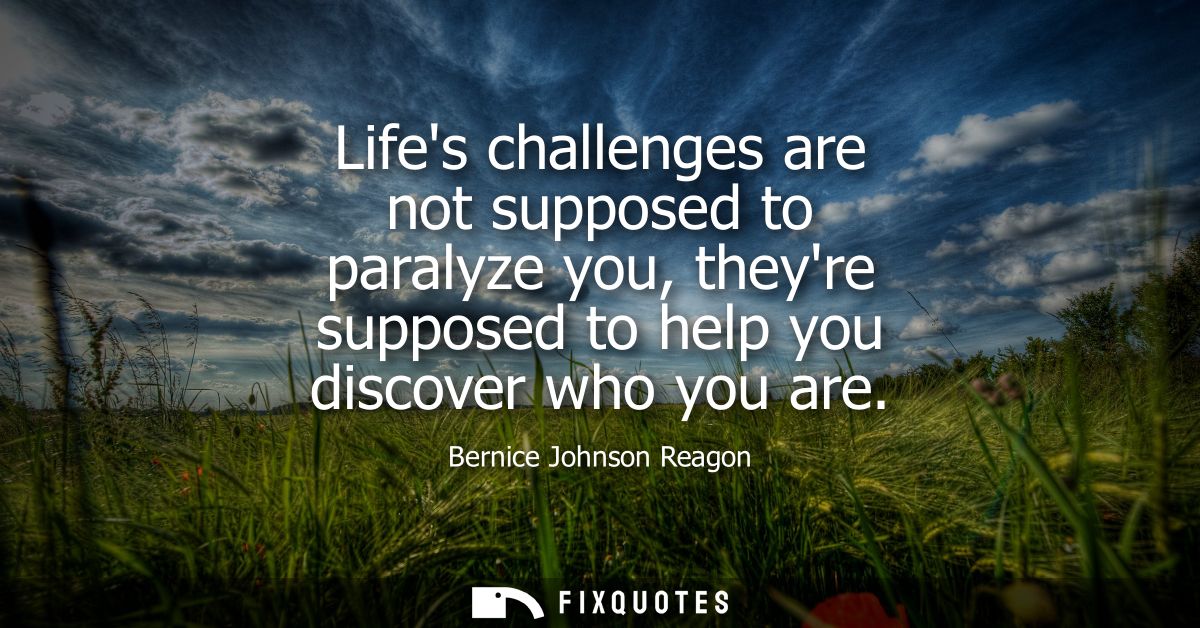
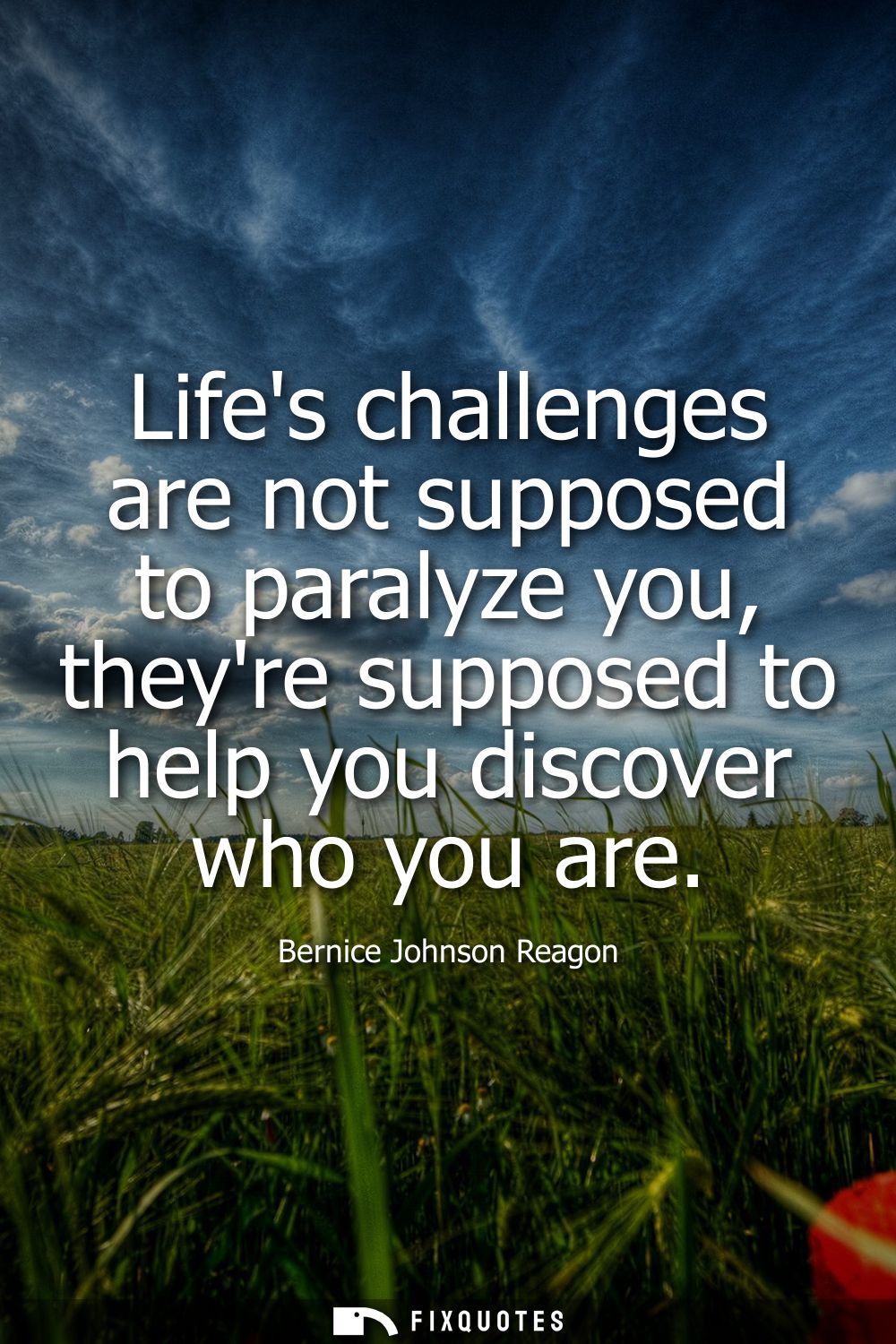
"Life's challenges are not supposed to paralyze you, they're supposed to help you discover who you are"
About this Quote
The second half flips the script with a subtle demand: challenges “help you discover who you are.” Not “prove” who you are, not “fix” you, not “make you stronger” in the gym-poster sense. Discover implies you already contain the answer; difficulty is the light that makes it visible. That’s a singer’s logic. In music, strain reveals tone. Under breath, you hear what’s real. Reagon’s background in freedom singing and ensemble work adds another layer: identity isn’t found in solitary self-reflection but in what you can do while carrying weight - for others, with others.
The phrasing also sidesteps the toxic idea that suffering is inherently noble. She doesn’t romanticize pain; she assigns it a function. The subtext is agency under constraint: you may not control the challenge, but you can control what it extracts from you - your values, your voice, your capacity to move anyway.
It’s a cultural credo from a generation that learned survival and selfhood in the same rehearsal room.
Quote Details
| Topic | Resilience |
|---|---|
| Source | Help us find the source |
| Cite |
Citation Formats
APA Style (7th ed.)
Reagon, Bernice Johnson. (2026, January 17). Life's challenges are not supposed to paralyze you, they're supposed to help you discover who you are. FixQuotes. https://fixquotes.com/quotes/lifes-challenges-are-not-supposed-to-paralyze-you-37305/
Chicago Style
Reagon, Bernice Johnson. "Life's challenges are not supposed to paralyze you, they're supposed to help you discover who you are." FixQuotes. January 17, 2026. https://fixquotes.com/quotes/lifes-challenges-are-not-supposed-to-paralyze-you-37305/.
MLA Style (9th ed.)
"Life's challenges are not supposed to paralyze you, they're supposed to help you discover who you are." FixQuotes, 17 Jan. 2026, https://fixquotes.com/quotes/lifes-challenges-are-not-supposed-to-paralyze-you-37305/. Accessed 3 Apr. 2026.