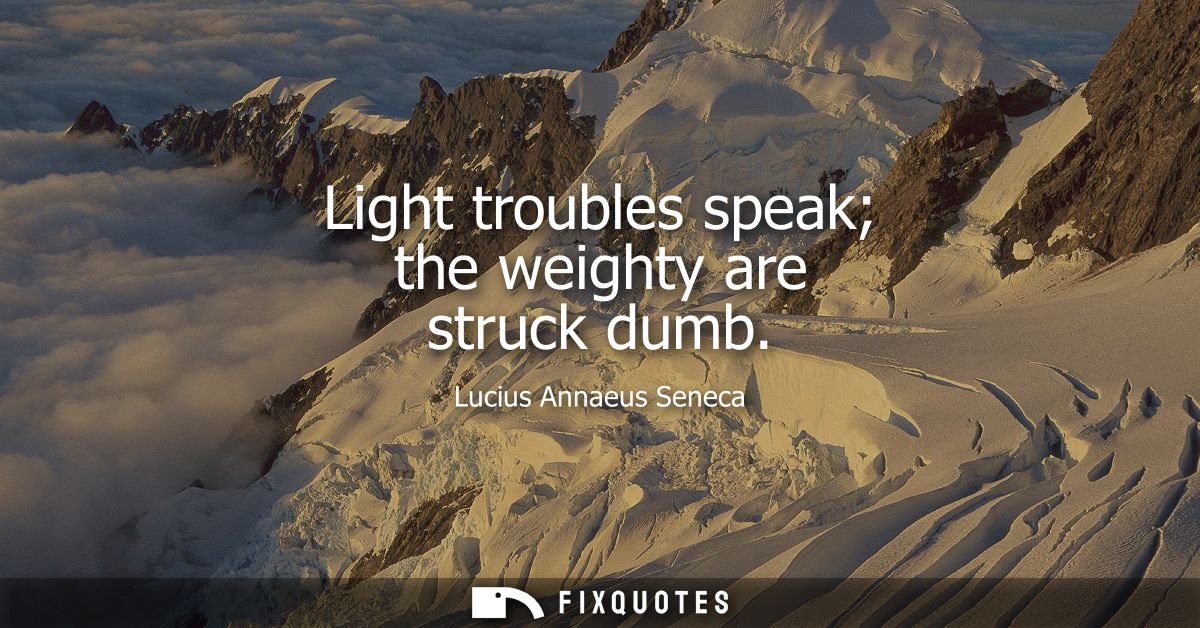
"Light troubles speak; the weighty are struck dumb"
About this Quote
Seneca is sketching a brutal hierarchy of pain: minor problems generate noise, major ones shut the mouth. The line works because it flips our usual expectation that the bigger the suffering, the louder the complaint. Instead, “speak” is reserved for “light troubles” - the everyday irritations that still leave you enough air, ego, and social bandwidth to narrate your discomfort. The “weighty” hits so hard it cancels performance. Silence becomes not dignity but physiological fact: shock, grief, catastrophe. You don’t deliver a monologue when the floor drops out.
As a Roman statesman and Stoic, Seneca also has a tactical intent. Stoicism prized self-command, and Rome prized public composure. The quote quietly polices the boundary between acceptable venting and unseemly collapse. It’s a warning and a consolation at once: if you find yourself wordless, that doesn’t mean you’re weak; it may mean you’ve encountered the kind of trouble that exceeds the rhetorical toolkit.
The subtext is political, too. Seneca served under Nero, in a court where speech could be dangerous and silence could be survival. “Struck dumb” reads like a nervous-system response, but it also nods to a culture where the heaviest troubles - accusations, exile, imperial wrath - weren’t discussed openly. In that context, quiet isn’t serenity; it’s the sound of consequence. The sentence lands with the clean finality of a Stoic maxim, yet it carries the shadow of a regime where the gravest realities were precisely the ones you could not afford to “speak.”
As a Roman statesman and Stoic, Seneca also has a tactical intent. Stoicism prized self-command, and Rome prized public composure. The quote quietly polices the boundary between acceptable venting and unseemly collapse. It’s a warning and a consolation at once: if you find yourself wordless, that doesn’t mean you’re weak; it may mean you’ve encountered the kind of trouble that exceeds the rhetorical toolkit.
The subtext is political, too. Seneca served under Nero, in a court where speech could be dangerous and silence could be survival. “Struck dumb” reads like a nervous-system response, but it also nods to a culture where the heaviest troubles - accusations, exile, imperial wrath - weren’t discussed openly. In that context, quiet isn’t serenity; it’s the sound of consequence. The sentence lands with the clean finality of a Stoic maxim, yet it carries the shadow of a regime where the gravest realities were precisely the ones you could not afford to “speak.”
Quote Details
| Topic | Wisdom |
|---|---|
| Source | Help us find the source |
| Cite |
Citation Formats
APA Style (7th ed.)
Younger, Seneca the. (2026, January 18). Light troubles speak; the weighty are struck dumb. FixQuotes. https://fixquotes.com/quotes/light-troubles-speak-the-weighty-are-struck-dumb-15849/
Chicago Style
Younger, Seneca the. "Light troubles speak; the weighty are struck dumb." FixQuotes. January 18, 2026. https://fixquotes.com/quotes/light-troubles-speak-the-weighty-are-struck-dumb-15849/.
MLA Style (9th ed.)
"Light troubles speak; the weighty are struck dumb." FixQuotes, 18 Jan. 2026, https://fixquotes.com/quotes/light-troubles-speak-the-weighty-are-struck-dumb-15849/. Accessed 23 Mar. 2026.
More Quotes by Seneca
Add to List