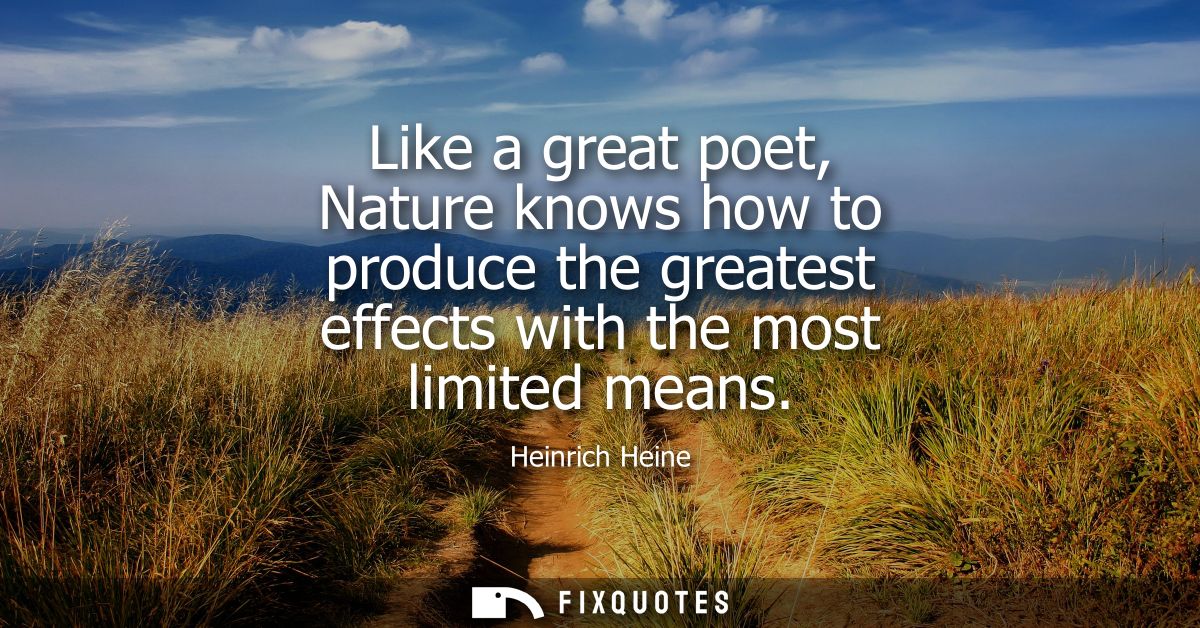
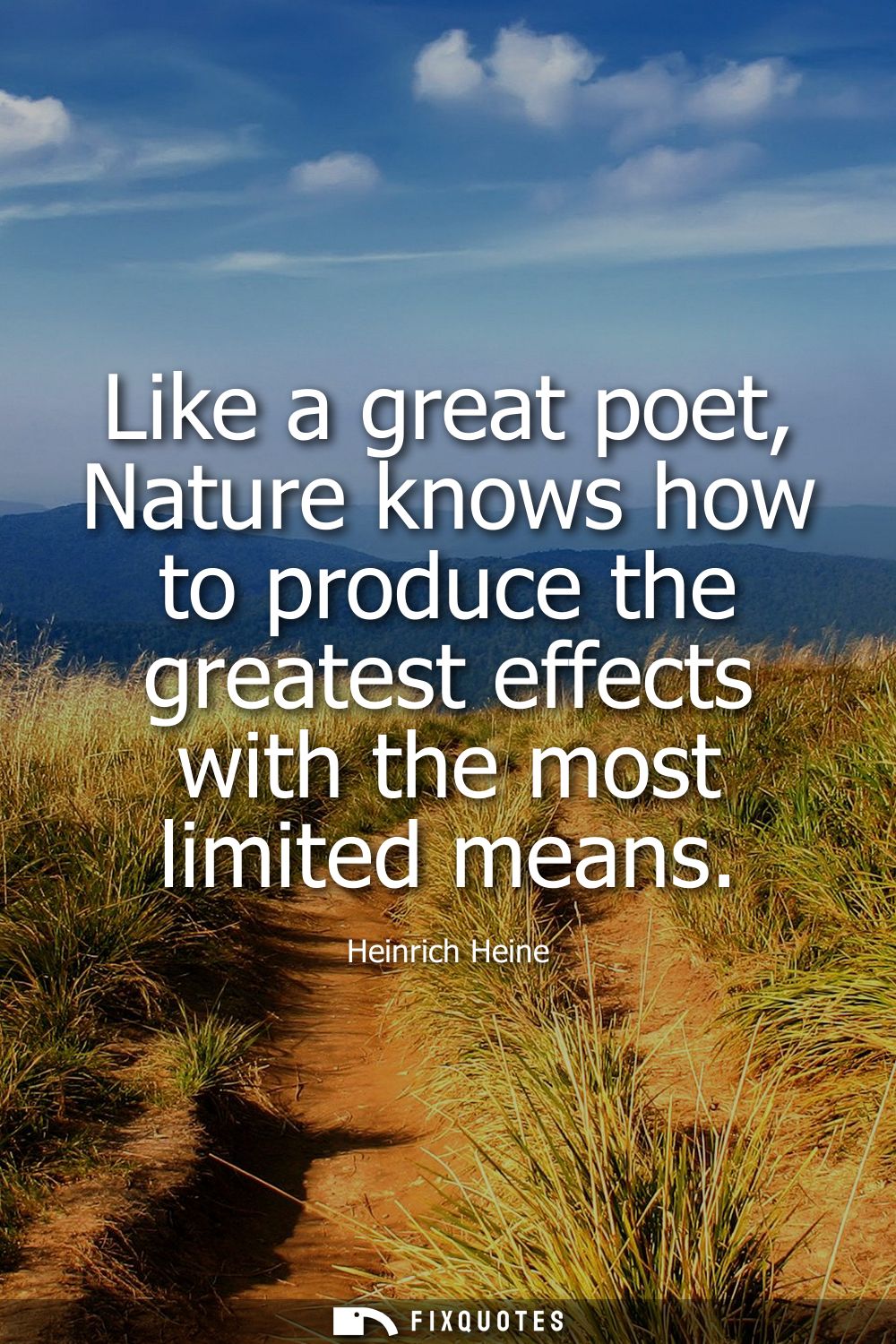
"Like a great poet, Nature knows how to produce the greatest effects with the most limited means"
About this Quote
The subtext is Heine’s own poetics. Writing in a century that loved swollen Romantic feeling and baroque philosophical systems, Heine often played the elegant skeptic, puncturing grandeur with clarity and bite. “Limited means” reads like an artistic manifesto: fewer words, sharper images, cleaner turns of thought. If Nature can conjure storms, blossoms, and bodies from a small toolkit, then a poet doesn’t need theatrical language to move the reader; craft, compression, and timing can do the violence.
Context matters because Heine stands at a hinge moment in European letters: post-Romantic, pre-modern, allergic to sanctimony. By making Nature the model poet, he also dodges metaphysics. He doesn’t claim Nature is moral, benevolent, or divine - only effective. The admiration is technical, not devotional. That’s why the sentence lands: it celebrates beauty while refusing to romanticize it, and it makes restraint feel not like deprivation but like power.
Quote Details
| Topic | Nature |
|---|---|
| Source | Help us find the source |
| Cite |
Citation Formats
APA Style (7th ed.)
Heine, Heinrich. (2026, January 18). Like a great poet, Nature knows how to produce the greatest effects with the most limited means. FixQuotes. https://fixquotes.com/quotes/like-a-great-poet-nature-knows-how-to-produce-the-12976/
Chicago Style
Heine, Heinrich. "Like a great poet, Nature knows how to produce the greatest effects with the most limited means." FixQuotes. January 18, 2026. https://fixquotes.com/quotes/like-a-great-poet-nature-knows-how-to-produce-the-12976/.
MLA Style (9th ed.)
"Like a great poet, Nature knows how to produce the greatest effects with the most limited means." FixQuotes, 18 Jan. 2026, https://fixquotes.com/quotes/like-a-great-poet-nature-knows-how-to-produce-the-12976/. Accessed 12 Feb. 2026.