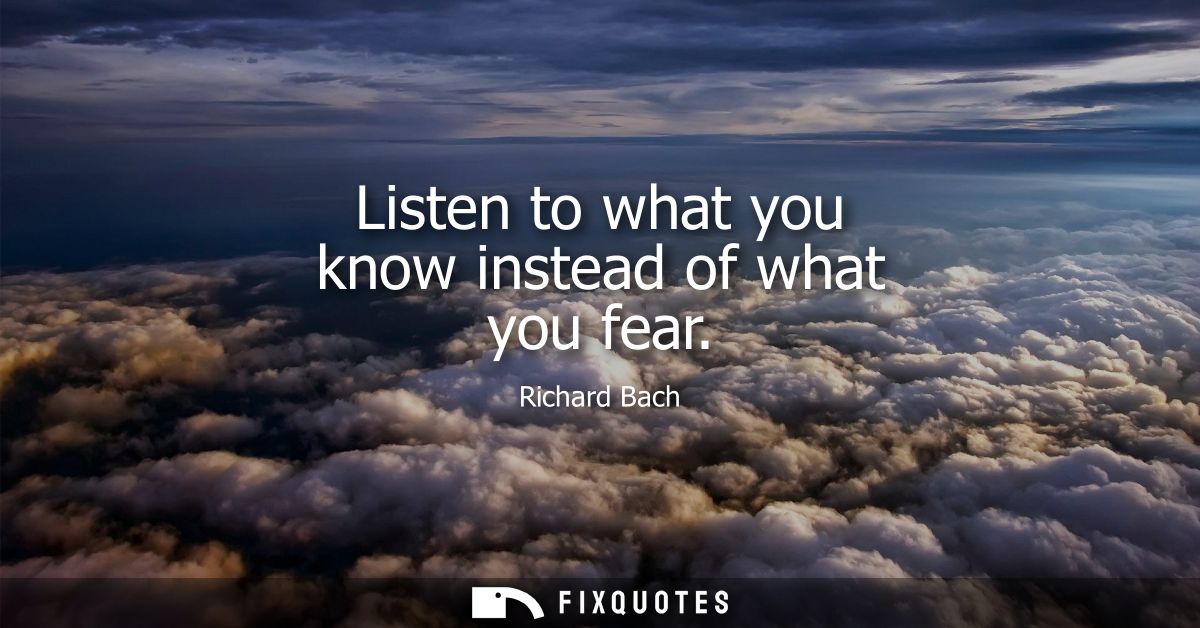
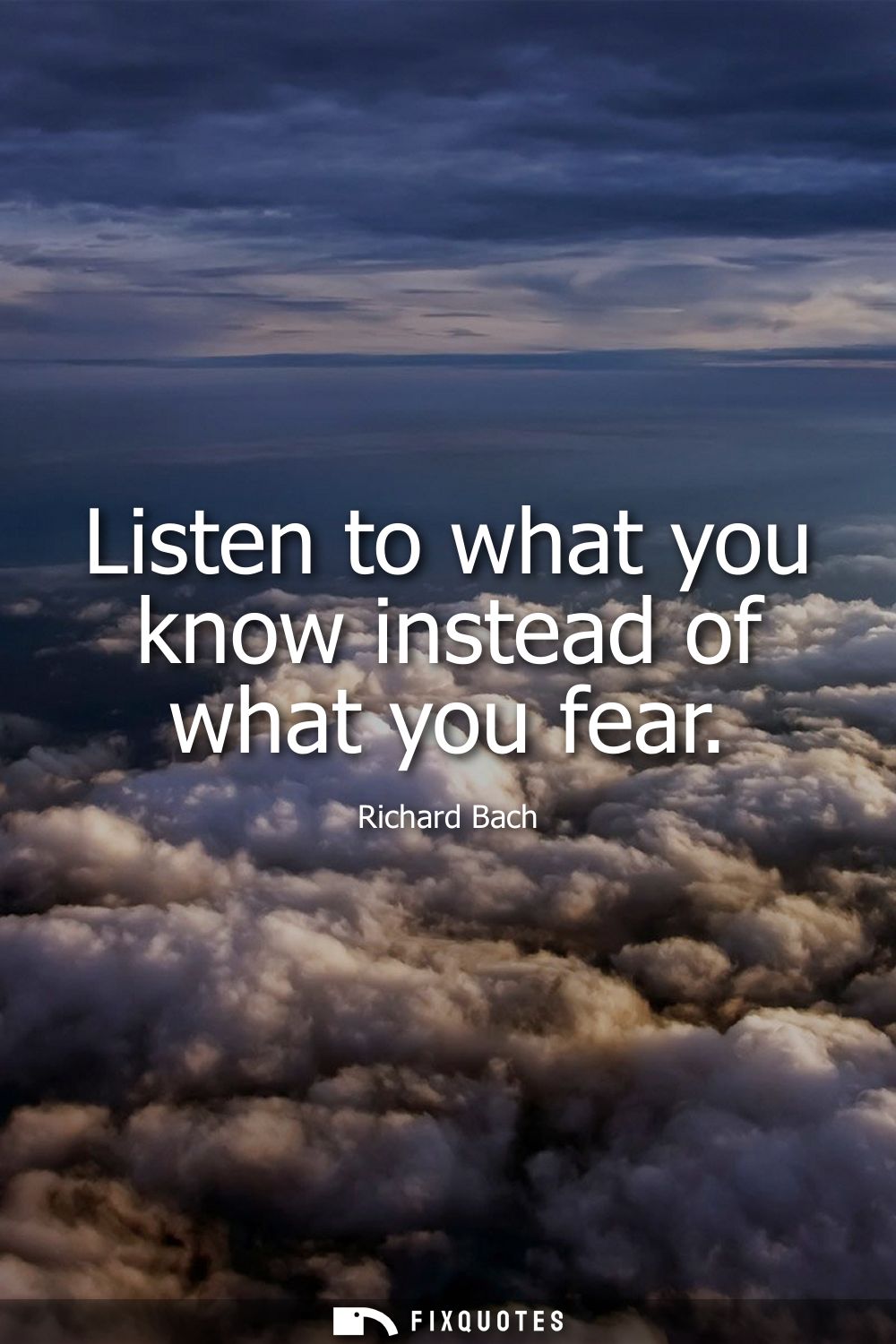
"Listen to what you know instead of what you fear"
About this Quote
Bach’s line flatters the part of you that already suspects your anxiety is a bad narrator. “Listen” makes the advice feel less like self-help commandment and more like a sensory practice: knowledge isn’t just data, it’s something your body has been trying to tell you all along. The verb also implies a crowded room inside the mind, with fear talking over everything else. The sentence is a quick piece of internal audio engineering: turn down the panic, raise the signal.
The neat trick is how Bach defines “what you know.” He doesn’t mean trivia or credentials; he means the accumulated, often quiet evidence of lived experience: patterns you’ve seen before, limits you’ve tested, values you keep circling back to. Fear, by contrast, is presented as content too - a story with its own predictions and motives. That’s the subtext: fear isn’t just a feeling, it’s a persuasive argument, and it tends to argue in absolutes.
As a novelist of flight, freedom, and spiritual self-direction, Bach is writing into a late-20th-century American mood that prized self-actualization while quietly manufacturing new anxieties (status, conformity, failure). The line doesn’t deny danger; it challenges the reader to distinguish intuition from catastrophe-thinking. Its intent is pragmatic rebellion: trust the steadier voice, act from clarity, and let fear become a weather report rather than a marching order.
The neat trick is how Bach defines “what you know.” He doesn’t mean trivia or credentials; he means the accumulated, often quiet evidence of lived experience: patterns you’ve seen before, limits you’ve tested, values you keep circling back to. Fear, by contrast, is presented as content too - a story with its own predictions and motives. That’s the subtext: fear isn’t just a feeling, it’s a persuasive argument, and it tends to argue in absolutes.
As a novelist of flight, freedom, and spiritual self-direction, Bach is writing into a late-20th-century American mood that prized self-actualization while quietly manufacturing new anxieties (status, conformity, failure). The line doesn’t deny danger; it challenges the reader to distinguish intuition from catastrophe-thinking. Its intent is pragmatic rebellion: trust the steadier voice, act from clarity, and let fear become a weather report rather than a marching order.
Quote Details
| Topic | Wisdom |
|---|---|
| Source | Help us find the source |
| Cite |
Citation Formats
APA Style (7th ed.)
Bach, Richard. (2026, January 17). Listen to what you know instead of what you fear. FixQuotes. https://fixquotes.com/quotes/listen-to-what-you-know-instead-of-what-you-fear-37168/
Chicago Style
Bach, Richard. "Listen to what you know instead of what you fear." FixQuotes. January 17, 2026. https://fixquotes.com/quotes/listen-to-what-you-know-instead-of-what-you-fear-37168/.
MLA Style (9th ed.)
"Listen to what you know instead of what you fear." FixQuotes, 17 Jan. 2026, https://fixquotes.com/quotes/listen-to-what-you-know-instead-of-what-you-fear-37168/. Accessed 12 Feb. 2026.
More Quotes by Richard
Add to List