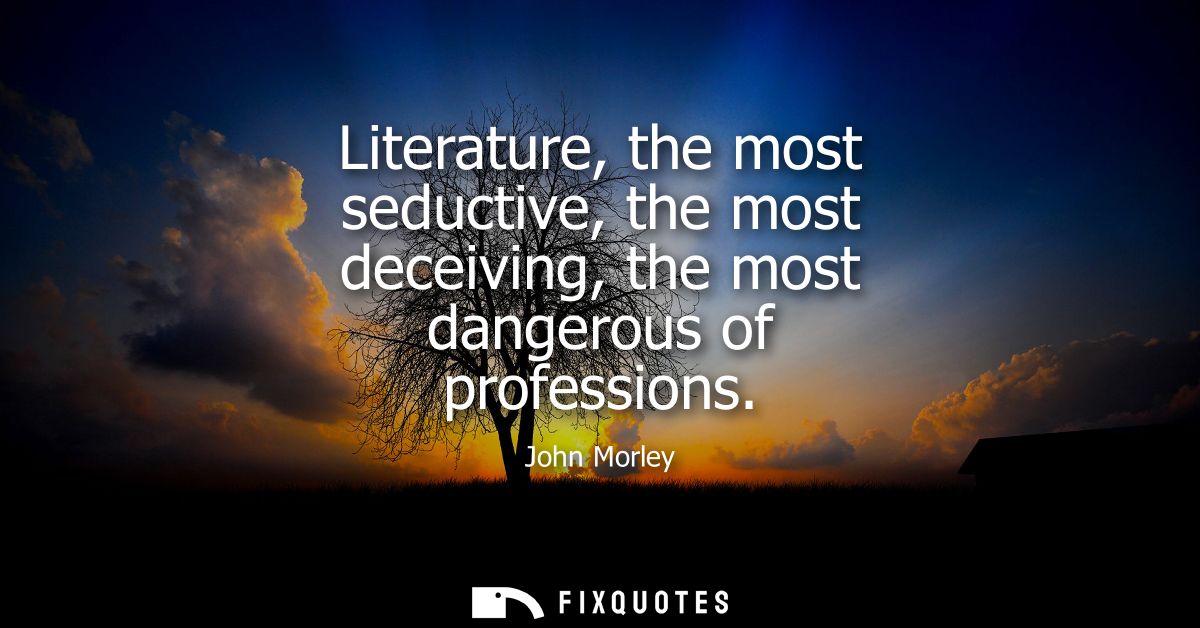
"Literature, the most seductive, the most deceiving, the most dangerous of professions"
About this Quote
As a statesman, Morley is speaking with the allergic awareness of someone who has watched pamphlets topple reputations and novels harden sentiment into policy. In a late-19th-century political culture increasingly shaped by mass literacy and newspapers, “men of letters” were not harmless aesthetes; they were rival power centers, capable of laundering partisan aims into moral common sense. Morley’s subtext is partly self-policing: the writer is tempted to confuse verbal mastery with moral authority, to treat persuasion as truth.
The brilliance of the sentence is its moral ambivalence. It doesn’t call literature “false,” it calls it “seductive” - admitting its beauty is the mechanism of its risk. If politics is the art of the possible, literature is the art of making the impossible feel necessary. That’s why it scares him. That’s why it works.
Quote Details
| Topic | Writing |
|---|---|
| Source | Help us find the source |
| Cite |
Citation Formats
APA Style (7th ed.)
Morley, John. (2026, January 18). Literature, the most seductive, the most deceiving, the most dangerous of professions. FixQuotes. https://fixquotes.com/quotes/literature-the-most-seductive-the-most-deceiving-4759/
Chicago Style
Morley, John. "Literature, the most seductive, the most deceiving, the most dangerous of professions." FixQuotes. January 18, 2026. https://fixquotes.com/quotes/literature-the-most-seductive-the-most-deceiving-4759/.
MLA Style (9th ed.)
"Literature, the most seductive, the most deceiving, the most dangerous of professions." FixQuotes, 18 Jan. 2026, https://fixquotes.com/quotes/literature-the-most-seductive-the-most-deceiving-4759/. Accessed 11 Mar. 2026.