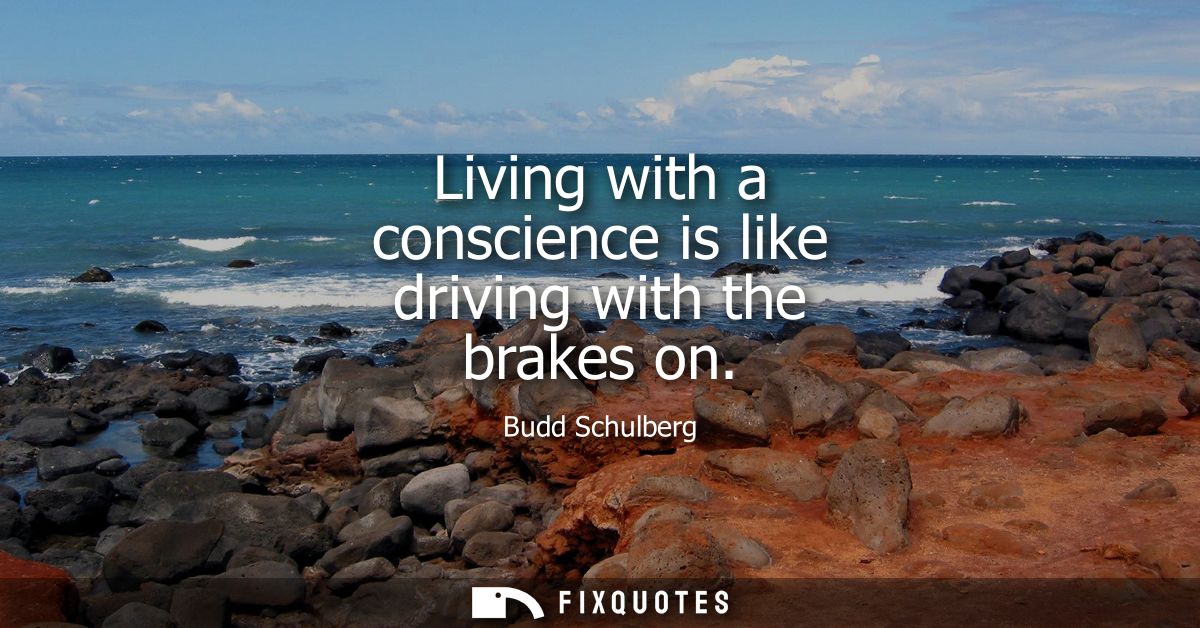
"Living with a conscience is like driving with the brakes on"
About this Quote
A line like this doesn’t praise guilt; it weaponizes it. Budd Schulberg frames conscience as drag, not compass: a constant friction that slows the clean, thrilling speed of getting what you want. The metaphor is deliberately mechanical and American - driving, brakes, forward motion - implying that modern life rewards acceleration. To have a conscience, then, is to accept inefficiency on purpose. You arrive later. You miss the easy openings. You feel the burn in the system.
Schulberg’s subtext is sharpened by his own biography. He wrote about ambition, corruption, and moral compromise in mid-century America (On the Waterfront is the loudest echo), and he lived the era’s ugliest question: what does it cost to do the "right" thing when the right thing is socially poisonous? Schulberg testified before HUAC, naming names; he later defended it as conscience-driven while many saw it as betrayal dressed up as virtue. Read through that history, the quote sounds less like a noble lament than a self-diagnosis: conscience doesn’t just restrain wrongdoing; it can be invoked to justify it, especially when the culture is demanding public performances of purity.
That’s why the line works. It refuses the comforting story that morality feels good. It suggests ethics are not a halo but a handicap - and then dares you to ask the uncomfortable follow-up: if conscience is braking, what exactly are we trying to speed toward, and who gets run over when we don’t slow down?
Schulberg’s subtext is sharpened by his own biography. He wrote about ambition, corruption, and moral compromise in mid-century America (On the Waterfront is the loudest echo), and he lived the era’s ugliest question: what does it cost to do the "right" thing when the right thing is socially poisonous? Schulberg testified before HUAC, naming names; he later defended it as conscience-driven while many saw it as betrayal dressed up as virtue. Read through that history, the quote sounds less like a noble lament than a self-diagnosis: conscience doesn’t just restrain wrongdoing; it can be invoked to justify it, especially when the culture is demanding public performances of purity.
That’s why the line works. It refuses the comforting story that morality feels good. It suggests ethics are not a halo but a handicap - and then dares you to ask the uncomfortable follow-up: if conscience is braking, what exactly are we trying to speed toward, and who gets run over when we don’t slow down?
Quote Details
| Topic | Ethics & Morality |
|---|---|
| Source | Later attribution: Little Giant Encyclopedia - Toasts and Quotes (Diagram Group, 2009) modern compilationISBN: 9781402767326 · ID: Hkk9xKshTfIC
Evidence:
... conscience ) 66 Living with a conscience is like driving a car with the brakes on . Budd Schulberg The nation's morals are like its teeth : the more decayed they are the more it hurts to touch them . GEORGE BERNARD SHAW 66 If your ... |
| Cite |
Citation Formats
APA Style (7th ed.)
Schulberg, Budd. (2026, March 28). Living with a conscience is like driving with the brakes on. FixQuotes. https://fixquotes.com/quotes/living-with-a-conscience-is-like-driving-with-the-157882/
Chicago Style
Schulberg, Budd. "Living with a conscience is like driving with the brakes on." FixQuotes. March 28, 2026. https://fixquotes.com/quotes/living-with-a-conscience-is-like-driving-with-the-157882/.
MLA Style (9th ed.)
"Living with a conscience is like driving with the brakes on." FixQuotes, 28 Mar. 2026, https://fixquotes.com/quotes/living-with-a-conscience-is-like-driving-with-the-157882/. Accessed 31 Mar. 2026.
More Quotes by Budd
Add to List