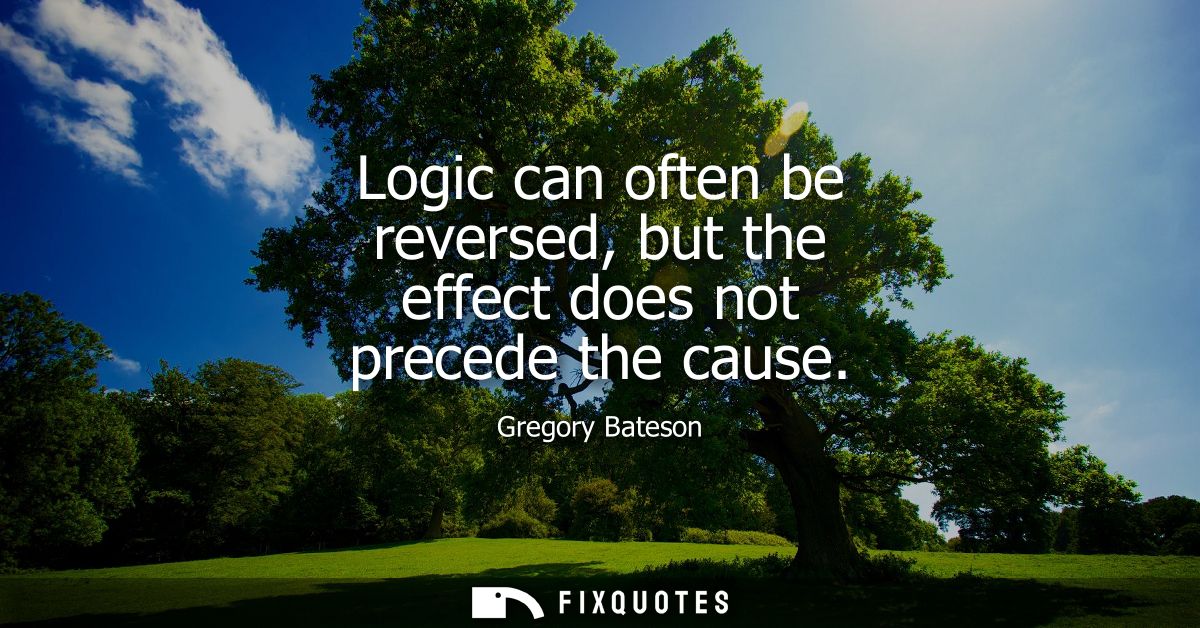
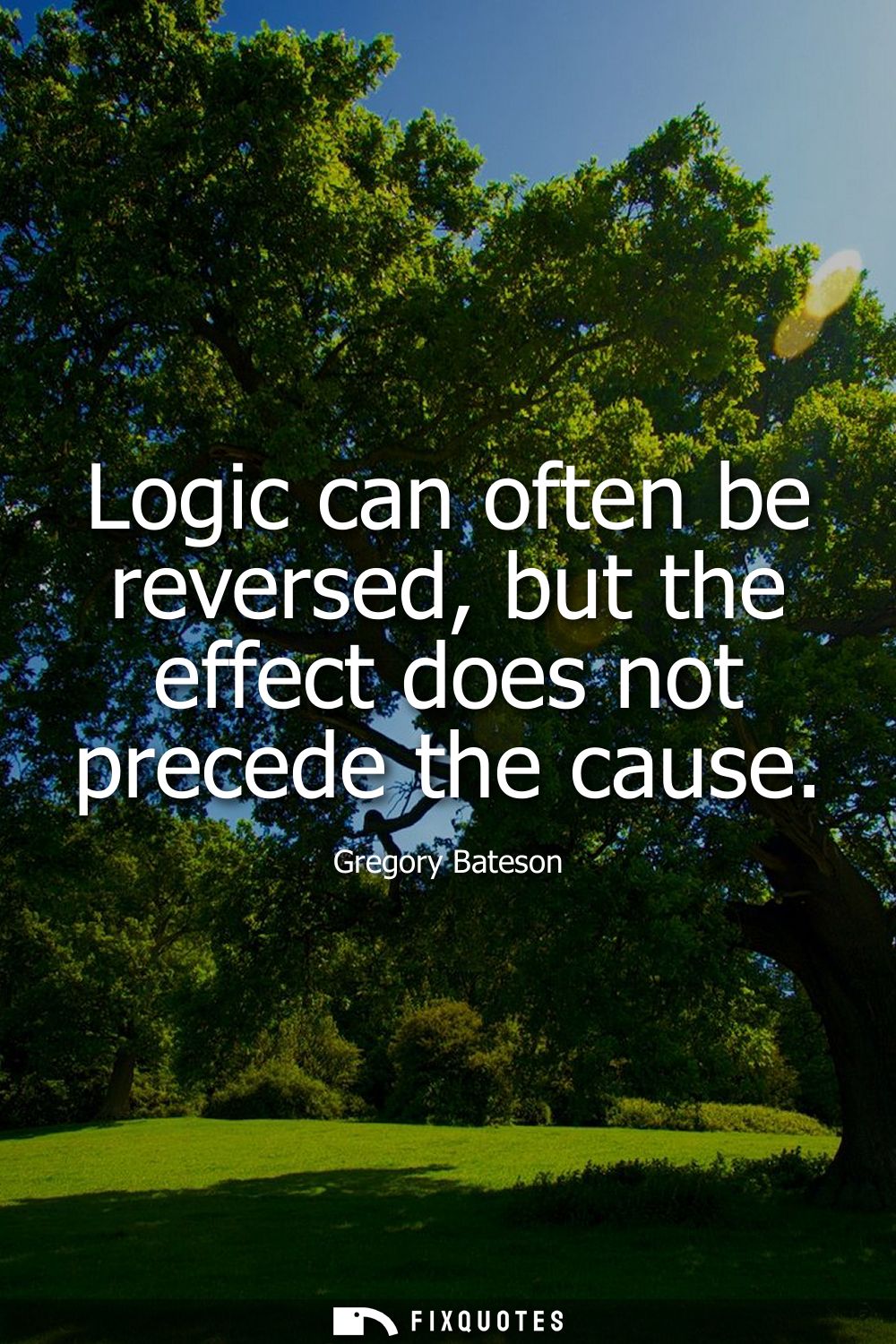
"Logic can often be reversed, but the effect does not precede the cause"
About this Quote
Then comes the hard stop: “but the effect does not precede the cause.” Bateson isn’t offering a bland truism so much as a boundary line. He’s reminding the reader that while explanations are reversible, time isn’t. You can invert an argument on paper; you can’t invert the arrow of causality in a living system without paying a price in confusion. The subtext is a warning against confusing maps with territory - a Bateson signature. Our descriptions (logic, models, narratives) are flexible. The world’s feedback loops are not obligated to comply.
Context matters: Bateson worked across anthropology, cybernetics, ecology, and psychiatry, fields where circular causality and feedback complicate simple linear stories. He knew that in complex systems, “cause” can be distributed, delayed, or indirect. Still, that complexity doesn’t license magical thinking. The line quietly targets conspiracy thinking, bad social science, and therapeutic blame games alike: when you start with the symptom and hunt for a single villain, you may get a satisfying plot, but you’ve reversed the investigative direction and called it insight.
It’s a scientist’s aphorism with an editor’s bite: reverse your logic all you want; reality won’t edit to match.
Quote Details
| Topic | Reason & Logic |
|---|---|
| Source | Help us find the source |
| Cite |
Citation Formats
APA Style (7th ed.)
Bateson, Gregory. (2026, January 15). Logic can often be reversed, but the effect does not precede the cause. FixQuotes. https://fixquotes.com/quotes/logic-can-often-be-reversed-but-the-effect-does-146337/
Chicago Style
Bateson, Gregory. "Logic can often be reversed, but the effect does not precede the cause." FixQuotes. January 15, 2026. https://fixquotes.com/quotes/logic-can-often-be-reversed-but-the-effect-does-146337/.
MLA Style (9th ed.)
"Logic can often be reversed, but the effect does not precede the cause." FixQuotes, 15 Jan. 2026, https://fixquotes.com/quotes/logic-can-often-be-reversed-but-the-effect-does-146337/. Accessed 6 Mar. 2026.