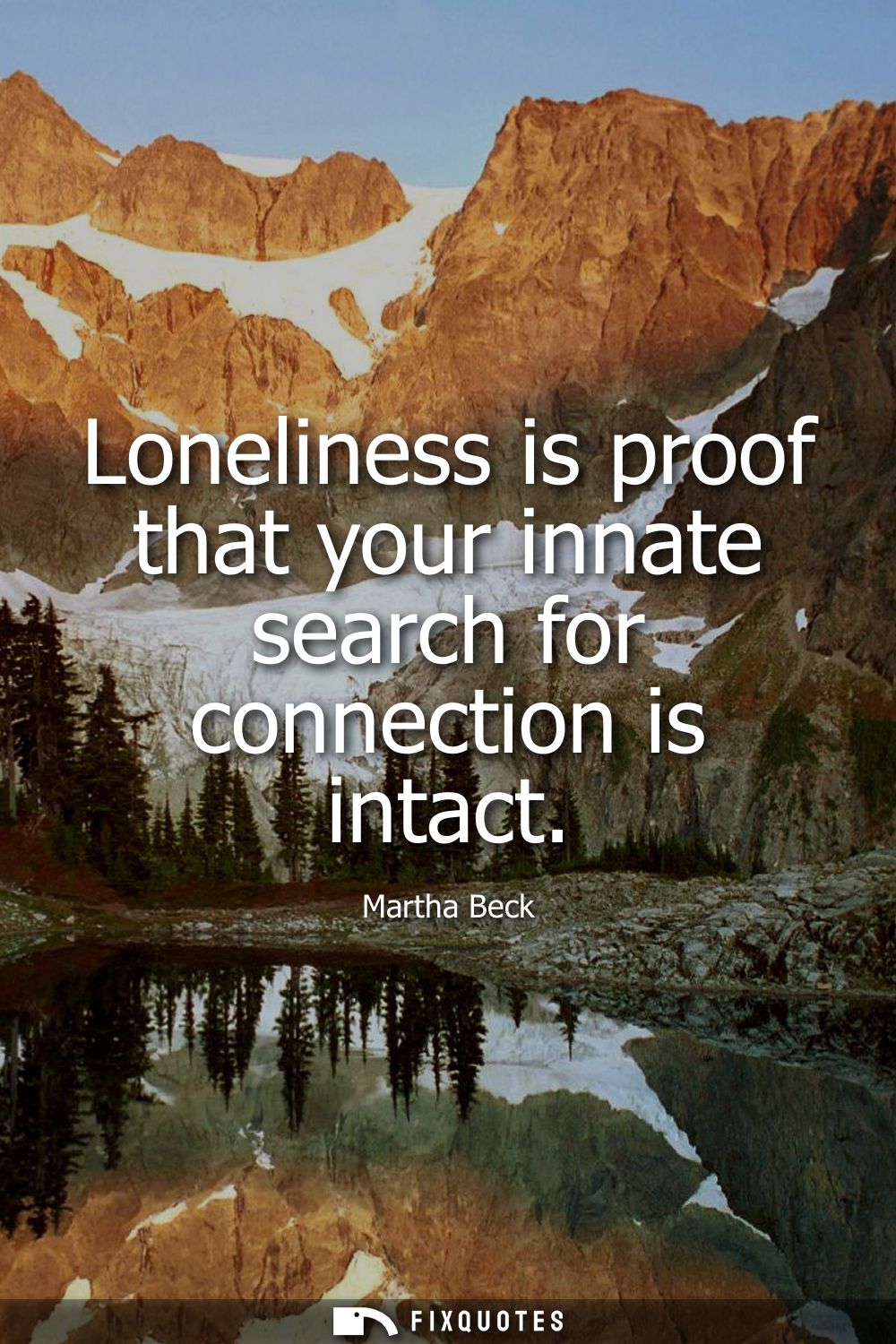
"Loneliness is proof that your innate search for connection is intact"
About this Quote
Loneliness gets framed as a personal flaw or a social failure; Martha Beck flips it into diagnostic evidence. The line works because it refuses the usual binary of “connected = healthy, lonely = broken” and instead treats loneliness as a functioning signal, like hunger or pain. If you feel it, the machinery of attachment hasn’t shut down. You still want people. You still believe, on some level, that connection is possible.
That’s the intent: to shift shame into self-trust. Beck’s world is coaching-adjacent self-help, where emotions are less problems to erase than information to interpret. “Proof” is doing heavy lifting here. It’s courtroom language, not therapy-speak, giving the reader something sturdier than reassurance. The phrasing also smuggles in a quiet rebuke to cultural stoicism: if you’ve trained yourself to be “fine” alone, the absence of loneliness might not be triumph; it might be numbness.
The subtext is tender but strategic. It tells the isolated person: you’re not uniquely defective, you’re responsive. It also implies agency: intact search means you can act on it. Beck doesn’t romanticize loneliness; she reframes it as an internal compass pointing toward community, intimacy, meaning.
Contextually, it lands in an era where isolation is both epidemic and aestheticized: remote work, curated online lives, and a premium placed on independence. By recasting loneliness as evidence of aliveness, Beck offers a counter-narrative: needing others isn’t weakness, it’s design.
That’s the intent: to shift shame into self-trust. Beck’s world is coaching-adjacent self-help, where emotions are less problems to erase than information to interpret. “Proof” is doing heavy lifting here. It’s courtroom language, not therapy-speak, giving the reader something sturdier than reassurance. The phrasing also smuggles in a quiet rebuke to cultural stoicism: if you’ve trained yourself to be “fine” alone, the absence of loneliness might not be triumph; it might be numbness.
The subtext is tender but strategic. It tells the isolated person: you’re not uniquely defective, you’re responsive. It also implies agency: intact search means you can act on it. Beck doesn’t romanticize loneliness; she reframes it as an internal compass pointing toward community, intimacy, meaning.
Contextually, it lands in an era where isolation is both epidemic and aestheticized: remote work, curated online lives, and a premium placed on independence. By recasting loneliness as evidence of aliveness, Beck offers a counter-narrative: needing others isn’t weakness, it’s design.
Quote Details
| Topic | Loneliness |
|---|---|
| Source | Verified source: When You Feel Lonely (Martha Beck, 2012)
Evidence: Loneliness, far from revealing some defect, is proof that your innate search for connection is intact.. The verifiable primary-source occurrence I found is Martha Beck’s own article 'When You Feel Lonely,' published on her website on November 5, 2012. The commonly circulated shortened form drops the opening clause 'Loneliness, far from revealing some defect,' and is therefore not the exact original wording. I did not find reliable evidence of an earlier book, speech, or interview containing this line before the 2012 article. In the article, the sentence appears near the end of the main text, not as a standalone quotation. Other candidates (1) A Year of Daily Meditation: 365 Lessons on Life, Love, an... compilation95.0% ... Loneliness is proof that your innate search for connection is intact.” MARTHA BECK Loneliness is a signal, affirm... |
| Cite |
Citation Formats
APA Style (7th ed.)
Beck, Martha. (2026, March 11). Loneliness is proof that your innate search for connection is intact. FixQuotes. https://fixquotes.com/quotes/loneliness-is-proof-that-your-innate-search-for-143145/
Chicago Style
Beck, Martha. "Loneliness is proof that your innate search for connection is intact." FixQuotes. March 11, 2026. https://fixquotes.com/quotes/loneliness-is-proof-that-your-innate-search-for-143145/.
MLA Style (9th ed.)
"Loneliness is proof that your innate search for connection is intact." FixQuotes, 11 Mar. 2026, https://fixquotes.com/quotes/loneliness-is-proof-that-your-innate-search-for-143145/. Accessed 30 Mar. 2026.
More Quotes by Martha
Add to List