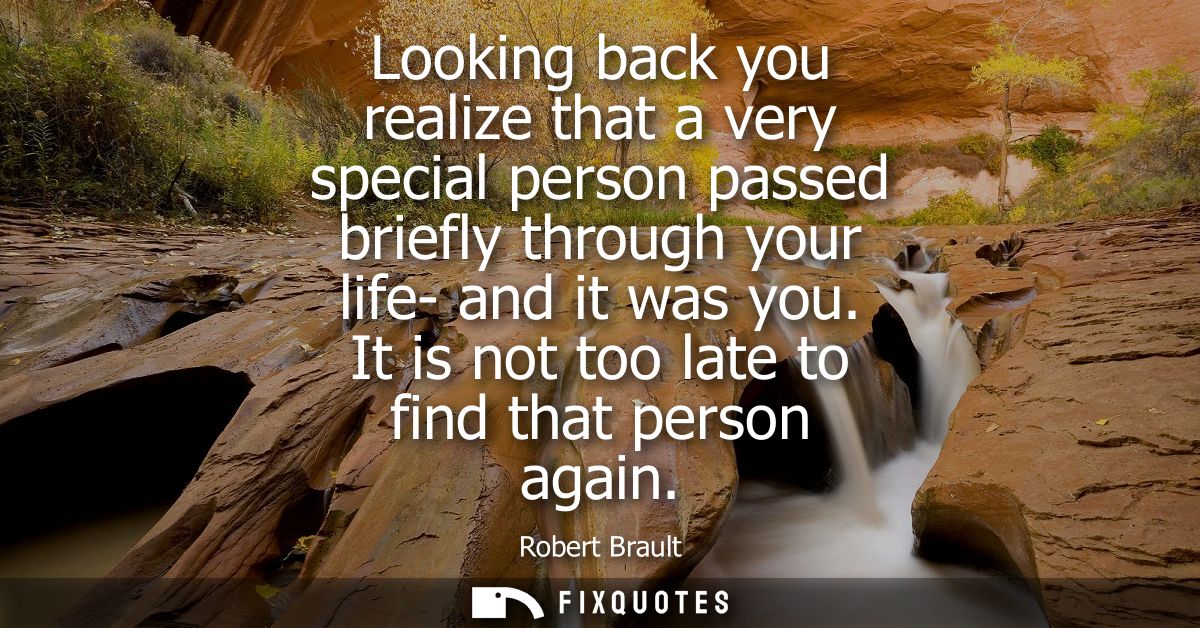
"Looking back, you realize that a very special person passed briefly through your life- and it was you. It is not too late to find that person again"
About this Quote
The subtext is almost accusatory in its tenderness. "Passed briefly through your life" implies you once had access to a version of yourself with sharper edges, clearer desires, fewer compromises. Life didn’t just happen to you; you participated in your own disappearance through adaptation, caution, overwork, caretaking, or the slow anesthesia of routine. By framing the earlier self as a "person", Brault makes self-alienation legible: if you'd be devastated to lose a friend, why are you so casual about losing your inner witness?
"It is not too late" is the moral hinge, and it’s deliberately modest. Not a promise of reinvention, but of recovery. The line resists hustle-culture glow by treating return as recognition: finding that person again isn’t about becoming someone new; it’s about rebuilding contact with what was already true. In a modern context saturated with branding and performance, Brault’s intent reads as a small rebellion: stop outsourcing your meaning. The missing protagonist of your life is still available for casting.
Quote Details
| Topic | Self-Love |
|---|---|
| Source | Later attribution: Walking Up Lombard (Reg L. Carver, 2012) modern compilationISBN: 9781477228241 · ID: ez7LGff590IC
Evidence:
... Looking back you realize that a very special person passed briefly through your life - and it was you . It is not too late to find that person again . ” Robert Brault I am obsessed with my car's rear view mirrors . Practically every ... |
| Cite |
Citation Formats
APA Style (7th ed.)
Brault, Robert. (2026, February 18). Looking back, you realize that a very special person passed briefly through your life- and it was you. It is not too late to find that person again. FixQuotes. https://fixquotes.com/quotes/looking-back-you-realize-that-a-very-special-75327/
Chicago Style
Brault, Robert. "Looking back, you realize that a very special person passed briefly through your life- and it was you. It is not too late to find that person again." FixQuotes. February 18, 2026. https://fixquotes.com/quotes/looking-back-you-realize-that-a-very-special-75327/.
MLA Style (9th ed.)
"Looking back, you realize that a very special person passed briefly through your life- and it was you. It is not too late to find that person again." FixQuotes, 18 Feb. 2026, https://fixquotes.com/quotes/looking-back-you-realize-that-a-very-special-75327/. Accessed 27 Mar. 2026.